 |
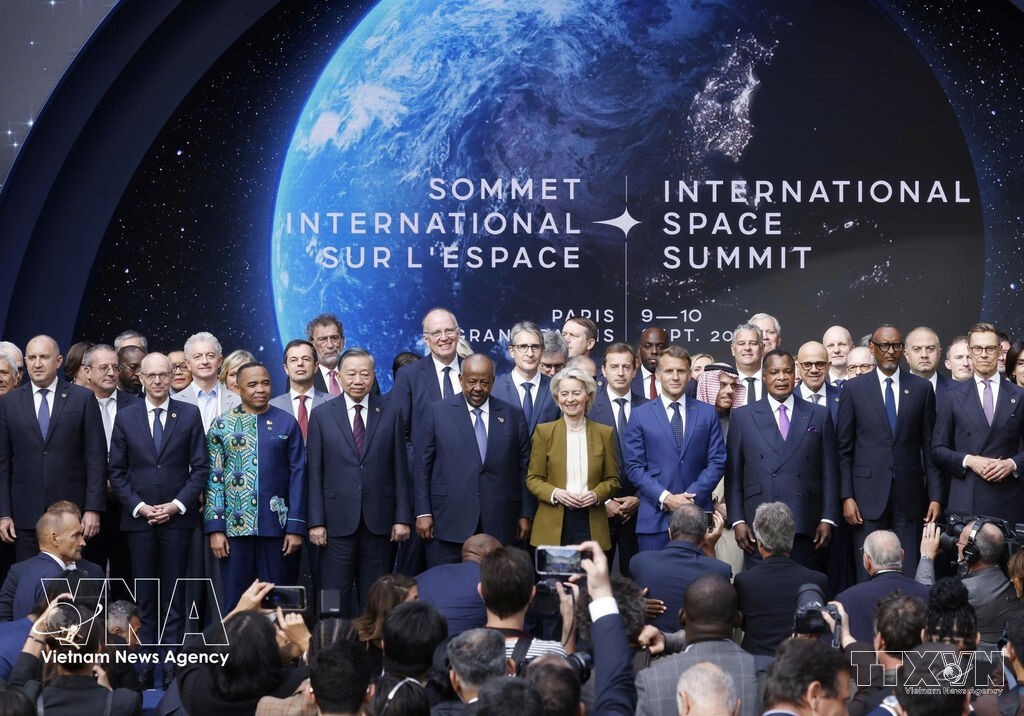
| General Secretary of the Communist Party of Vietnam (CPV) Central Committee and President To Lam and delegates attend the International Space Summit in Paris, France, on September 10 (Photo: VNA) |
Paris (VNA) – General Secretary of the Communist Party of Vietnam (CPV) Central Committee and President To Lam has proposed establishing a “space for development and resilience” network, stressing that outer space must serve peace and people while being used responsibly, safely and sustainably for the benefit of humanity.
The top Vietnamese leader made the proposal while delivering a keynote address opening the high-level thematic session on building a new space for a rapidly changing world at the International Space Summit in Paris, France, on September 10 (local time).
In his speech, General Secretary and President Lam highly valued French President Emmanuel Macron’s initiative to organise the International Space Summit, which provides an opportunity for countries to exchange views and help shape a new vision in which the development of capabilities goes hand in hand with responsibility, and national interests are aligned with the common interests of the international community.
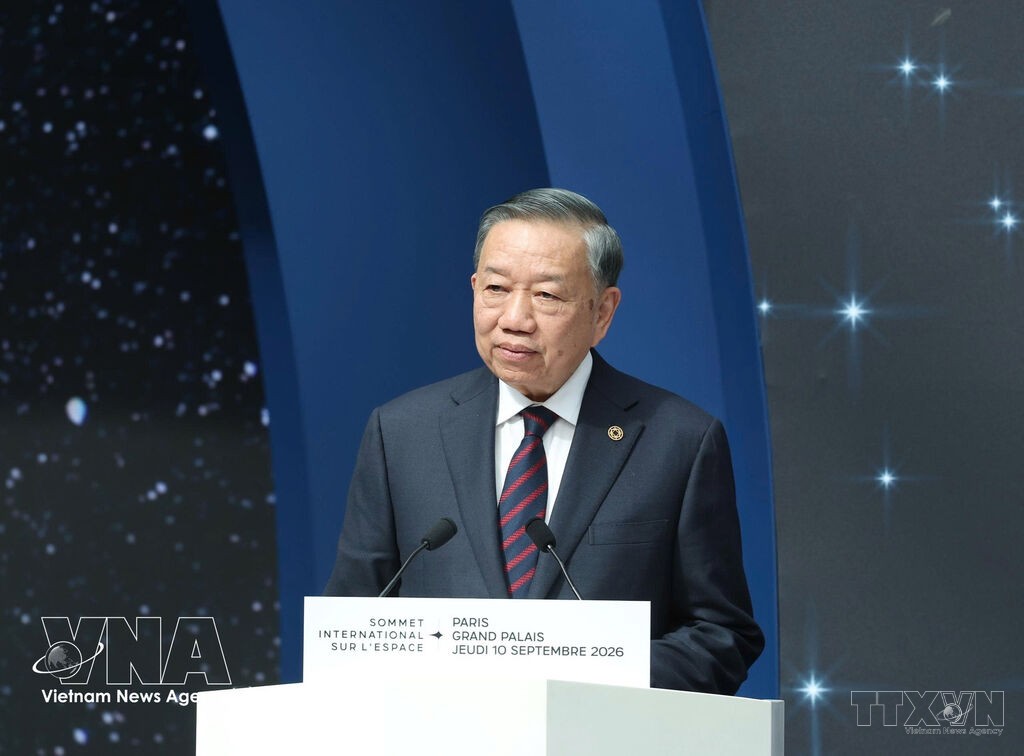 |
| General Secretary of the Communist Party of Vietnam (CPV) Central Committee and President To Lam speaks at the International Space Summit in Paris, France, on September 10 (Photo: VNA) |
He highlighted the growing importance of space activities to the modern life and economy, with satellites, remote sensing, and space positioning and data serving communications, transport, natural resource management, disaster prevention and climate change response.
He, however, pointed to challenges arising from the rapid expansion of space activities, including space debris, collisions, orbits and frequencies, militarisation, appropriation, technological gaps and the growing role of the private sector. He called for a multilateral governance framework to ensure that outer space remains peaceful, safe, sustainable and accessible to all, while promoting innovation, the space economy and the transformation of data into knowledge, services and better decisions for the Earth.
According to General Secretary and President Lam, Vietnam advocates five principles, namely preserving outer space for peaceful purposes through dialogue, trust-building, and conflict and arms race prevention, with no threat or use of force; putting people and development on Earth at the centre, with priority given to disaster early warning, climate monitoring, resources management and the Sustainable Development Goals; upholding international law and the UN Charter, placing the UN and the UN Committee on the Peaceful Uses of Outer Space (COPUOS) at the centre of multilateral space governance while strengthening the role of the International Telecommunication Union (ITU); ensuring equality among countries in accessing and benefiting from research and technological advances; and promoting the responsible, transparent and sustainable use of outer space, while reducing space debris and the risk of collisions.
For Vietnam, he said, aerospace technology is among the strategic technologies prioritised for development and a component of the country’s development capacity, with three priority areas - enhancing self-reliance in space technology and data; developing space economy ecosystem and encouraging financial models for applications serving public interests; and improving the institutional framework and governance capacity for space activities in line with international law.
International cooperation has made important contributions to Vietnam’s efforts to use outer space for the benefit of its people, peace and development, he said, noting that in 1980, Vietnam became the first Asian country to send a person into space, and it has since developed capabilities to manufacture and launch small satellites, as well as conduct research, training, remote sensing and observation serving sustainable development.
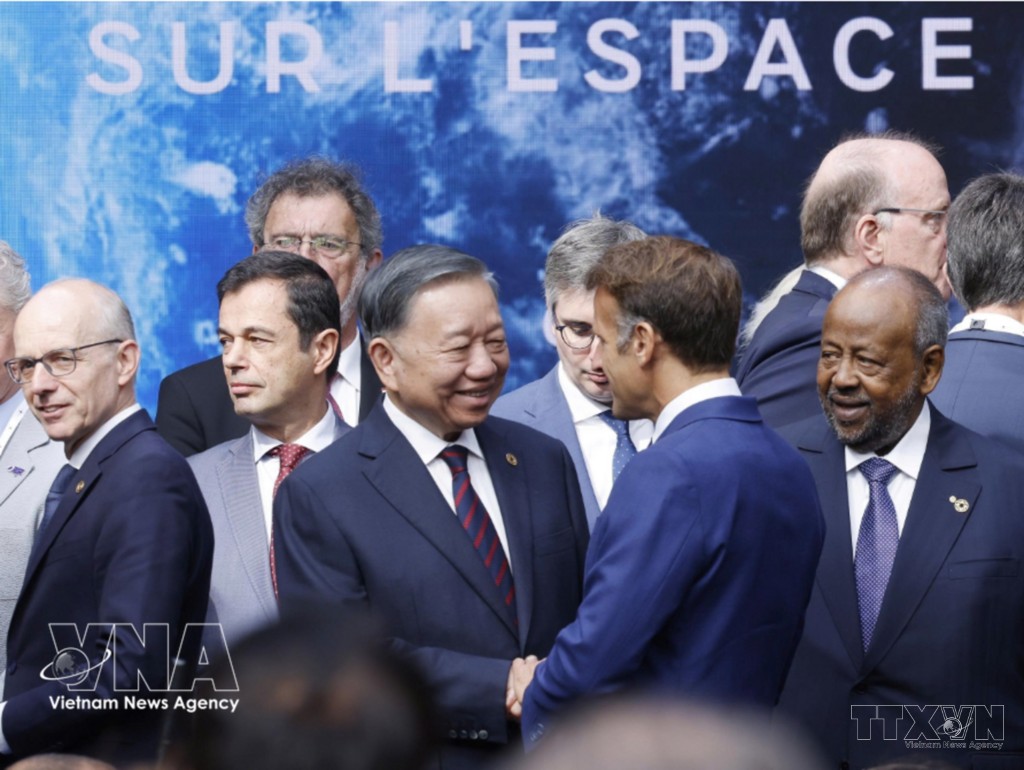 |
| General Secretary of the Communist Party of Vietnam (CPV) Central Committee and President To Lam and delegates at the International Space Summit in Paris, France, on September 10 (Photo: VNA) |
In this regard, the Vietnamese leader highlighted France as one of Vietnam’s important partners in space cooperation, with the VNREDSat-1 satellite project serving as a notable example.
He proposed an initiative for Vietnam, France, the UN, ASEAN and other partners to explore the establishment of a network “space for development and resilience”, with a focus on sharing and utilising space data for development, strengthening capacity for the safe and sustainable use of outer space, and linking research, training, business and investment to foster the space economy. He said the network could initially focus on Southeast Asia, with Vietnam ready to serve as a connectivity hub.
Emphasising that outer space opens up vast horizons, but that the ultimate measure of progress lies in the value it brings to people and the Earth, General Secretary and President Lam affirmed that Vietnam stands ready to work with other countries to turn the summit’s outcomes into concrete actions.
This session is the first of three debates of this kind held as part of the September 9 - 10 summit, which brings together heads of state and government, leaders of national space agencies, representatives of international organisations and businesses, and aerospace researchers from around 130 countries, along with a live connection to the International Space Station (ISS).
The summit features policy discussions and introduces opportunities for international cooperation in aerospace technology, services, research and training, focusing on promoting the space economy, ensuring space security through dialogue and partnerships, and advancing science and technology for space exploration.
In his opening remarks, French President Emmanuel Macron stressed the need for common governance mechanisms and clear international rules to ensure the safe, sustainable and peaceful use of outer space amid growing global competition.
European Commission President Ursula von der Leyen said the full potential of outer space could only be realised through international cooperation, noting that the global space economy is expected to triple by 2035.
For his part, Indian Prime Minister Narendra Modi called for cooperation over confrontation, sustainable development over short-term interests, and inclusive access to space technologies. He stressed the importance of international law, dialogue and multilateral governance, while expressing India’s wish for France and other countries to partner in its next stage of space development.
Greek Prime Minister Kyriakos Mitsotakis stressed that smaller countries should also have access to space technologies through international partnerships, while Director General of the European Space Agency Josef Aschbacher called for greater European technological autonomy.
Meanwhile, European Commissioner for Defence and Space Andrius Kubilius warned against fragmentation and closed space ecosystems, calling for European launch capabilities to serve European needs and for dialogue with both established and emerging technology companies. Italian Minister of Enterprises Adolfo Urso similarly stressed the need for a diverse European space industry, calling for more investment to leverage greater participation by corporations, private companies and startups./.