 |
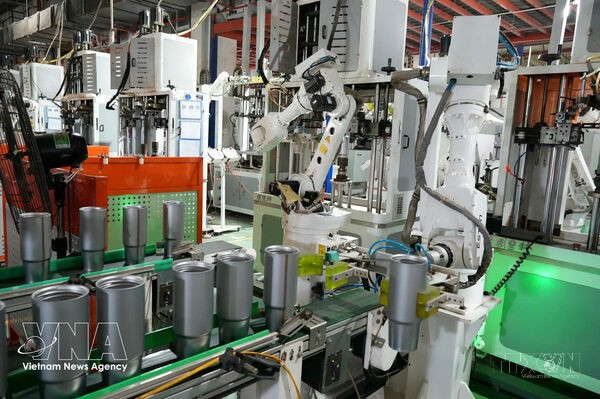
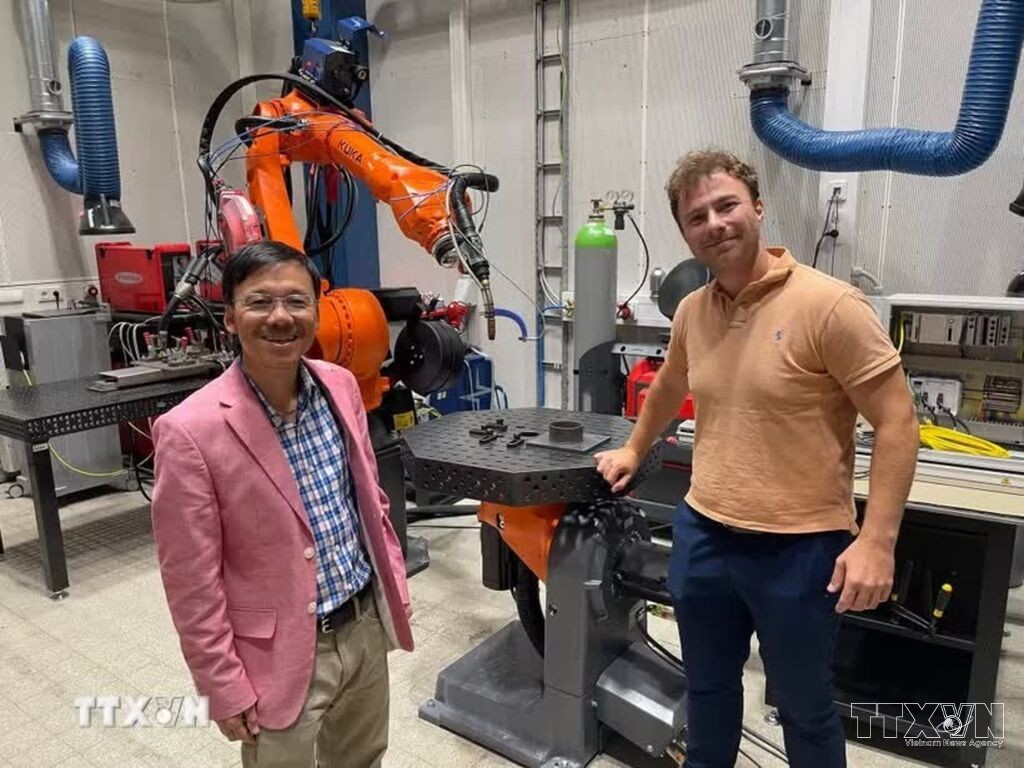
| Assoc. Prof. Vu Viet Hung (left) visits a robotic 3D printing facility. (Photo published by VNA) |
Ottawa (VNA) – Vietnam and Canada's upgrade of their ties to a Strategic Partnership is widening room for cooperation in science, technology and innovation, with several areas poised to move quickly from proposals to joint projects.
Assoc. Prof. Vu Viet Hung, Chairman of the Canadian Vietnamese Scientists and Experts Association (CVSEA), told Vietnam News Agency reporters after a meeting with General Secretary of the Communist Party of Vietnam Central Committee and President To Lam that the key takeaway was the leaders' emphasis on the value of overseas Vietnamese expertise.
The guidance framed scientists and experts abroad as a key resource for Vietnam's sci-tech development and socio-economic transformation. The CVSEA is expected to build a stronger network that acts as "science and technology ambassadors" in Canada while mentoring younger Vietnamese to create a lasting pipeline of successors, he said.
The meeting also stressed closer collaboration among experts, scientists and companies to tackle major challenges facing Vietnam, especially in strategic technologies with breakthrough potential. Beyond long-term goals, cooperation should produce projects with clear results and benefits for all participants.
Hung said the Strategic Partnership framework offers a basis for such work, with science and technology as one of its pillars and a potential driver for energy, transport, trade, investment, culture and education.
As a lecturer at the Royal Military College of Canada, he pointed to three areas where cooperation could be launched in practice.
The first is energy, environment and sustainable development. Canada's energy advantages and Vietnam's push for energy security give both sides' companies, universities and research institutes grounds to develop and transfer technologies for extracting, converting and storing liquefied natural gas (LNG) and hydrogen, as well as processing and transporting critical minerals associated with environmental protection.
The second is digital technology, artificial intelligence (AI) and innovation. Canada's research strength paired with Vietnam's manpower, market size and speed of adoption could address national-level challenges and help small- and medium-sized enterprises modernise production and tap into the international innovation ecosystem. Vietnamese universities, professional associations and businesses also stand to gain from Canada's experience, models and innovation ecosystem.
The third is dual-use technology tied to national defence and security in aerospace. Possible areas include airspace security and surveillance, maritime and island communications, aircraft manufacturing technology, low-Earth-orbit satellites and pilot training simulators. The CVSEA could serve as an adviser, a connector among universities, research institutes and companies, or a direct partner in specific projects.
On the outlook, Hung said Canada's Indo-Pacific Strategy, together with the new partnership framework, provides a highly favourable foundation for cooperation.
To convert commitments into results, he urged Vietnam to take a more proactive stance on financing mechanisms and create conditions for companies to join, thus speeding up the commercialisation of technology.
He also called for flexible use of a "set the problem, find the solution" approach driven by practical needs, to draw scientists and businesses from both countries into solving specific challenges. The approach could be applied from scientific research and technology transfer to business-to-business cooperation.
If such mechanisms are put in place, the partnership's sci-tech potential could gradually become concrete projects and tangible outcomes, Hung said./.