 |
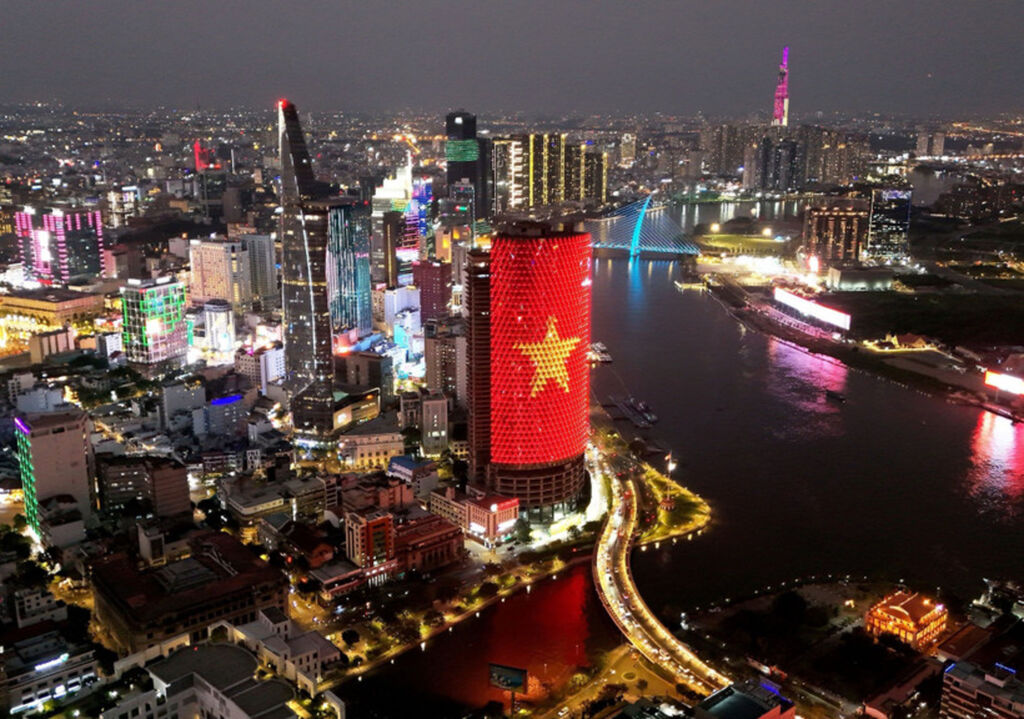
| A corner of Ho Chi Minh City (Photo: VNA) |
Hanoi (VNA) – Achieving double-digit economic growth in 2026 is widely seen as an “uphill battle”, prompting Vietnam to pool resources early and push hard from the outset of the year.
Which growth scenario for 2026?
A growth path for 2026 has been outlined in line with the National Assembly’s resolution setting a target of more than 10% expansion.
Under this scenario, gross domestic product (GDP) would need to rise 9.1% in the first quarter and 10.2% in the second, lifting first-half growth to 9.7%. The third quarter would require 10.2% expansion, pushing nine-month growth to 9.9%. The final quarter would then accelerate to 10.4% to hit the full-year goal.
The United Overseas Bank (UOB), in its latest GDP forecast for 2026, pointed to a “high statistical base” as a major obstacle ahead.
A high statistical effect, the risk of an export slowdown after an earlier surge, and uncertainty over US tariff policy are among key headwinds for Vietnam’s growth trajectory, said Suan Teck Kin, Head of Global Economics and Market Research at UOB Singapore.
According to Suan, Vietnam’s economic openness leaves it especially exposed to trade tensions, including potential US tariffs. Exports of goods and services account for as much as 83% of GDP, second only to Singapore’s 182% in ASEAN, and the country remains heavily reliant on the US market.
Beyond trade risks, other challenges loom, including consumer purchasing power, industrial output, and the ability of emerging growth drivers to scale quickly. The Ministry of Finance (MoF) indicated that 10% GDP growth in 2026 would require the Industrial Production Index to climb 12-14%, export turnover to rise 15-16%, and total retail sales of goods and services to hike 13-15%. By contrast, those indicators grew 9.2%, 17% and 9.2%, respectively, in 2025. Reaching the new targets will therefore demand an extraordinary effort.
Solid foundation for 2026
Despite these challenges, Vietnam enters 2026 on a relatively solid footing, built on the 2025 achievements.
The bank noted that Vietnam’s exports and manufacturing have stayed robust despite US tariff pressures. Rising confidence has also boosted foreign investment: newly registered FDI reached 38.4 billion USD, edging higher than the prior year, while disbursed FDI hit a record 27.6 billion USD, surpassing the previous peak of 25.4 billion USD in 2024 as investors accelerated plans amid visible global supply-chain shift toward Vietnam.
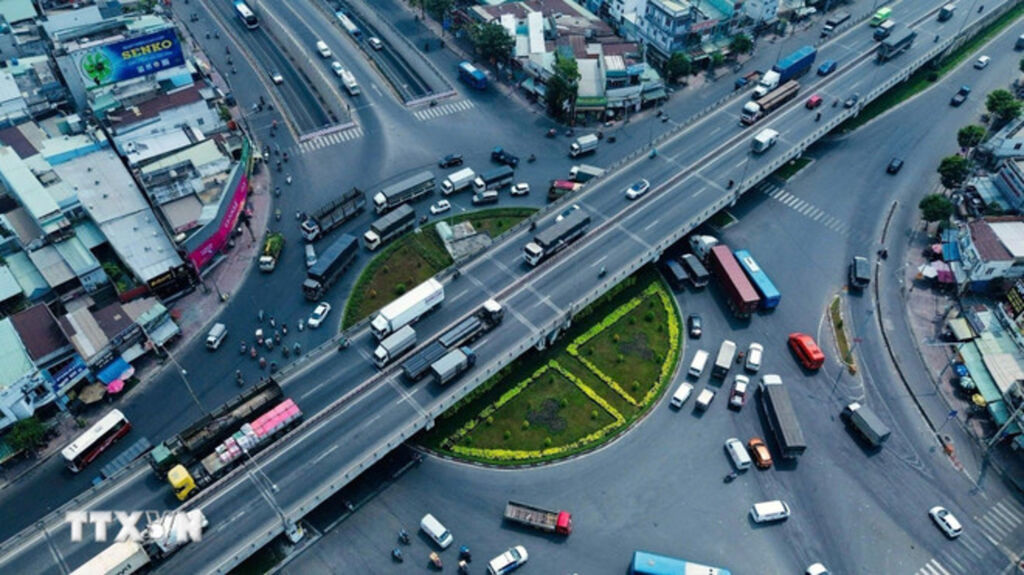 |
| An Suong intersection in Ho Chi Minh City (Photo: VNA) |
Another positive signal came from S&P Global Market Intelligence, which reported Vietnam’s Purchasing Managers’ Index (PMI) at 53 in December 2025. This marked six consecutive months of improving business conditions, with both output and new orders rising strongly and business confidence hitting a 21-month high.
Economists said the foundation for 2026 also rests on deeper structural factors, including the outcomes of the 14th National Party Congress, administrative streamlining, the effectiveness of the two-tier local administration model, timely policy and institutional rollout, and the launch and completion of a series of major construction projects. Above all, local authorities’ determination to meet ambitious GRDP growth targets is also crucial.
A full-force push for double-digit growth
Addressing a national conference on accelerating public investment in 2025 and 2026, Prime Minister Pham Minh Chinh directed ministries and localities to fully disburse all 2025 public investment capital, while immediately launching projects to ensure spending from the start of the year.
The MoF reported that as of December 31, over 755.1 trillion VND (29 billion USD) in public investment had been disbursed, or 83.7% of the PM’s plan. This leaves nearly 146.9 trillion VND to be spent in the final weeks of the 2025 budget year, which ends in late January 2026. Meanwhile, total public investment fund for 2026 amounts to 1.08 quadrillion VND, which will also require swift rollout.
The PM also called for a reduction in the incremental capital-output ratio (ICOR) from around 6 to 4.5. Achieving this will demand better project preparation, strict timeline adherence, and quality control so that projects can be brought into operation sooner.
Other key policy priorities include refining institutional framework and laws, particularly those governing investment and trade, to unleash production capacity, pool all available resources and create new growth drivers; prioritising growth while maintaining macroeconomic stability, controlling inflation and ensuring major economic balances; and keeping public debt and state budget deficit within legal limits.
For 2026, only six out of 34 localities have set growth targets below 10%, while the rest aim above 10%. Hai Phong, Quang Ninh and Bac Ninh have the most ambitious goals, at around 12–13%.
At a recent online meeting between the Government and local authorities, many localities put forward proposals to achieve double-digit growth and pledged accountability to the Government for meeting those goals./.