 |
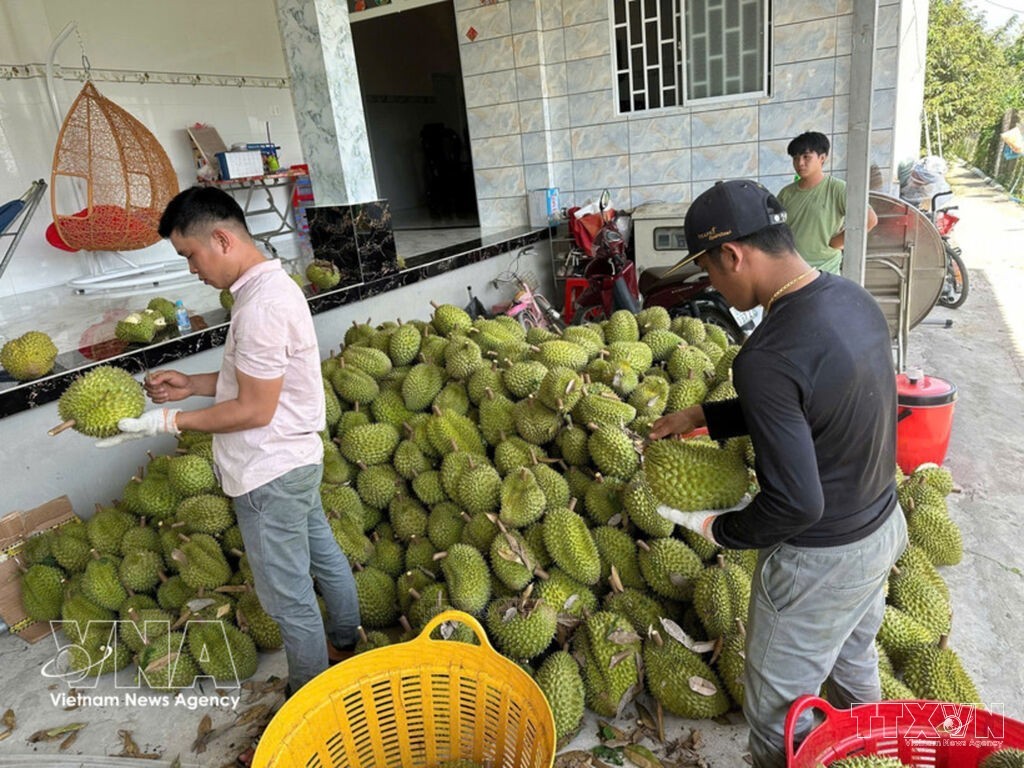
| India's opening of its market to Vietnamese durian is a notable development that creats new opportunities for producers and exporters in both countries. (Photo: VNA) |
New Delhi (VNA) – The Vietnamese Trade Office in India organised an online seminar on August 20 to promote market opening and agricultural trade between the two countries.
In his opening remarks, Vietnamese Trade Counsellor in India Bui Trung Thuong said the event aimed to provide market information and strengthen direct connections between the two business communities.
He underlined that economic and trade cooperation is an important pillar of Vietnam–India relations, with agricultural trade offering considerable room for expansion and diversification.
India's opening of its market to Vietnamese durian and Vietnam’s approval of the import of fresh Indian grapes are notable developments that have created new opportunities for producers and exporters in both countries, Thuong said.
However, he noted, turning market access into actual trade flows requires closer coordination, information sharing and compliance with requirements on quality, plant quarantine, food safety, logistics and traceability.
A representative of the Agricultural and Processed Food Products Export Development Authority (APEDA) introduced India’s strengths in producing and exporting fruits such as grapes, pomegranate, mango, banana and orange.
The representative said India has developed traceability systems, pesticide residue controls, packaging facilities and supply chains meeting import-market requirements. Vietnam is considered a promising market for Indian agricultural products. Meanwhile, Indian businesses are preparing to ship their first consignments of grapes to Vietnam in the next crop season, and seeking to expand the range of products exported to the Vietnamese market.
Rajaram Sangle, a representative of the Indian Grape Exporters Association, said businesses are expected to conduct trial grape shipments starting December following Vietnam’s opening of its market to Indian grapes. He proposed organising business meetings in Vietnam in October or November to connect Indian exporters with Vietnamese importers, retailers and supermarket chains.
Representatives of plant protection authorities from both countries also presented quarantine regulations and recommendations for businesses.
Vietnamese businesses welcomed India’s opening of its market to Vietnamese durian, describing it as a major opportunity for the sector. They also pointed to challenges involving import procedures, logistics, cold storage, transportation time and consumer awareness, proposing more business-matching and promotional activities.
HG Invest stressed the importance of air freight for high-value, perishable and time-sensitive agricultural products such as grapes and durian. Combining air transport with cold-storage, cargo consolidation and distribution systems could shorten transit times, preserve product quality and improve trade efficiency.
Participants also suggested expanding agricultural cooperation beyond fresh produce trade to food processing, agricultural technology, plant varieties, logistics and other parts of the value chain.
The India–Vietnam Chamber of Commerce proposed that the two governments step up information provision and establish support mechanisms to help businesses better understand and comply with import-market regulations.
Closing the seminar, Thuong affirmed that the Vietnamese Trade Office in India will continue providing market information, connecting businesses, organising trade-promotion activities and coordinating with relevant agencies and associations to promote bilateral agricultural trade.
As Vietnam and India target bilateral trade of 25 billion USD by 2030, agricultural trade remains an area with significant potential. Gradual market opening for each other’s key products, together with stronger business connectivity, logistics and supply chains, is expected to contribute to agricultural trade and the broader trade target./.