 |
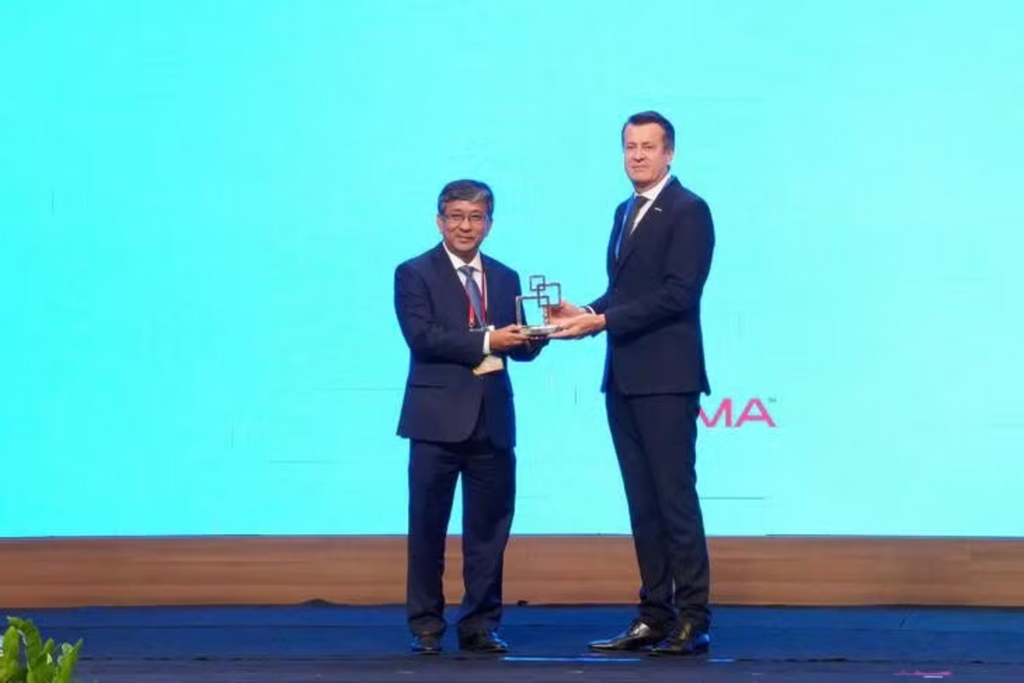
| Deputy Minister of Science and Technology Tran Trung Tinh (L), representing the Vietnamese Government, receives the GSMA Government Leadership Award 2026 from the Global System for Mobile Communications Association (GSMA) (Photo: suckhoedoisong.vn) |
Quang Ninh (VNA) – The Ministry of Science and Technology, representing the Vietnamese Government, received the GSMA Government Leadership Award 2026 from the Global System for Mobile Communications Association (GSMA) at the opening of the Ministerial Roundtable on Digital and Artificial Intelligence on October 28, as part of Vietnam International Digital Week 2026 (VIDW 2026) in Quang Ninh city.
The annual award honours one country each year, selected by an independent international panel of experts involving representatives from organisations such as the International Telecommunication Union (ITU), the Organisation for Economic Co-operation and Development (OECD) and the GSMA. It recognises governments that demonstrate sustained policy leadership, strategic vision and an outstanding regulatory environment to promote mobile and digital development, as well as ambitions translated into concrete action.
Vietnam is the only country to receive the award in 2026. Brazil won in 2025 for its effective spectrum management policies and innovative telecommunications regulations, while Trinidad and Tobago received the award in 2024 and India in 2023.
The award recognises Vietnam’s efforts to develop policies, improve institutions and build infrastructure for digital transformation. The 2023 Telecommunications Law and Politburo Resolution No. 57-NQ/TW on breakthroughs in science and technology, innovation and national digital transformation provide important foundations, establishing digital infrastructure as a cornerstone of the digital economy and society.
Speaking at the award ceremony, Julian Gorman, GSMA’s head for Asia-Pacific, said Vietnam has been honoured for its approach to linking national ambitions with policy direction, implementation capacity and cooperation with industry.
He praised Vietnam’s strategic vision of treating telecommunications connectivity as economic infrastructure, its policies to promote network investment, its development of 5G and its people-centred approach. These foundations, he said, would enable Vietnam to further develop its digital economy, strengthen industrial capabilities and play a greater role in shaping the future of the global telecommunications industry.
According to the GSMA, Vietnam’s digital economy is projected to account for 30% of GDP by 2030. The country’s ability to attract foreign direct investment in semiconductors, artificial intelligence and smart manufacturing is seen as a key driver of economic restructuring, technological advancement and national competitiveness.
The GSMA’s Digital Nations 2026 report on building trusted digital ecosystems in Asia-Pacific highlights Vietnam’s progress across five pillars: infrastructure, innovation, data governance, cybersecurity and human skills.
These pillars are closely interconnected and underpin the sustainable development of the digital ecosystem. Modern connectivity infrastructure broadens access to services, innovation drives new products and business models, and data governance and cybersecurity help build trust. Digital skills, meanwhile, enable people and businesses to make effective use of the opportunities offered by technology.
One of Vietnam’s notable achievements highlighted by the GSMA is the rapid development of next-generation telecommunications infrastructure. By 2026, the country had installed more than 40,000 5G base stations, covering approximately 92% of the population and placing it among the world’s fastest countries in deploying 5G and expanding coverage.
Alongside infrastructure expansion, internet connectivity has also improved significantly. According to i-Speed, the measurement system operated by the Vietnam Internet Network Information Centre (VNNIC) under the Ministry of Science and Technology, mobile and 5G internet speeds in Vietnam rose sharply in 2026, exceeding 500 Mbps for the first time early in the year, with one operator reaching a peak of 617 Mbps. The national average download speed cited in the announcement remained above 437 Mbps.
According to Ookla’s Speedtest Global Index, based on data updated for August and September 2026, Vietnam ranked eighth worldwide for mobile broadband speed for the first time in September, with a median download speed of 230.31 Mbps. This marked an improvement from 10th place in July and ninth in August. Hanoi also entered the top five cities worldwide for mobile network speeds.
For fixed broadband, Vietnam ranked seventh globally in July 2026, with a speed of 307.11 Mbps, before placing eighth in August at 301.48 Mbps, more than twice the global average of 129.68 Mbps. In September, the country remained among the world’s top 10, with a speed of 297.64 Mbps.
Alongside 5G deployment, Vietnam is stepping up efforts to eliminate mobile coverage gaps and expand broadband access. The completion of the 2G network shutdown and implementation of the public telecommunications service programme under Decision No. 777/QD-TTg in 2026 have provided a basis for telecommunications operators to extend connectivity to disadvantaged areas.
A key campaign in 2026 brought coverage to 1,856 locations, including 788 hamlets and villages and 1,068 residential clusters in remote, mountainous, border and island areas. In addition to expanding terrestrial infrastructure, Vietnam is testing low-Earth orbit satellite internet solutions to improve connectivity in areas where conventional telecommunications networks are difficult to deploy.
Vietnam’s goal of ensuring that 100% of its population can access digital services requires continued coordination between regulators and telecommunications operators. It also calls for infrastructure development to be accompanied by stronger digital skills, information security and access to services that meet people’s practical needs./.