 |
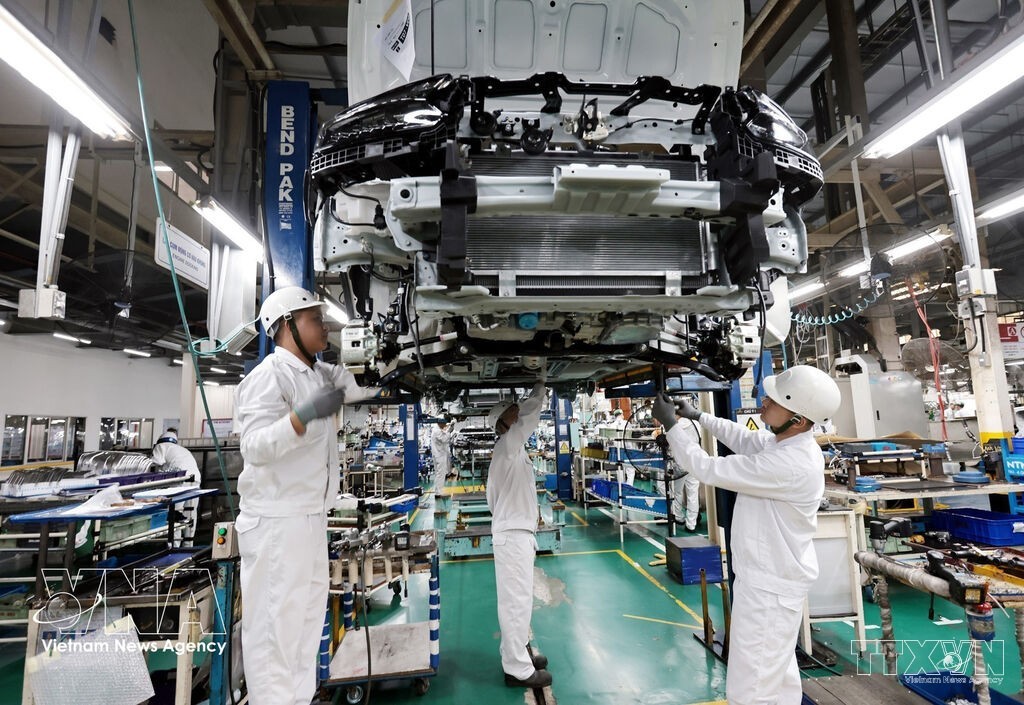
| Automobile production at the Honda Vietnam factory in Vinh Phuc ward, Phu Tho (Photo: VNA) |
Hanoi (VNA) — Vietnam’s automobile market is undergoing significant changes in both sales volume and product structure. Electrified vehicles have emerged as a notable growth driver, while a race in promotions and a wave of new model launches are expected to boost demand in the final months of the year.
Vietnam records highest sales growth among ASEAN-6
Once considered an emerging segment, electrified vehicles are increasingly becoming an important part of the automobile market.
According to data released by PwC in late September, total vehicle sales across the six ASEAN-6 markets, namely Vietnam, Indonesia, Thailand, Malaysia, the Philippines and Singapore, reached about 1.755 million units in the first half of 2026, up 11% year on year. Vietnam recorded the highest sales growth in the group at 31.1%, followed by Indonesia at 15.9% and Thailand at 15.1%.
With around 291,000 vehicles sold in the first six months of 2026, Vietnam ranked fourth among ASEAN-6 markets in terms of market size, after Indonesia, Thailand and Malaysia. The figures show that demand for automobiles in Vietnam continues to grow, while the product mix is rapidly shifting towards electrified vehicles.
According to the latest data from the Vietnam Automobile Manufacturers’ Association (VAMA), cumulative sales by its member companies have reached 246,935 units, up 12% year on year. However, a fuller picture of the market emerges when sales by Hyundai Thanh Cong, which contributed 31,540 units, are included. Notably, VinFast recorded a remarkable 71% increase in sales year on year, with cumulative sales reaching 154,073 units.
Assessing the results, Duong Thi Thu Trang, Deputy CEO of Global Sales at VinFast, said Vietnam is currently one of the world's fastest-growing electric vehicle markets, with EV market share continuing to expand. From September 2024 to August 2026, VinFast maintained its position as Vietnam's top-selling carmaker for 24 consecutive months, directly driving the share of electrified vehicles to a record high in the domestic automobile industry.
Combining sales figures from the three main groups, namely VAMA, VinFast and Hyundai Thanh Cong, total actual vehicle sales in Vietnam have surpassed 400,000 units, reaching 432,548 units of all types. This represents a 26.4% increase from the same period in 2025, reflecting the market's rapid recovery and expansion.
EVs, hybrids gain market share
A key feature of Vietnam's automobile market in 2026 is the rapid adoption of electrified vehicles. According to PwC, electrified vehicles (xEVs) accounted for around 44% of total passenger vehicle sales in Vietnam in the first half of 2026.
Battery electric vehicles (BEVs) continue to play an important role in this group. Models positioned at accessible price points and targeting urban, family and commercial-use needs have made significant contributions. In the first eight months, VF 3 sales reached 35,798 units, VF 5 sales 27,948 units and Limo Green sales 34,991 units.
The growth of EVs comes as Vietnam's electrified vehicle market has expanded significantly in recent years. According to PwC, xEV penetration in Vietnam reached 36% in 2025, up from 22% in 2024. xEV sales reached around 189,000 units in 2025, up 95%.
Data for the first half of 2026 show that Vietnam sold more than 127,000 electric and hybrid passenger vehicles. This indicates that electrification is no longer limited to early adopters but is spreading across a broader range of segments and user needs.
Alongside pure EVs, hybrid vehicles have emerged as a transitional option. In the first eight months of 2026, hybrid sales by VAMA members reached 13,889 units, up 65% year on year. The increase shows growing consumer interest in fuel efficiency and lower operating costs while maintaining less reliance on charging infrastructure.
Changes in powertrain technology have been accompanied by a growing preference for higher-riding vehicles. SUVs, crossovers and MPVs remain popular thanks to their flexible space and practicality. Meanwhile, the emergence of urban EVs and electric MPVs is broadening choices for both individual customers and commercial operators.
The 2026 market is therefore changing not only in terms of sales volume but also in product structure. Petrol-powered vehicles, hybrids and pure EVs are coexisting, creating more diverse competition over prices, technology and ownership costs.
In the final months of the year, experts held that competition in the automobile market is expected to remain intense as manufacturers and dealers step up demand-stimulation programmes while preparing to launch new products./.