 |
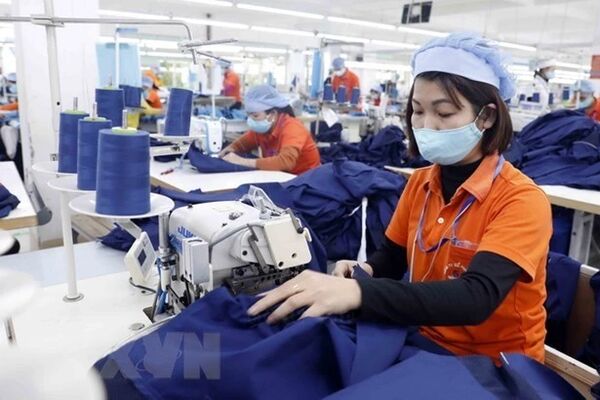
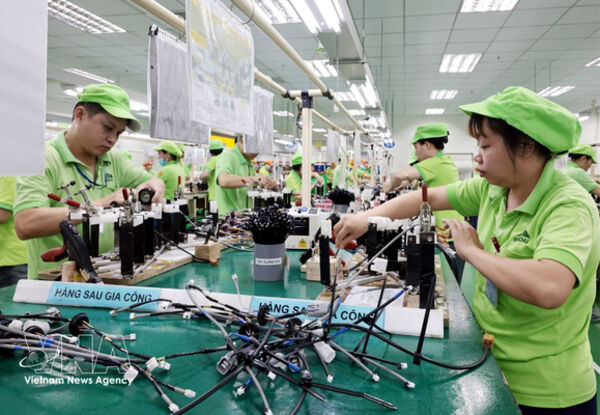
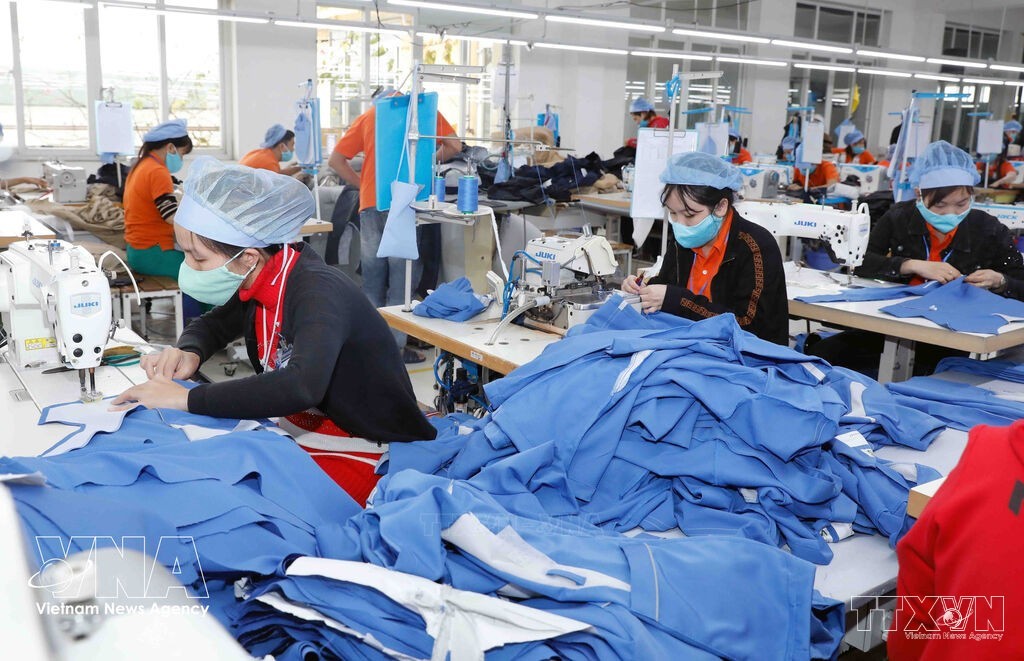
| Garments for export to the Japanese market are produced at Hung Viet Garment Company in Hung Yen province. (Photo: VNA) |
Hanoi (VNA) – Vietnam's textile and garment industry weathered global market challenges to post exports of more than 22.2 billion USD in the first half of 2026, up 1.7% year-on-year, but achieving the full-year target of 48 billion USD will require greater productivity, stronger governance and expanded production.
Mounting challenges
Cao Huu Hieu, General Director of the Vietnam National Textile and Garment Group (Vinatex), said the group recorded revenue of more than 10 trillion VND (380 million USD) in the first six months, up 9.6% from a year earlier. Pre-tax profit increased 32.4% to 882.9 billion VND, while average monthly income for employees rose 8.9% to 12.4 million VND.
He said the results reflected efforts to improve resilience through tighter inventory control, more efficient cotton procurement and better use of raw materials to reduce risks associated with cotton price and exchange rate fluctuations. Vinatex has also further aligned its product mix to market demand while expanding supplies to customers in China, foreign-invested enterprises and the domestic market.
The group has worked with member companies to secure new orders, strengthen competitiveness and shift to higher-value products. Improved productivity, closer customer engagement and more efficient governance have helped maintain stable operations despite difficult market conditions, Hieu said.
He cautioned that the business outlook remains challenging as global demand weakens and competition intensifies. The temporary 10% tariff on all imports into the US is due to expire on July 24, while continued global growth slowdown is expected to place additional pressure on exporters in the second half of the year.
According to Hieu, soft consumer demand in major markets, rising price competition, volatile financing and raw material costs, together with stronger competition from rivals, will continue to test businesses.
To achieve its full-year targets of more than 20 trillion VND in revenue, 1.4 trillion VND in pre-tax profit and a 10% increase in trade surplus, Vinatex is restructuring its customer portfolio, prioritising strategic partners, improving productivity, strengthening cash-flow management and accelerating digital transformation. It is also enhancing quality management, social responsibility standards and origin traceability to meet stricter import requirements.
Fostering strategic growth pillars
Nguyen Ngoc Binh, General Director of Hoa Tho Textile and Garment JSC, said rising logistics costs, higher raw material prices and increasing trade risks also weighed on the company's profitability in the first half of the year.
Despite these challenges, Hoa Tho reported revenue of 2.893 trillion VND, up 9% year-on-year and equivalent to 52% of its annual target. Export turnover reached 148.5 million USD, fulfilling 55% of the yearly plan and rising 14% from a year earlier, while profit totalled 224.3 billion VND, or 56% of this year's target.
For the remainder of the year, the company will continue focusing on operational efficiency while accelerating new product development, digital transformation, technology adoption and automation to reinforce its foothold, Binh said.
Vu Duc Giang, Chairman of the Vietnam Textile and Apparel Association (VITAS), said while the industry's exports surpassed 22.2 billion USD in the first half of 2026, imports of textile and garment materials rose 4.3% year-on-year to 13.24 billion USD.
He said the sector still faces structural challenges, including slow demand recovery in major markets, fierce price competition, dependence on imported materials for 60–70% of production inputs, and rising compliance costs related to environmental, social and governance (ESG) standards and product traceability.
Giang stressed that future growth can no longer rely on expanding production capacity alone. Meeting this year's 48 billion USD export target will require greater productivity, higher value addition, stronger domestic sourcing, broader market diversification, and faster digital and green transformation.
He also identified several strategic priorities, including developing the domestic market, strengthening Vietnamese fashion brands, attracting investment in weaving, dyeing and finishing, deepening integration into global supply chains, and promoting the adoption of automation, smart factories and artificial intelligence to improve the industry's long-term competitiveness./.