 |
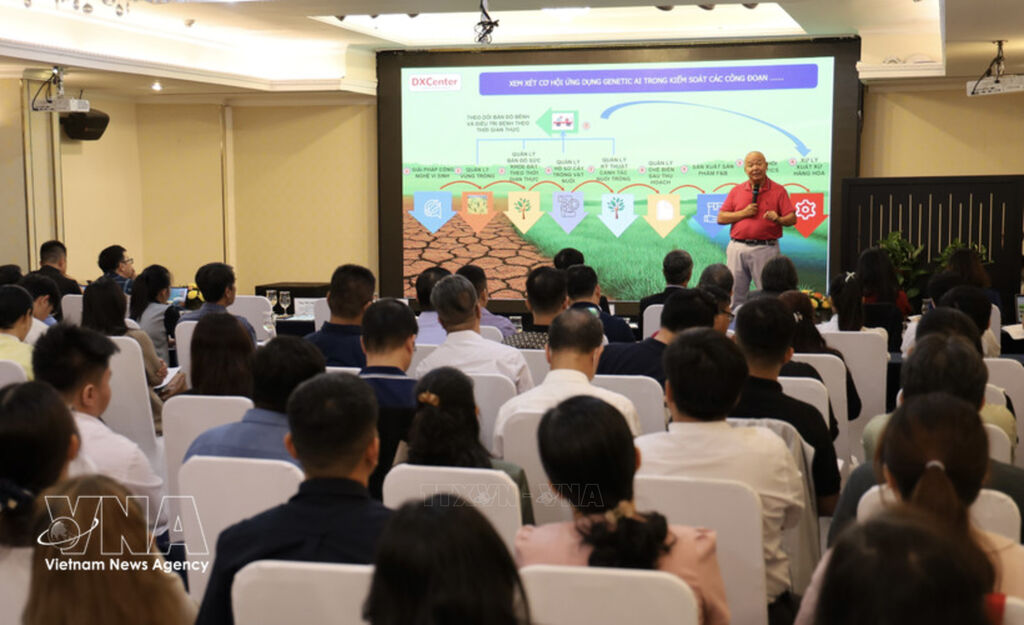
| A view of the workshop on the application of AI and real-world data in food product research and development held in Ho Chi Minh City on April 22. (Photo: VNA) |
Ho Chi Minh City (VNA) – Amid rapidly shifting global consumer preferences in the food and beverage (F&B) sector, Artificial Intelligence is increasingly viewed as a core “ingredient” in restructuring value chains and propelling Vietnamese F&B enterprises towards a breakthrough in the 2026–2030 period.
The assessment was made by experts at a workshop on the application of AI and real-world data in food product research and development, jointly organised by the Investment and Trade Promotion Centre (ITPC) and the Digital Transformation Consulting and Support Centre of Ho Chi Minh City on April 22.
Le Anh Hoang, Deputy Director of ITPC, highlighted that AI and data-driven applications have become critical to enhancing competitiveness, particularly in the food industry—one of the city’s four key industrial pillars. Beyond identifying risks and managing supply chains, AI enables demand forecasting, quality control, and in-depth analysis of consumer trends.
Dr Nguyen Ba Thanh, Director of the Institute of Biotechnology and Food Technology at the Industrial University of Ho Chi Minh City, noted that AI is delivering tangible advances in research and development (R&D). Traditional product development cycles of 18–36 months can now be reduced to just 3–9 months using generative AI models and sensory simulation technologies.
Beyond R&D, AI is reshaping the entire F&B operational chain. In supply chain management, predictive technologies help reduce food waste, while computer vision systems can detect production defects with accuracy exceeding 95%. On the market side, personalisation tools are enhancing order values by recommending products tailored to consumer behaviour and weather conditions.
Thanh stressed that: “The combination of food specialists and AI technology will deliver optimal outcomes, with humans retaining the coordinating role. AI is no longer a supplementary option but an essential technology driving competitiveness and economic restructuring.”
Vietnam’s introduction of an AI Law, effective from March 2026, is seen as a significant step in establishing a legal framework for technology deployment. However, challenges persist, including a shortage of in-house AI talent and insufficient data infrastructure, with nearly half of enterprises yet to meet requirements.
The scholar suggested that businesses start with projects that deliver quick results within six to 12 months, like quality control systems, demand forecasting, or customer service chatbots. In the long run, F&B companies are advised to move toward with AI-driven operating models to keep up with fast-changing market demands.
From an operational perspective, Phi Anh Tuan, a lead consultant on digital transformation at DXCentre, noted that integrating computer vision with autonomous decision-making systems can create intelligent management mechanisms that adjust machinery to mitigate risks early in the supply chain.
Addressing green consumption trends, Nguyen Minh Duc, Vice Secretary General of the Vietnam E-commerce Association, said e-commerce platforms are becoming valuable data repositories. Through platform analytics and social media insights, businesses can better understand demand patterns, pricing expectations, customer feedback, and packaging trends.
He added that while some firms hesitate due to perceived costs, adopting AI does not necessarily require significant upfront investment. Companies can begin with low-cost or free tools before gradually moving towards automated data collection, advanced analytics, and fully integrated management systems.
Experts concluded that consumers are no longer waiting for large corporations but favour businesses that respond precisely to their needs. In this context, leveraging AI and big data is no longer merely a competitive advantage; it is fast becoming a prerequisite for sustainable growth in Vietnam’s F&B sector./.