 |
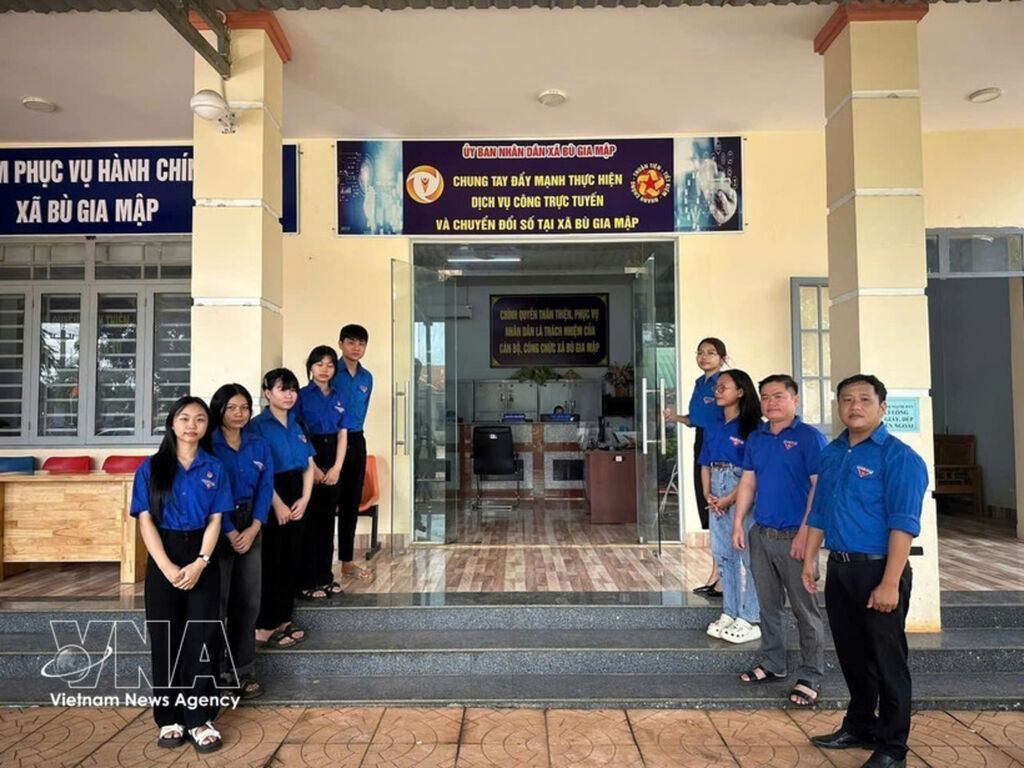
| Youth union members in Bu Gia Map commune help local residents complete administrative procedures. (Photo: VNA) |
Dong Nai (VNA) – A year after adopting the two-tier local administration model, Bu Gia Map, a remote border commune in the southern city of Dong Nai with a significant ethnic minority community, has experienced notable improvements in public administration, making digital public services more accessible to residents and boosting governance efficiency.
Located along a 47km border with Cambodia, Bu Gia Map is home to 1,898 households, with ethnic minorities accounting for 74.5% of the population. Agriculture remains the mainstay of the local economy, while limited socio-economic development has continued to constrain digital infrastructure and residents' access to information.
To address administrative challenges in the area, the commune's public administrative service centre has become a key driver of changes, pioneering new ways of delivering public services.
According to the director of the centre, Nguyen Van Duoc, coordination among agencies and the application of digital technologies have significantly improved the handling of administrative procedures.
Applications can be submitted and processed seamlessly either in person at the centre or online via the National Public Service Portal. The entire process is handled through an electronic one-stop system, while the digitisation of application files and processing results is supported by upgraded IT infrastructure and reliable internet connectivity, Duoc said.
As of June 26, the commune had publicly listed all 428 administrative procedures under its authority. The centre had received 3,040 online applications, with 98.2% processed ahead of schedule, helping improve the quality of services for residents and businesses.
Beyond improved administrative performance, local officials said the greatest achievement of the two-tier local administration model has been the gradual shift in residents' digital habits. Many residents who were previously unfamiliar with using smartphones are now able to complete administrative procedures online independently or with support from local officials.
Dieu Khen, a resident of Bu Nga hamlet, said he had to make repeated trips to complete paperwork because of missing documents, often losing a full working day. After receiving guidance from communal officials and community digital technology teams on creating an electronic identification account and using a smartphone for online procedures, he can now complete most formalities digitally and only visits the one-stop centre to collect the final results.
Thi Lien, head of Bu Dot hamlet, said many ethnic minority residents were initially reluctant to use online public services due to limited digital skills and a preference for face-to-face transactions. However, community digital technology teams have worked with local authorities to visit households and provide hands-on guidance. As residents recognised the convenience, reduced travel and lower costs, they gradually embraced the new approach.
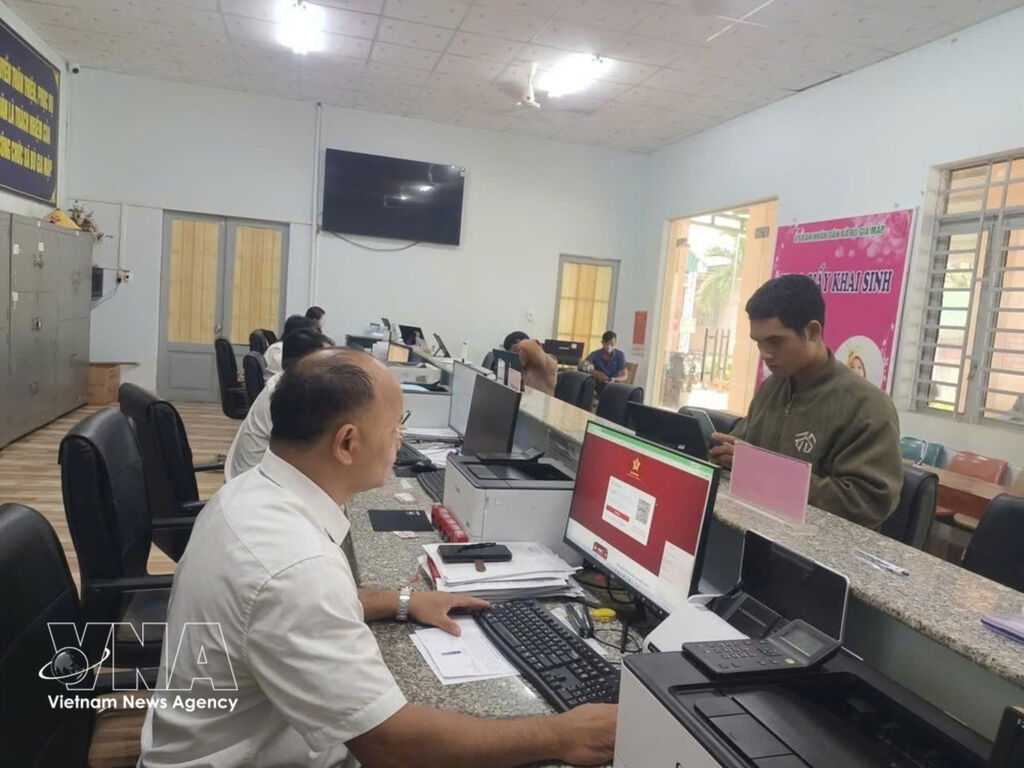 |
| Residents complete administrative procedures at the Public Administration Service Centre in Bu Gia Map commune. (Photo: VNA) |
From operational improvements at the one-stop service centre to the positive changes experienced in local communities, the two-tier local administration model has, after a year of implementation, proven its strengths in Bu Gia Map commune.
Le Hoang Nam, Secretary of the Party Committee of Bu Gia Map commune, said administrative reform and digital transformation have become key priorities in the locality. Operating an integrated digital one-stop service has not only eased officials' workloads but also reduced travel time and costs for people living in remote border areas. Many procedures that previously required approval from higher-level authorities can now be resolved directly at the commune level.
He also acknowledged remaining challenges, including occasional software incompatibility and slow internet connectivity in border areas. To improve the model, he highlighted the need to strengthen the Party's leadership, clearly define officials' responsibilities, mobilise trusted figures within ethnic minority communities to build public consensus, and keep citizens at the centre of administrative reform.
After a year of operation, the two-tier local administration model has improved public satisfaction, enabling more ethnic minority residents to access digital public services while strengthening trust in grassroots authorities./.