 |
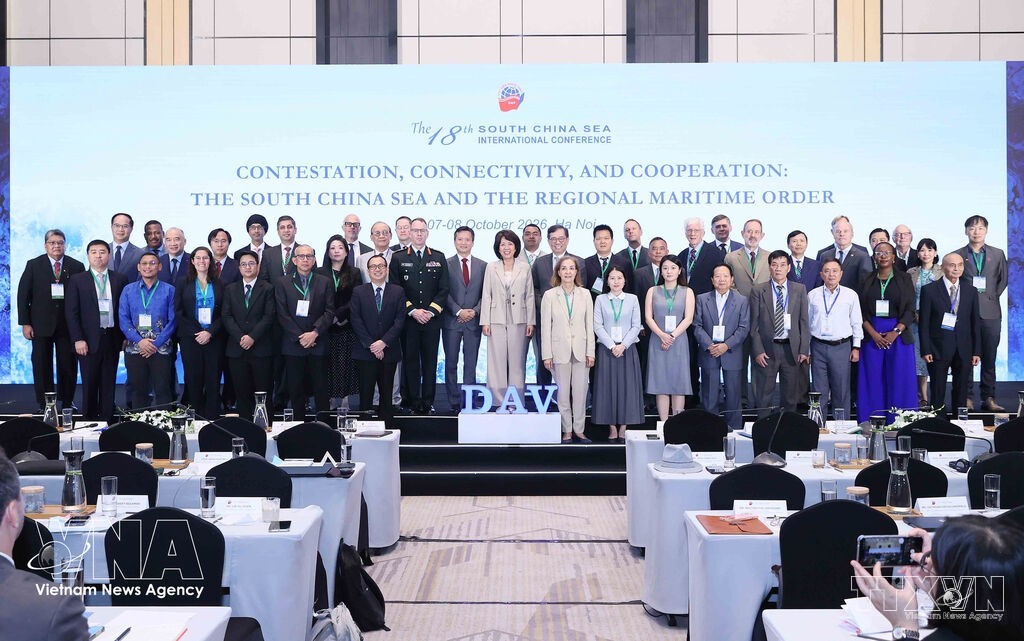
| Participants in the 18th international conference on the East Sea in Hanoi (Photo: VNA) |
Hanoi (VNA) – The 18th international conference on the East Sea concluded in Hanoi on October 8, with experts stressing the need to strengthen international law, crisis-management mechanisms and practical cooperation to maintain peace and stability in the strategically important waterway.
Organised by the Diplomatic Academy of Vietnam under the theme “Contestation, Connectivity and Cooperation: The South China Sea and the Regional Maritime Order,” the two-day conference brought together experts and policymakers to discuss challenges facing the region’s maritime order.
Discussions focused on four major areas: managing disputes while upholding rules and preventing crises; protecting connectivity, freedom of navigation and infrastructure resilience; promoting practical cooperation to address common needs; and building an inclusive and stable maritime order based on international law and shared responsibility of regional countries.
Participants noted that although no major conflicts have occurred, the East Sea is facing long-term strategic competition. Gray-zone activities are gradually affecting the situation on the ground and undermining trust, making it important to control actions that could escalate tensions and pursue peaceful solutions to disputes.
Experts underlined the importance of the UN Convention on the Law of the Sea (UNCLOS), dialogue and appropriate crisis-management mechanisms. Proposals included applying the Code for Unplanned Encounters at Sea (CUES) to coast guard forces, improving maritime domain awareness, establishing hotlines and increasing information sharing.
They also called on ASEAN and China to work towards a substantive, effective, efficient Code of Conduct in the East Sea (COC) that matches international law and UNCLOS, while stressing that no single mechanism should bear the entire burden of managing tensions.
The conference also highlighted the need to strengthen the resilience of maritime infrastructure and supply chains.
Discussions shared that stability in the East Sea must be viewed within a broad, interconnected framework linking it to strategic maritime routes such as the Straits of Hormuz and Malacca, as a disruption at any single point could impact the entire network. Safeguarding this connectivity requires an inter-regional approach to maintain safe and seamless maritime routes, alongside the preparation of crisis response mechanisms and scenarios.
Enhancing resilience is a key measure for ensuring connectivity. In this regard, many scholars offered valuable recommendations: diversifying supply sources, developing alternative energy sources and transport routes, strengthening stockpiling capabilities, upgrading infrastructure, and utilising modern technology for monitoring operations.
Regarding critical infrastructure such as submarine cables, it is essential to diversify cable routes and clearly define the roles of various stakeholders in ensuring the security and resilience of submarine cables. Experience from various regions demonstrates that self-reliance and cooperation – among nations, international and regional organisations, and the public and private sectors – play a crucial role in bolstering the resilience of submarine cable networks.
Experts identified search and rescue, fishermen’s safety, disaster response, submarine cable protection, marine scientific research, fisheries management, environmental protection, information sharing, infrastructure protection and maritime law enforcement capacity as areas where practical cooperation could be expanded.
Examples of Vietnam–China fisheries cooperation in the Gulf of Tonkin and Vietnam–Philippines cooperation, including support for fishermen, were cited as useful experiences.
Participants pointed out that ensuring a stable and inclusive regional order requires comprehensive measures that adhere to international law – with UNCLOS serving as the foundational framework – and necessitates that ASEAN and ASEAN-led mechanisms, such as the ASEAN Regional Forum (ARF) and the ASEAN Defence Ministers' Meeting Plus (ADMM+), further strengthen their centrality.
They held that ASEAN must take a more proactive role in building trust, safeguarding shared interests, establishing norms, and fostering connectivity among parties as well as with multilateral, bilateral, and minilateral mechanisms. These mechanisms should complement one another, enhance information sharing, and avoid fragmentation or exclusion.
An inclusive order must ensure that small- and medium-sized nations can participate in shaping norms, protecting their legitimate interests, and enhancing their response capabilities. Improvements in maritime safety, infrastructure resilience, and benefits to the community will serve as benchmarks for the effectiveness of regional cooperation, they added.
Speaking at the closing session, Dr Nguyen Hung Son, Director of the Diplomatic Academy of Vietnam, said the discussions highlighted that peace and stability in the East Sea do not depend solely on the early settlement of disputes. Rather, countries need to build a system of rules, enhance predictability and resilience, and promote practical cooperation.
The conference also featured the Southeast Asia Dialogue, Southeast Asia-Pacific Dialogue, Young Leaders Programme and annual East Sea Report, providing additional platforms for policy discussion and research on maritime issues./.