 |
| Editorial team meets to begin review of 100-year Party leadership |
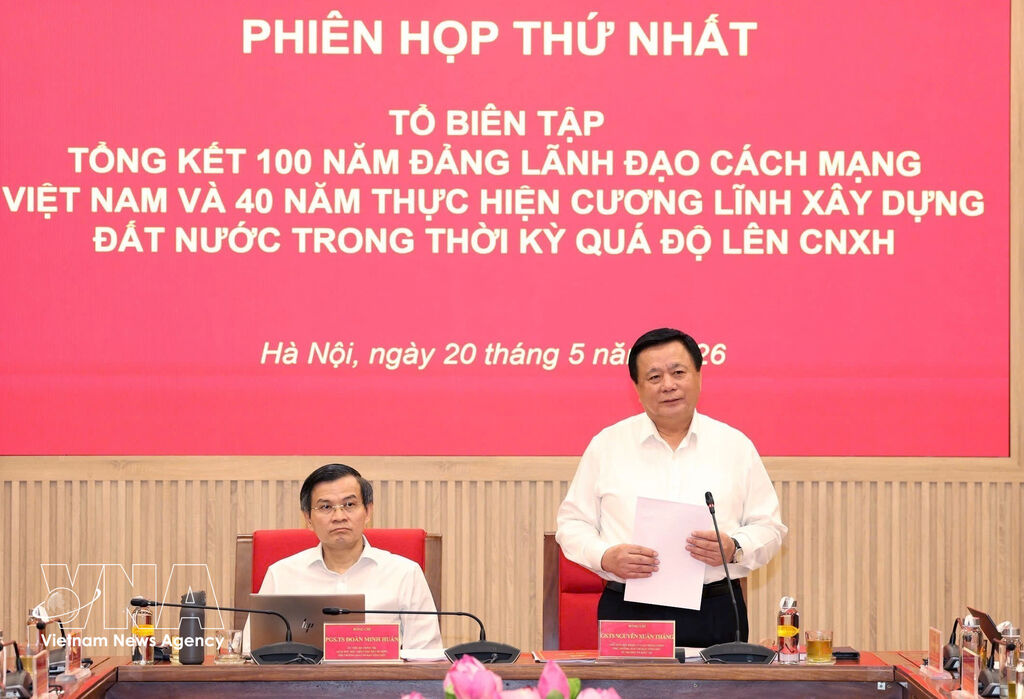
Hanoi (VNA) – An editorial team met at the Ho Chi Minh National Academy of Politics (HCMA) in Hanoi on May 20 to begin a sweeping review of the Communist Party of Vietnam (CPV)’s century-long leadership, a process aimed at shaping the country’s long-term development roadmap ahead of the 15th National Party Congress.
Specifically, it is tasked with evaluating the Party's leadership during 1930–2030 and charting leadership orientations for national development for the next 100 years. The review runs in parallel with an assessment of four decades under the Platform on National Construction during the transition to socialism.
Delegates discussed the overall review agenda, draft working regulations, detailed plans, thematic outlines, guidelines for specialised review groups, and guidance frameworks for municipal and provincial Party committees, ministries, and agencies. The Steering Committee announced the editorial team’s formation and assigned members to two dedicated review panels.
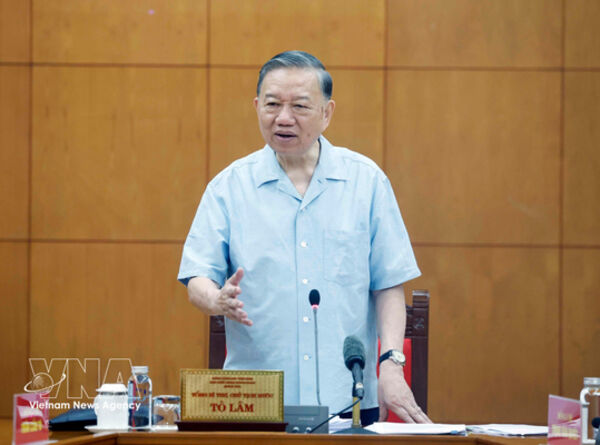
In his opening speech, Politburo member Prof. Dr. Nguyen Xuan Thang, who chairs the Central Theory Council, serves as deputy head of the Steering Committee, and leads the editorial team, said the gathering reflects the urgency of following directives issued by Party General Secretary and State President To Lam at the Steering Committee’s first session while also mapping key discussion priorities.
HCMA President Assoc. Prof. Dr. Doan Minh Huan, who is Politburo member, deputy head of the Steering Committee and standing deputy head of the editorial team, underlined the review’s significance. He called for a balanced approach that combines historical analysis with theoretical and practical evaluation, urged members to work proactively, maintain confidentiality, avoid excessive specialisation, and widen involvement by drawing in experts and cross-disciplinary perspectives.
Participants agreed that Party leadership has been the decisive factor of Vietnam’s revolutionary achievements. They underscored the historical trajectory, development principles, and lessons distilled from the revolutionary process under the CPV’s leadership.
Regarding the assessment of the 40-year implementation of the Platform, they stressed the need to tackle pressing theoretical and practical issues and proposed updates and additions to the platform to meet the demands of a new era.
The review, they said, should be comprehensive but sharply focused, build on findings from earlier evaluations, and provide the editorial team with the documentation and information it needs to work effectively.
Concluding the event, Thang described the review as a major strategic political task, adding that the process must deliver historical depth, theoretical vision, and strategic foresight to guide Vietnam toward fast and sustainable development in the decades ahead.
The editorial team was instructed to finalise documents, assign clear responsibilities and deliverables, and keep the review on schedule./.