 |
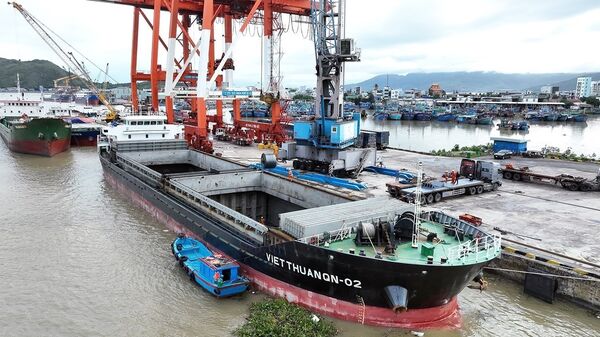
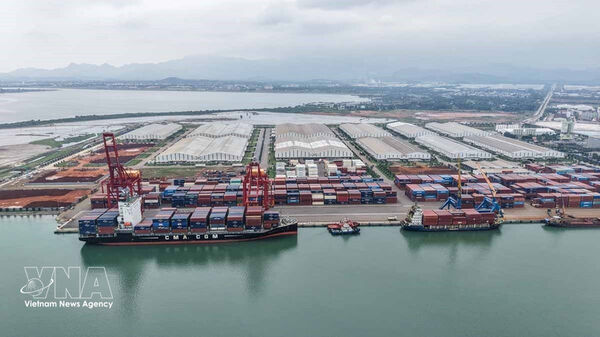
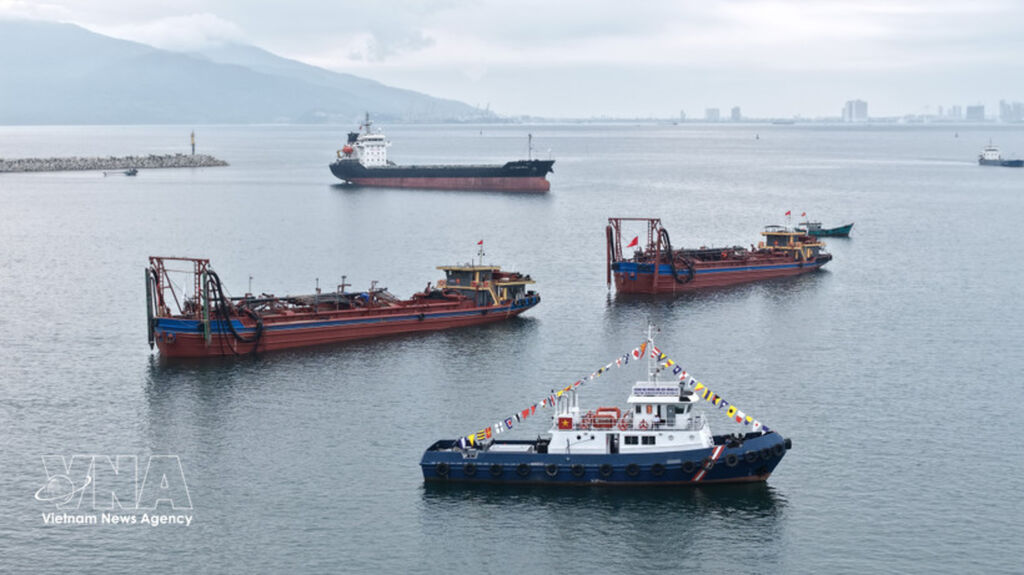
| A view of the Lien Chieu Container Port construction project in Da Nang city (Photo: VNA) |
Hanoi (VNA) - As global supply chains are being reshaped, Vietnam’s logistics sector is emerging as a potential new growth engine, with the capacity not only to cut costs but also to reposition the country from a transit point into a regional hub for supply chain organisation, production and trade connectivity across ASEAN.
Amid sweeping restructuring in global trade driven by digitalisation, green transition and geopolitical shifts, logistics is no longer a back-end function. It is increasingly a decisive factor in economic performance, especially as Vietnam deepens integration into international supply chains. The challenge now extends beyond faster delivery to building a modern and interconnected logistics ecosystem capable of organising supply chains at a regional scale.
In this context, the Prime Minister’s issuance of the logistics services development strategy for 2025–2035, with a vision to 2050, signals a pivotal shift in Vietnam’s development mindset as for the first time, logistics is defined not merely as a supporting service but as a strategic pillar of national competitiveness.
The strategy sets out concrete targets, including annual growth of 12–15%, reducing logistics costs to 12–15% of GDP, accelerating digital transformation, and developing at least five logistics centres of international standards. Authorities have also moved quickly to translate policy into action, rolling out implementation plans with clear responsibilities and timelines.
According to Deputy Minister of Industry and Trade Nguyen Sinh Nhat Tan, logistics is no longer merely about transportation, and it has evolved into a yardstick of economic competitiveness. He stressed that strengthening linkages to form end-to-end supply chains is essential to help Vietnamese goods expand market access and integrate more deeply into global networks, particularly as Vietnam emerges as a new manufacturing hub in Asia.
However, despite its strategic geo-economic location, Vietnam’s logistics sector continues to face bottlenecks, including high costs, fragmented infrastructure connectivity across road, rail, seaports and inland container depots, and weak regional coordination.
Deputy Director of the MoIT’s Agency for Domestic Market Surveillance and Development Bui Nguyen Anh Tuan noted that the most significant breakthrough lies in developing logistics centres as convergence points for infrastructure, markets, services, data and supply chains. The priority is to establish regional and inter-regional hubs linked with seaports, dry ports, border gates, railways, expressways and e-commerce platforms, avoiding scattered investment while creating large-scale nodes capable of connecting regional and global supply chains.
From a business perspective, many opinions highlight that the new logistics strategy is opening up significant opportunities for domestic firms to engage more deeply in global supply chains.
Tran Ngoc Khanh, General Director of OPL Logistics JSC, noted that the strategy is not merely a policy direction but a real turning point, enabling local logistics companies to shift from fragmented service models to large-scale infrastructure investment. The Government’s prioritisation of developing logistics centres linked with seaports, inland container depots and intermodal railways is seen as a key opportunity for Vietnamese enterprises to integrate further into global value chains.
Nonetheless, challenges persist, including limited connectivity infrastructure, insufficient incentives for green transition, and fragmented data systems among regulatory agencies. In the future, smart logistics will require not only data exchange but also the application of artificial intelligence to ensure seamless, transparent and optimised supply chains.
Nguyen Le Hang from SLP Vietnam, highlighted that green logistics and modern infrastructure deliver three key benefits - cost efficiency, speed and adaptability. She said that compliance with green standards, clean energy use and transparent emissions data is increasingly becoming a “passport” for businesses to access major international clients, attract investment and enhance their position in global supply chains.
At the local level, major economic centres are actively positioning themselves within the national logistics network. Ho Chi Minh City aims to become an international logistics hub, Hanoi is focusing on urban logistics, while Hai Phong is advancing port-based logistics and green transport. However, experts said without stronger regional coordination, the risk of fragmented and inefficient investment remains high.
They agree that developing a green, smart, tiered and interconnected logistics system will significantly boost national competitiveness by lowering logistics, production and export costs. This is particularly critical as Vietnam targets rapid and sustainable growth in the 2026–2030 period.
With coordinated efforts in institutional reform, infrastructure development, digitalisation, green transition and regional linkages, logistics is poised to become a new growth engine. More importantly, it offers Vietnam an opportunity to move beyond being a transit point to becoming a regional hub for supply chain organisation, enhancing its role as a key connector of production, trade and logistics in ASEAN./.