 |
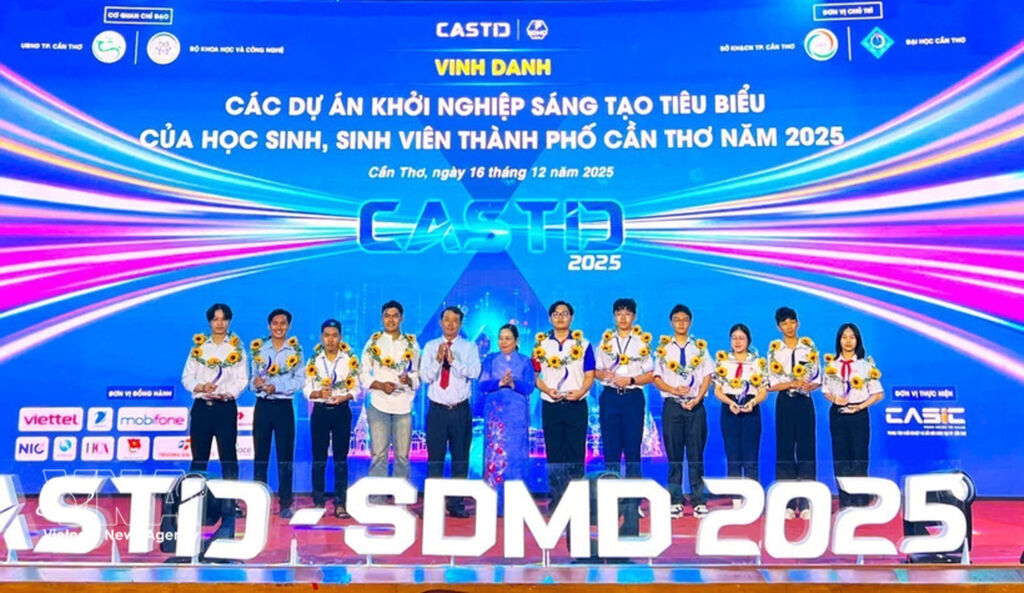
| Students in the Mekong Delta city of Can Tho are honoured for their outstanding performance in startup activities. (Photo: VNA) |
Hanoi (VNA) – The Ministry of Education and Training has issued a plan to implement a programme on supporting student entrepreneurship in the 2026-2035 period, aiming to develop a comprehensive startup ecosystem across the education sector.
The new plan builds on the outcomes of the previous project while shifting the focus from individual startup activities to the development of an integrated and sustainable entrepreneurship ecosystem.
Unlike the earlier phase, which mainly concentrated on communications campaigns, training programmes, startup competitions, entrepreneurship festivals, support centres and funding assistance, the new strategy seeks to strengthen links among schools, businesses, investors and localities, while promoting startup models within educational institutions.
One notable feature of the plan is the introduction, for the first time, of controlled pilot mechanisms, or “sandboxes”, for startup and spin-off enterprises established within educational institutions. The ministry will also issue guidance on intellectual property rights, management and benefit-sharing mechanisms related to research products and startup projects developed by teachers and students.
The programme also includes measures to support small- and medium-sized enterprises originating from educational institutions, while expanding networks of mentors, businesses, angel investors, alumni and startup support organisations. Sector-based mentor-investment-commercialisation chains are expected to be gradually established to better support startups throughout their development process.
A key target under the new plan is the establishment of five digital technology incubators, or Deeptech Hubs, at universities and research institutes with strong potential. The ministry also plans to launch a training programme for 1,000 outstanding technology entrepreneurs and develop criteria for selecting and supporting startup ecosystems within educational institutions.
Compared to the previous phase, the 2026-2035 plan places greater emphasis on standardising entrepreneurship support activities across schools and training institutions.
The ministry will develop a list of minimum support services, evaluation criteria for innovative startup activities, and entrepreneurship competency standards for consultants, lecturers, teachers and students. Teaching materials, training resources and startup support personnel will also be standardised.
In addition, the education sector plans to introduce digital platforms supporting entrepreneurship, including information portals, monitoring and reporting systems, databases of projects and mentors, and shared data systems serving programme management and implementation.
The programme will prioritise key technical fields, strategic technologies, cultural industries, green startups and the circular economy, while promoting entrepreneurship education linked with career orientation, experiential learning and STEM and STEAM education at schools./.