 |
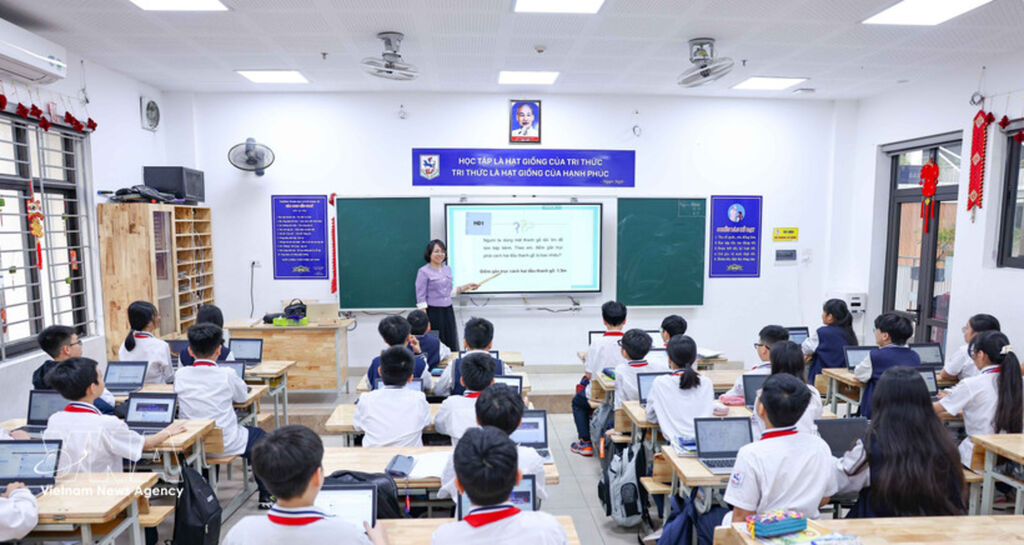
| “Google Digital Classroom”, a space that inspires passion and builds core digital skills for students. (Photo: VNA) |
Hanoi (VNA) – Hanoi is accelerating plans to expand its high-quality school system while tightening output benchmarks, aiming to build a genuinely high-performing network capable of spearheading wider education reform.
In addition to 23 accredited institutions, the city plans to establish 37 more, lifting the total to 60. The move signals a shift in approach rather than a mere technical adjustment, aligning with the Politburo’s Resolution 71-NQ/TW on education breakthroughs and Hanoi’s Action Programme 05-CTr/TU.
Key reforms
Of the current 23 schools, 17 are public, and six are private. The model has already shown clear results, particularly in upgrading facilities, reducing class sizes and enhancing curricula, contributing to improved quality.
These schools have also led innovation in teaching methods, creating ripple effects across the broader public system by promoting digital adoption and competency-based learning. At the same time, they have broadened options for parents and helped ease pressure on top-tier schools.
In the next phase, expansion will focus on areas with favourable socio-economic conditions. The State will continue to guarantee baseline standards, while parents contribute to premium services, with transparent quality commitments in place.
Deputy Director of the Hanoi Department of Education and Training Pham Quoc Toan said the model will move from input-based management to end-to-end quality governance, shifting from rigid criteria to an open standards framework grounded in national level-2 benchmarks, while allowing schools to surpass these standards and build distinct identities.
Curricula will blend core and advanced content, designed to be open, integrated and competency-focused, with emphasis on foreign languages, STEM, digital skills, arts, and sports. Quality control will also be strengthened through regular monitoring and the potential withdrawal of accreditation if standards are not maintained.
The additional 37 schools will comprise four preschools, 12 primary schools, 13 lower secondary schools and eight upper secondary schools. Selection will be based on existing capacity, readiness for implementation and social demand, ensuring alignment with the city’s overall education planning.
Broader access, balanced development
The expansion plan has attracted strong attention from parents, a timely response to growing demand for high-quality education. With a clear roadmap, effective quality oversight and appropriate support mechanisms, it is expected to widen access and raise system-wide standards.
Pham Hai Luong from Nghia Do ward said increasing the number of such schools would give families more choice, rather than concentrating demand on a handful of elite institutions. However, he stressed the need for stringent quality control across teaching staff, curricula and infrastructure, along with reasonable tuition policies to ensure equity.
Nguyen Thi Hanh from Thach Ban ward shared similar views but warned against gaps between inner-city and suburban areas, emphasising the need to improve mainstream public schools to ensure broader impact.
Vice Chairwoman of the Hanoi People’s Committee Vu Thu Ha noted that the high-quality school model is a distinctive feature under the Capital Law and relevant Politburo resolutions. After more than a decade of piloting, she said a clearer, more substantive approach is needed to expand access.
Under the revised model, schools will be organised by service areas rather than administrative boundaries or enrolment zoning, enabling students to access better learning environments locally. Hanoi targets around 150 high-quality schools by 2030, equivalent to about 5% of the total, with implementation beginning from curriculum design aligned with the 2018 general education programme, ensuring no added academic burden on students./.