 |
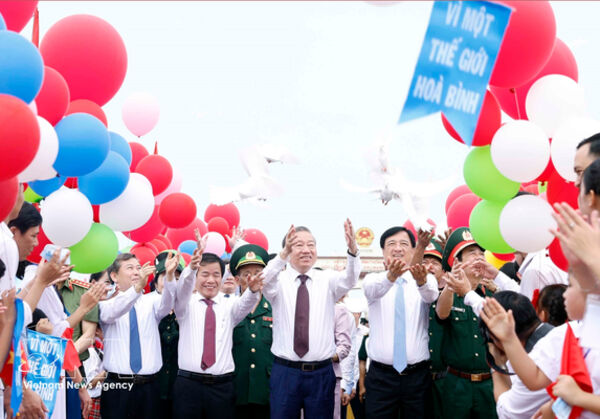
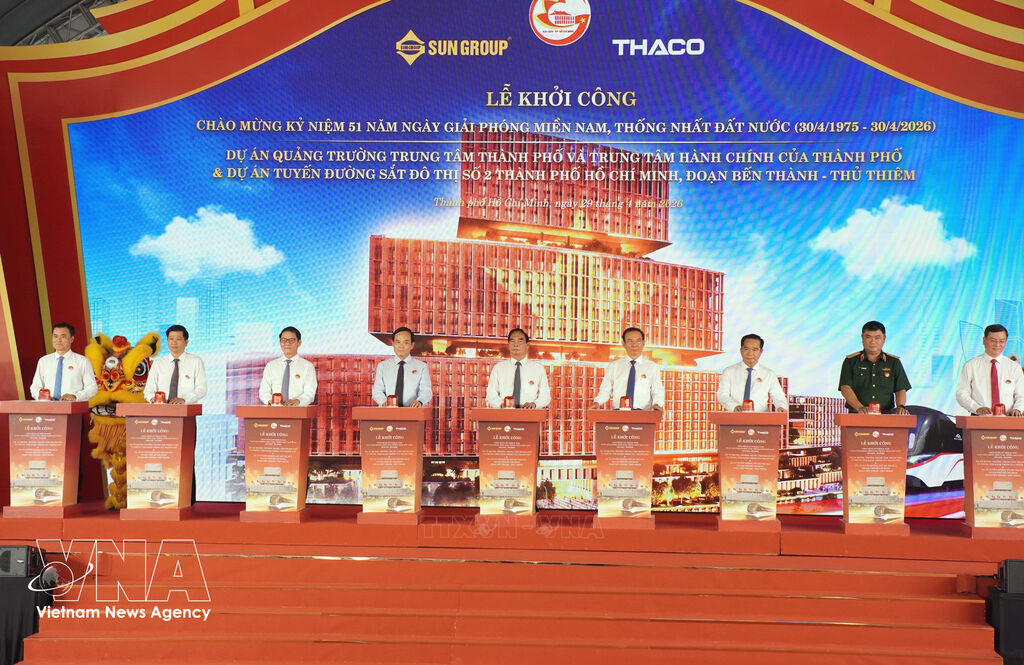
| The groundbreaking ceremony for the Ho Chi Minh City Central Square and Administrative Centre project, and Metro Line No.2 (Ben Thanh – Thu Thiem section) on April 29. (Photo: VNA) |
Ho Chi Minh City (VNA) – The People’s Committee of Ho Chi Minh City on April 29 held a groundbreaking ceremony for four large-scale projects, marking the 51st anniversary of the Liberation of the South and National Reunification (April 30, 1975 – 2026).
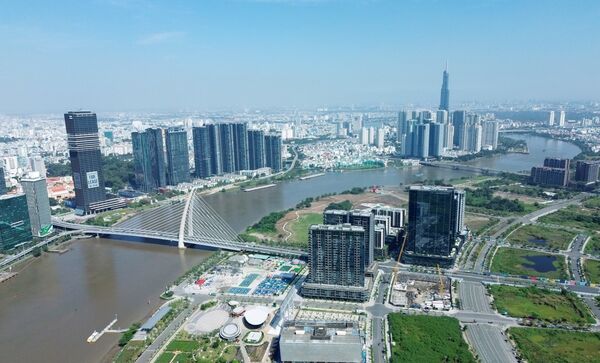
At the Thu Thiem new urban area, city leaders pressed the button to commence construction of two projects: the city's central square and administrative centre, and the Metro Line No.2's section from Ben Thanh to Thu Thiem.
These two projects are designed to serve as strategic landmarks for Thu Thiem, which is set to become the new administrative centre of Ho Chi Minh City, as well as a hub for international finance and trade. The city central square and administrative centre project, covering nearly 47 hectares in the core area of Thu Thiem (An Khanh ward), will provide administrative services and serve national and community interests. It is planned for implementation between 2026 and 2028, with a total investment of nearly 29.6 trillion VND (1.16 billion USD).
In its first phase, the central square component has been commenced with an investment of over 733 billion VND (28.7 million USD). The square is expected to accommodate approximately 268,000 people for political events and up to 500,000 for cultural activities, forming a major civic space alongside parks and landscape features along the Saigon River.
Meanwhile, the Ben Thanh – Thu Thiem rail line, an extension of Metro Line No.2 (Ben Thanh – Tham Luong), has a total estimated investment of 46.295 trillion VND (1.81 billion USD). Stretching 6.2 km with six underground stations, the route will begin at Ben Thanh Station, run beneath Ham Nghi street, and cross the Saigon River to Thu Thiem. The project is targeted for completion by 2030, in parallel with the Ben Thanh – Tham Luong section, whose construction kicked off in January 2026.
According to municipal authorities, the urban railway will play a critical role in linking the existing city centre with Thu Thiem, while also connecting to key transport corridors such as the Thu Thiem – Long Thanh railway, thereby enhancing access to Tan Son Nhat and Long Thanh International Airports.
In addition to transport and urban expansion, the city is promoting cultural and educational infrastructure. Projects include the renovation and expansion of the Ho Chi Minh Museum – Ho Chi Minh City branch and the development of the International University Urban Area.
The development of the Nha Rong – Khanh Hoi port area and expansion of the Ho Chi Minh Museum's heritage area will cover approximately 39.5 hectares, with a total investment of over 20 trillion VND (784 million USD). The first phase will focus on a 9-hectare core zone at Nha Rong wharf, with an estimated cost of over 1.22 trillion VND, including public spaces, parks, and essential infrastructure.
The International University Urban Area in Xuan Thoi Son commune is planned as an integrated urban zone combining education, research, and innovation, with a projected population of 135,000 residents and 60,000 students. It is expected to become operational by 2035.
On the occasion, the municipal People’s Committee granted a decision approving the investor of the 129 trillion VND (5 billion USD) Can Gio international transshipment port project to a consortium comprising Vietnam Maritime Corporation, Saigon Port JSC, and Terminal Investment Limited Holding S.A.
Speaking at the event, Chairman of the municipal People’s Committee Nguyen Van Duoc said the projects will help shape a megacity of regional and international stature. They are expected to establish a modern governance framework, improve public service delivery, develop a highly connected public transport system, and create cultural spaces that balance modern development with heritage preservation.
Implemented under public-private partnership (PPP) models, following build-transfer (BT) contracts, the projects involve major domestic private corporations such as Vingroup, Sun Group, and THACO. Their participation highlights the growing role of the private sector in Ho Chi Minh City infrastructure development. The projects are expected to generate strong momentum for the city’s next phase of growth./.