 |
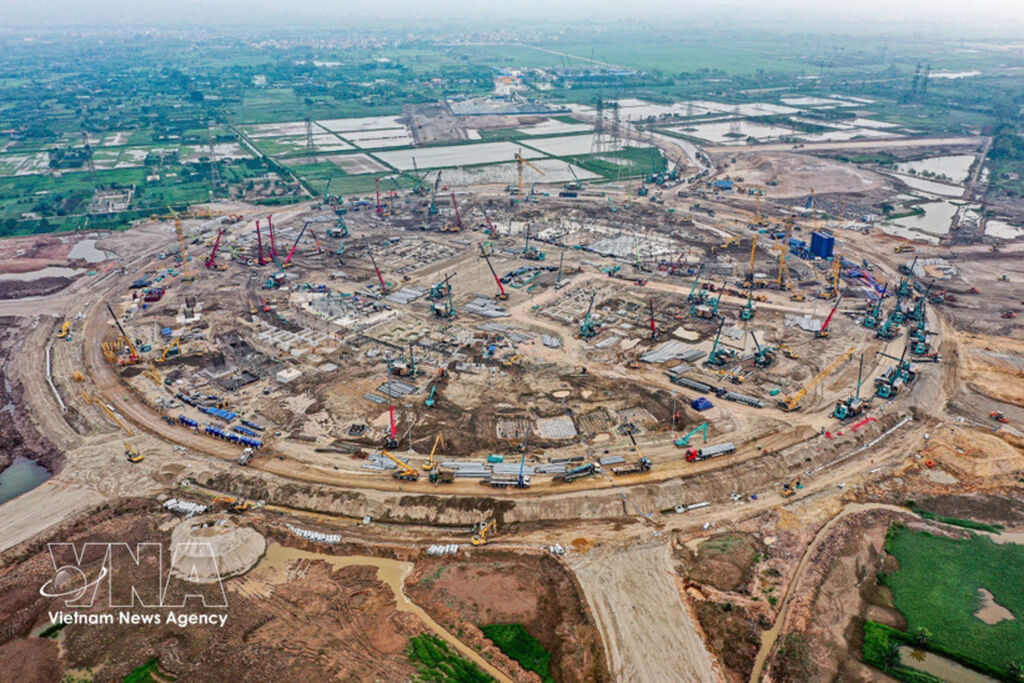
| A panoramic view of the Trong Dong Stadium's construction site in Hanoi. (Photo: VNA) |
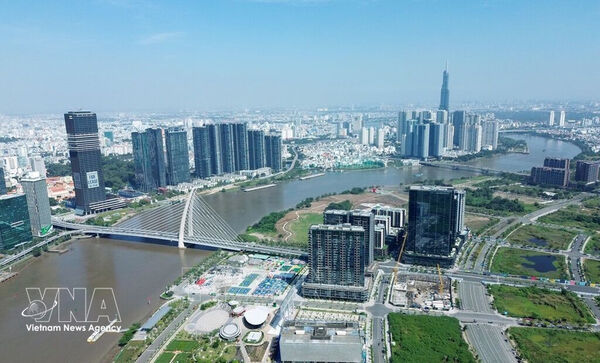
Ho Chi Minh City (VNA) - Hanoi and Ho Chi Minh City have been ranked among the top five fastest-growing urban centres in the world, according to a newly released Growth Hubs Index ranking by Savills.
The recognition underscores Vietnam’s rising role in regional and global value chains, driven by strong structural advantages and accelerating urban development.
Vietnam emerges thanks to structural advantages
The index, which evaluates 245 cities worldwide, highlights Asia as the primary engine of global urban growth over the next decade, supported by favourable fundamentals such as a young population, rapid urbanisation, and ongoing shifts in global manufacturing.
In this context, Vietnam stands out prominently as Ho Chi Minh City ranks second globally, while Hanoi takes fifth place in the growth potential ranking. The simultaneous presence of both Vietnamese megacities in the global top tier reflects not only strong growth potential, but also the country’s increasingly prominent role in regional value chains.
Chris Marriott, CEO of Savills Southeast Asia, noted that a young demographic is providing a powerful impetus for regional economies. A plentiful labour force, rising consumption, and accelerated urbanisation are driving demand across various real estate segments, ranging from industrial and logistics to residential and mixed-use developments.
Furthermore, the “China + 1” strategy continues to accelerate the wave of manufacturing relocation to emerging markets, with Vietnam emerging as a premier destination. The steady influx of foreign direct investment (FDI) is not only bolstering the manufacturing base but also creating a spillover effect on the real estate market, particularly in Ho Chi Minh City and Hanoi, which serve as the country’s primary hubs for infrastructure, labour, and consumer demand.
However, Savills cautioned that rapid growth alone does not guarantee long-term appeal. Reports on “Resilient Cities Index" indicated that established global leaders such as New York, Tokyo, London, and Seoul all share a common ability to balance economic expansion with quality of life, while continuously investing to enhance their overall competitiveness.
Increasingly, resilience is no longer a theoretical concept but a practical benchmark for evaluating a city. This encompasses economic foundations, technology ecosystems, Environmental, Social, and Governance standards, and the quality of the living environment. Crucially, the actual execution of development strategies is emerging as a key factor.
Neil MacGregor, CEO of Savills Vietnam, remarked that Vietnam possesses all the drivers to maintain high growth, from infrastructure and foreign investment to domestic demand. He noted that markets that can transform plans into reality will be the ones to capture the opportunities.
Infrastructure - a lever for transforming growth into resilience
As resilience is increasingly becoming a core benchmark for global cities, infrastructure is seen as a foundational factor enabling Vietnam to transform its growth potential into sustainable development capacity.
A large-scale wave of public investment is gradually reshaping the market structure. With around 234 infrastructure projects underway, representing an estimated total investment of about 3.4 quadrillion VND (over 129 billion USD), major works such as Long Thanh International Airport, metro systems in Hanoi and Ho Chi Minh City, and more than 380 km of newly operational sections of the North–South expressway are creating new economic development corridors.
Apart from improving connectivity, infrastructure is also reshaping urban space and investment flows. Satellite areas around Hanoi and Ho Chi Minh City are gradually emerging as new growth poles, while industrial real estate is directly benefiting from the development of integrated manufacturing and logistics ecosystems.
Notably, the impact of infrastructure goes beyond “hard infrastructure.” Factors such as quality of life, the environment, education and healthcare, often regarded as “soft infrastructure,” are increasingly influencing decisions by businesses and high-skilled labour forces. These elements are also becoming core components of a city’s long-term competitiveness.
Against the backdrop of the global growth centre continuing to shift toward Asia, Vietnam is targeting double-digit economic growth, anchored on two key pillars - infrastructure investment and FDI inflows. However, as experts note, the decisive factor lies not only in the scale of investment but also in implementation efficiency, ranging from project timelines and the legal framework to the financial environment.
In the long term, with a stable economic foundation, sustained positive FDI inflows, and rapid urbanisation, the market outlook remains highly positive./.