 |
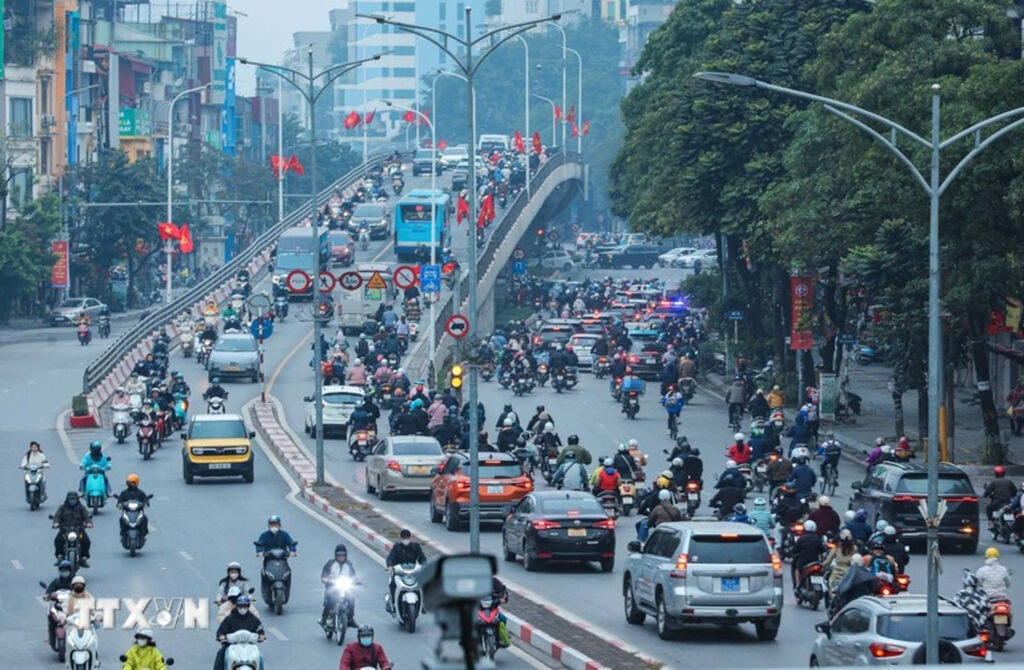
| HanoiAir can forecast air quality trends over time and across locations, helping authorities guide and implement pollution control measures. - Illustrative image (Photo: VNA) |
Hanoi (VNA) – Air quality in some areas of Hanoi on January 8 was at unhealthy levels, prompting warnings for residents, especially the elderly, children, and those with underlying conditions such as cardiovascular or respiratory diseases, to limit outdoor activities, according to readings from Hanoi’s early air quality forecasting system (HanoiAir).
HanoiAir is an early air quality forecasting system developed experimentally by the municipal Department of Agriculture and Environment in collaboration with the National Centre for Hydro-Meteorological Forecasting and the University of Engineering and Technology under the Vietnam National University – Hanoi (VNU-Hanoi).
The system can forecast air quality trends over time and across locations, helping authorities guide and implement pollution control measures.
In early January, Hanoi’s air quality has been deteriorating. Forecasts indicate that the city’s average air quality index (AQI) from January 9–13 will rise compared to last week, with a peak of 114 on January 10 and 139 on January 11, reaching unhealthy-for-sensitive-groups levels. The southern, southwestern, and northwestern areas of the capital city are expected to be the most affected.
These figures highlight the real risk of worsening air pollution without early warning systems and timely response mechanisms, especially as Hanoi continues to expand infrastructure and upgrade urban areas.
Apart from providing information, Hanoi’s early air quality forecasting system serves as a tool to trigger concrete management actions. Based on the forecasts, the municipal Department of Agriculture and Environment has issued guidance urging relevant agencies, localities, and units to implement urgent measures to curb pollution sources.
Vu Xuan Tung, Deputy Director of the municipal Department of Agriculture and Environment, said the early air quality forecasting system is not merely for “reference” but serves as a crucial tool for practical management and decision-making.
According to the department, winter–spring air pollution episodes develop rapidly and are strongly influenced by adverse weather conditions. Without early forecasts, authorities risk being reactive, reducing the effectiveness of pollution control measures.
Tung said HanoiAir is an important step for the capital city in shifting from reactive responses to scenario-based management. He added that based on the forecasts, the municipal Department of Agriculture and Environment will coordinate with relevant agencies and local authorities to proactively implement urgent tasks under Directive No. 19 off the municipal People’s Committee, ensuring continuous and sustained actions rather than short-term measures.
According to the Hanoi Department of Agriculture and Environment, AQI readings have at times reached poor and very poor levels. Key pollution sources include transport, industrial and construction activities, along with the burning of straw and household waste.
Hanoi has affirmed its commitment not to trade environmental protection for economic growth. The city is moving to establish low-emission zones (LEZs) as a core measure to control emissions and promote green, sustainable urban development, in line with Resolution No. 57/2025/NQ-HDND of the municipal People's Council and the 2024 Capital Law./.