 |
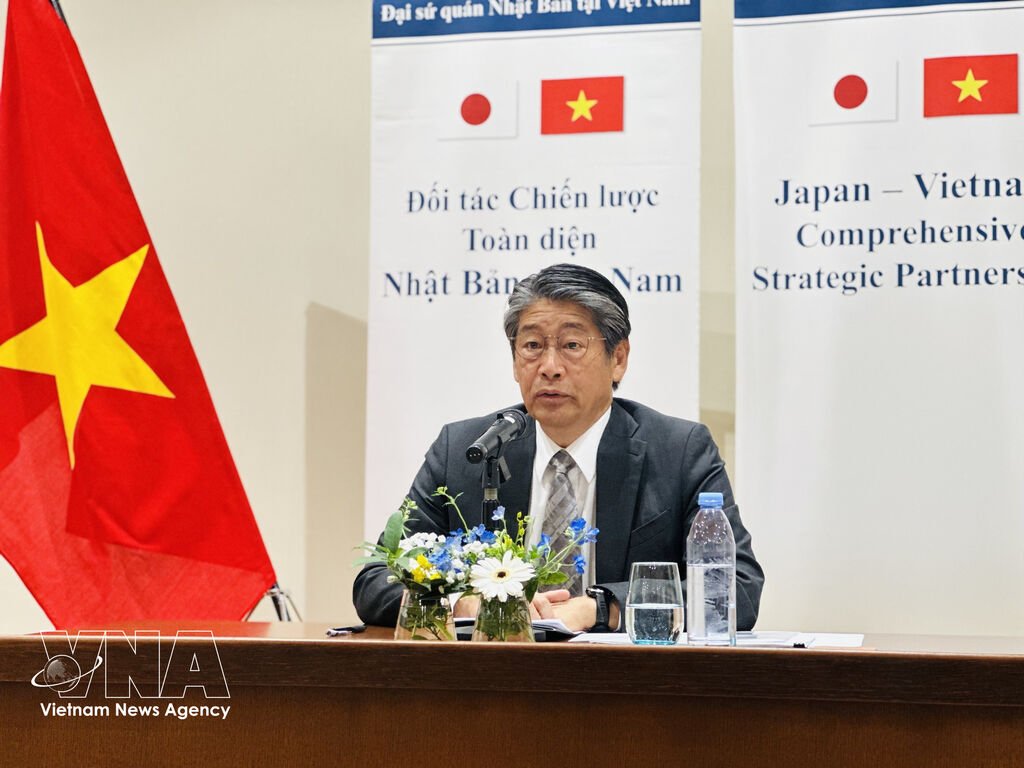
| Japanese Ambassador to Vietnam Ito Naoki (Photo: VNA) |
Hanoi (VNA) — The upcoming official visit to Vietnam by Japanese Prime Minister Takaichi Sanae from May 1-3 will help bring bilateral relations to a new height, according to Japanese Ambassador to Vietnam Ito Naoki.
Speaking at a press briefing with Vietnamese media on April 28, Ito Naoki described the trip as highly significant, taking place as Vietnam marks the 51st anniversary of national reunification (April 30, 1975-2026), and reflecting the strong importance the Japanese Government attaches to bilateral relations.
The visit, to be made at the invitation of Prime Minister Le Minh Hung, also comes at a particularly meaningful time as Vietnam has recently completed the consolidation of its government apparatus. Ambassador Ito noted that it has become almost customary for Japanese prime ministers to visit Vietnam within a year of taking office, underscoring Japan’s consistent prioritisation of ties with Vietnam.
The trip aims to build trust between the two countries’ leaders, review the achievements of the Comprehensive Strategic Partnership, and confirm key directions for future cooperation.
Japan deeply admires Vietnam’s remarkable economic achievements during more than 50 years since national reunification, as well as the country’s path of peace and development, the ambassador stated.
He added that the visit will serve as an opportunity for both countries to reaffirm closer coordination within the Comprehensive Strategic Partnership framework, and address regional and global issues of shared concern.
Ito said a key highlight of the visit will be PM Takaichi’s policy speech at the Vietnam National University, Hanoi (VNU-Hanoi) on the Free and Open Indo-Pacific (FOIP) strategy. This will mark the first time a Japanese PM delivers a policy speech in Vietnam since 2020.
The FOIP vision was first introduced by late Japanese PM Shinzo Abe a decade ago, based on the recognition that the Indo-Pacific region would become the centre of global growth. However, over the past decade, the world has changed significantly, with the rise of artificial intelligence (AI) and technological revolutions, the growing prominence of the Global South, and increasingly complex geopolitical developments.
According to the ambassador, PM Takaichi strongly believes that FOIP must evolve to respond to these changes of the times. In particular, economic security has become a major concern for many countries, and building resilient supply chains is now one of the most important priorities.
Choosing Hanoi and the VNU-Hanoi as the venue for the speech carries significant meaning, reflecting Japan’s recognition of ASEAN’s central role, as well as Vietnam’s important position in the region and strong ongoing reforms.
The Japanese ambassador also noted that the visit will focus on four main pillars of cooperation, reflecting the strategic priorities of both countries, including innovation, science and technology, and green transition; energy security and strategic infrastructure; diplomacy, defence and security, and contributions to regional peace; and people-to-people exchanges, and cultural and academic cooperation./.