 |
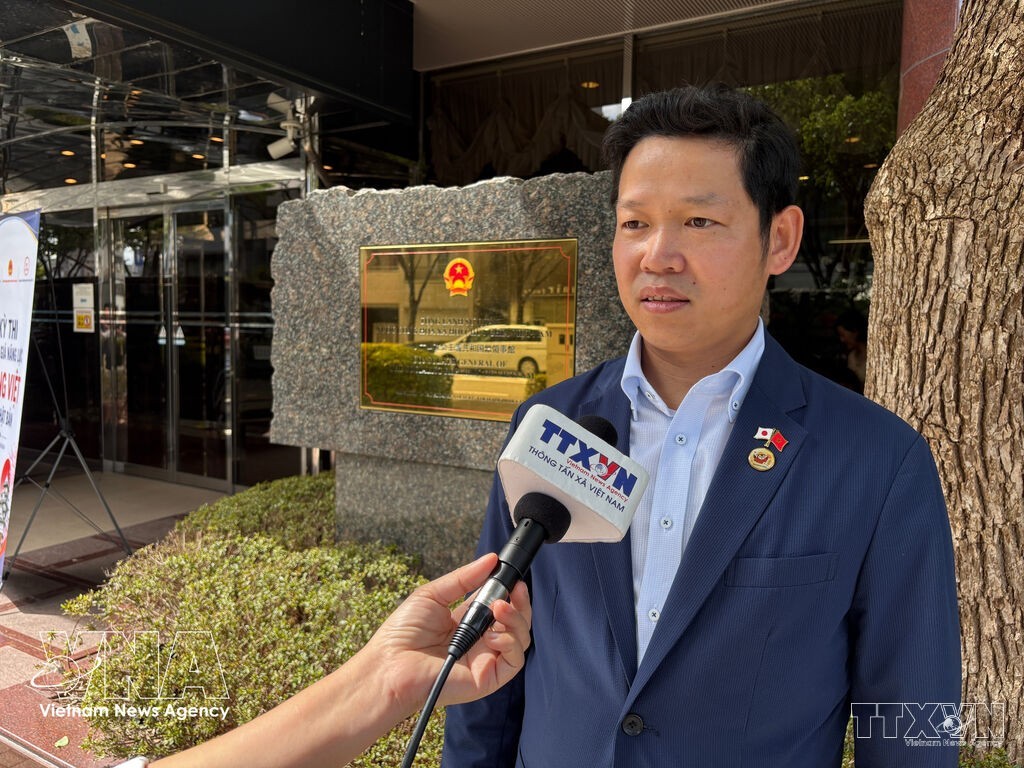
| Tran Trung Kien, Secretary General of the Vietnam-Japan Economic Cooperation Promotion Association (VJECPA), talks to the Vietnam News Agency. (Photo: VNA) |
Tokyo (VNA) – The Vietnamese community in Japan can help build a two-way ecosystem that channels Japanese resources into Vietnam while supporting Vietnamese products, businesses and brands in entering the Japanese market, serving as a substantive economic bridge between the two countries, according to Tran Trung Kien, Secretary General of the Vietnam-Japan Economic Cooperation Promotion Association (VJECPA).
He noted that Japan has many strengths that match Vietnam’s development needs, particularly in technology, manufacturing, supporting industries, automation, high-tech agriculture, healthcare, elderly care, education and training, digital transformation, green industry and the circular economy. Many Vietnamese in Japan work directly in these fields, giving them an important advantage in facilitating knowledge and technology transfer and connecting businesses in the two countries.
According to Kien, a Vietnamese expert in Japan does not necessarily need to return home permanently, but can contribute through technology transfer, human resource training, management consulting or business matchmaking. Likewise, a Vietnamese entrepreneur in Japan can contribute not only capital but also help bring Japanese businesses, technologies and distribution networks into Vietnam.
From the perspective of promoting Vietnam-Japan economic cooperation, Kien said the biggest challenge is not a lack of people willing to contribute, but the absence of effective mechanisms to turn that willingness into concrete cooperation.
A Vietnamese expert in Japan may possess valuable technology or expertise, but bringing those resources to Vietnam raises practical questions over which business or locality needs them, which agency can receive them and what cooperation mechanism should be used. Without suitable intermediaries, those with resources and those in need of them may struggle to find each other.
Commenting on the significance of Resolution No. 23-NQ/TW of the Politburo on overseas Vietnamese affairs, Kien said that one of its highlights is its renewed approach to the position and role of overseas Vietnamese. The resolution identifies them as an integral part of the Vietnamese nation and an important strategic resource that contributes to strengthening national power and serves as a bridge between Vietnam and the world.
He described this as a significant development from the previous approach, particularly as the overseas Vietnamese community has changed considerably. More than 6.5 million Vietnamese now live in over 130 countries and territories, with growing numbers of experts, intellectuals, scientists, entrepreneurs and highly skilled workers, while the community is also becoming younger. Their resources therefore extend beyond investment capital and remittances to knowledge, technology, management expertise, business networks, access to international markets and, importantly, their understanding of both Vietnam and their host countries.
The VJECPA Secretary General welcomed the shift from “mobilising, gathering and supporting” to “accompanying, creating mechanisms and mobilising resources”, saying this will enable overseas Vietnamese to participate more deeply in national development. This is also what Vietnamese businesspeople and experts in Japan hope to see.
To realise the spirit of Resolution 23, Kien held that deeper mechanisms are needed to enable overseas Vietnamese not only to bring resources home but also to accompany domestic businesses and ensure those resources are effectively absorbed and utilised.
Kien said Resolution 23 places a responsibility on organisations such as the VJECPA to become substantive bridges rather than merely facilitating formal connections.
The association can focus on building a network of Vietnamese entrepreneurs, experts and intellectuals in Japan, particularly those with expertise in fields where Vietnam has pressing needs, while developing databases covering Vietnam’s needs and the resources available in Japan, Kien said./.