 |
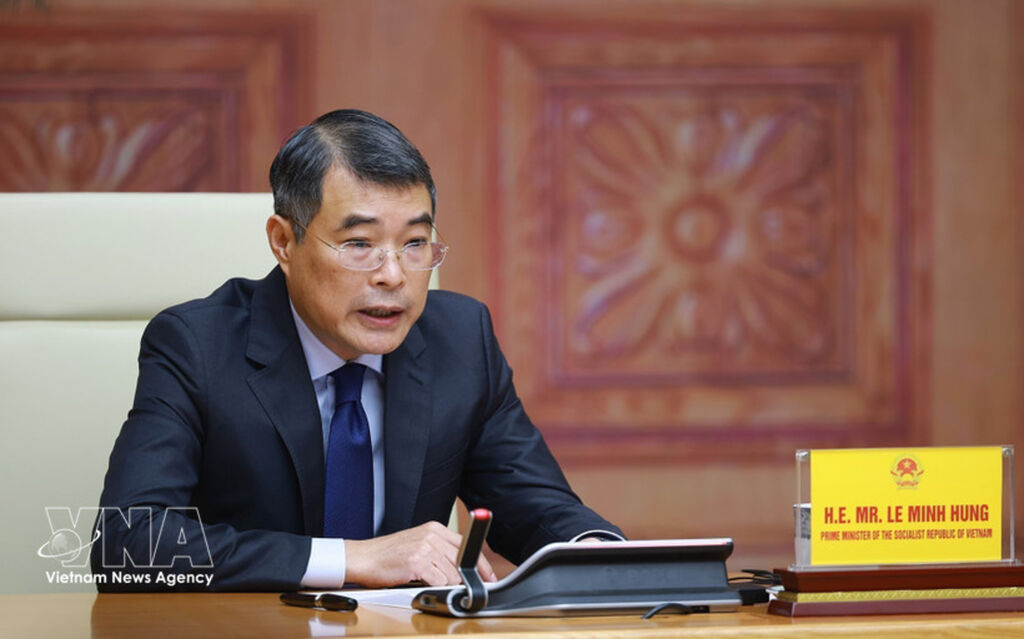
| Prime Minister Le Minh Hung addresses the expanded online summit of the Asia Zero Emission Community (AZEC) on energy security on April 15. (Photo: VNA) |
Hanoi (VNA) – Prime Minister Le Minh Hung proposed three key cooperation directions to address energy challenges and sustain supply chains while attending the expanded online summit of the Asia Zero Emission Community (AZEC) on energy security on April 15.
PM Hung noted that the current energy crisis stems not only from short-term disruptions but also from deeper structural imbalances and intensifying strategic competition among countries, particularly in access to energy resources. He stressed that beyond diversifying energy supply, it is essential to build strategic trust, enhance cooperation and dialogue, and settle disputes through peaceful means in accordance with international law.
The Vietnamese leader reaffirmed Vietnam’s commitment to achieving net-zero emissions by 2050, identifying renewable energy development and green transition as strategic priorities. He proposed three key directions for cooperation to deal with energy risks and ensure supply chains.
He underlined that in the short term, countries should strengthen coordination and policy alignment to diversify energy sources, facilitate trade and ensure stable, uninterrupted supply chains, especially for energy and food.
In the medium and long term, they should enhance strategic autonomy and resilience by developing synchronised energy infrastructure, increasing strategic reserves and promoting technology transfer.
In addition, he called for accelerating the effective and substantive implementation of cooperation projects within the AZEC framework, tailored to each country’s capabilities and conditions.
PM Hung expressed his support for Japan’s proposal to upgrade AZEC to AZEC 2.0 and affirmed that Vietnam would continue to actively and proactively coordinate with Japan and other partners to effectively implement AZEC initiatives, contributing to a greener, more sustainable and more prosperous future for present and future generations.
The summit brought together leaders from 15 countries, including 10 AZEC members – Japan, Australia, Brunei, Cambodia, Indonesia, Malaysia, the Philippines, Singapore, Thailand and Vietnam – along with five guest countries, namely the Republic of Korea, Bangladesh, India, Sri Lanka and Timor-Leste, as well as representatives of the Asian Development Bank and the International Energy Agency.
In her opening remarks, Japanese PM Takaichi Sanae underlined that the meeting was convened amid disruptions to global energy supply chains, which have posed growing challenges to energy security across Asia. She announced that Japan would allocate a 10-billion-USD financial package to support Asian countries in diversifying energy supplies, focusing on urgent measures such as procurement of materials, maintaining supply chains, and strengthening long-term economic and energy resilience. She also proposed upgrading the AZEC initiative to AZEC 2.0 to further enhance energy security and resilience in the region.
Leaders and representatives of international organisations welcomed Japan’s initiative to host the summit in the current context, expressing concern over ongoing supply chain disruptions and underscoring the importance of maintaining open and secure trade routes in line with international law. They also voiced support for AZEC 2.0 and closer cooperation to bolster energy security.
Concluding the meeting, the Japanese PM thanked Vietnam and other participating countries for their insightful contributions and proposals, noting that relevant Japanese agencies will promptly engage with partners to further discuss and operationalise the initiatives put forward at the summit./.