 |
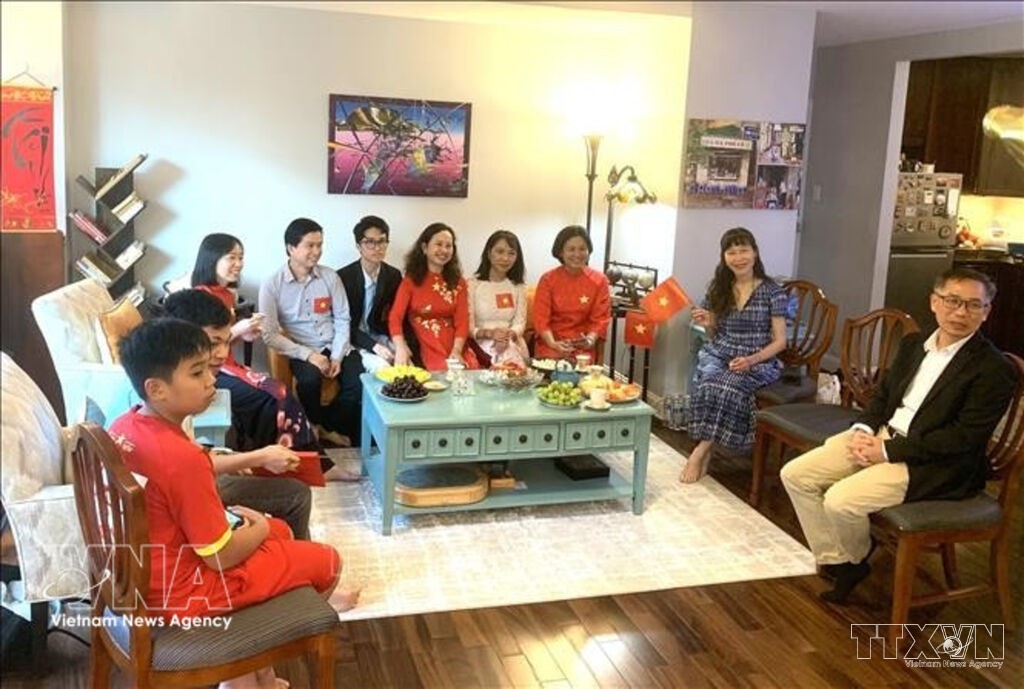
| An OV family in Washington DC, the US, watch a live broadcast of the 80th National Day celebrations in 2025. (Photo: VNA) |
New York (VNA) – The Politburo's Resolution No. 23-NQ/TW on overseas Vietnamese (OV) affairs has been warmly welcomed by Vietnamese people abroad, who consider it as a positive shift in policy direction sparking hopes that their skills, knowledge, and global connections will be further tapped to support the homeland’s development in the new era.
Speaking to the Vietnam News Agency’s correspondent in New York on August 26, Hung Nguyen, a Vietnamese-American living and doing business in Massachusetts, said Resolution 23 provides a timely and more comprehensive policy orientation that reflects the rapid development of OV communities after more than two decades of implementing the Politburo's Resolution No. 36-NQ/TW, issued on March 26, 2004.
He highlighted a significant feature of the new resolution which reaffirms that OVs are an inseparable part of the Vietnamese nation, while elevating their role as “one of the country’s important strategic resources”. This not only recognises the increasingly visible contributions by Vietnamese communities abroad, but also reflects a new approach to harnessing their role in national development, the country's integration into the world and the promotion of its international stature.
Hung Nguyen, a successful entrepreneur in the US, said a notable difference between Resolution 23 and Resolution 36 lies in the shift in policy thinking. While the earlier resolution focused on encouraging OV resources, providing support and enhancing the great national solidarity, the new one places greater emphasis on accompanying OVs, creating favourable mechanisms and effectively mobilising resources from OV communities to assist with the homeland's development.
He perceived that this approach is appropriate to the current context as the more than 6.5 million Vietnamese living abroad are not only large in number but also increasingly strong in professional expertise, scientific and technological capabilities, economic potential, investment capacity, and international networks.
In the US in particular, many Vietnamese have established themselves in technology, health care, education, finance, manufacturing, media and international business. They could make practical and effective contributions to Vietnam through policy advice, research cooperation, technology transfer, high-quality human resources training, investment in innovation and market expansion.
Hung Nguyen said Resolution 23 provides an important political foundation for the Vietnamese community in the US to participate more deeply in the homeland's development. Recognising OVs as a strategic resource and a vital bridge between Vietnam and the world will empower relevant agencies to formulate substantive and long-term policies aligned with their wish and capacity to make contributions.
However, he stressed that the key to turning the resolution into reality lies in translating its broad orientations into concrete mechanisms, policies and action plans. Policies should be favourable, transparent, stable and accessible while reducing procedural barriers that prevent OVs from engaging with Vietnam.
Vietnam could develop programmes that link OV experts by sector and locality, establish networks for policy advice, knowledge transfer, and innovation support, and design mechanisms for investment attraction, research cooperation, and market development that suit OVs' conditions, he suggested.
Another expectation among OVs is that the spirit of “accompanying” Vietnamese people abroad, as stated in the resolution, should be reflected in greater respect and open dialogue. According to Hung Nguyen, building lasting trust requires continued efforts to narrow differences in perception and coordination methods between domestic parties and OV communities.
If the new mechanisms truly foster trust and create favourable conditions, the Vietnamese community in the US in particular, and those worldwide in general, will be further motivated to make long-term, effective, and far-reaching contributions to their homeland, he added./.