 |
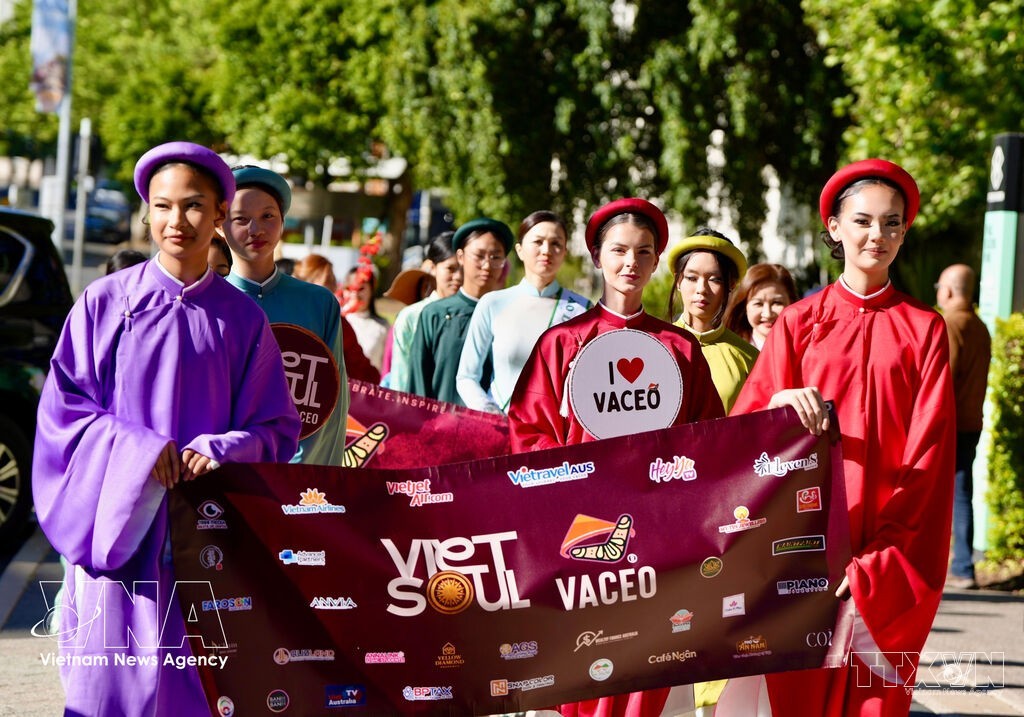
| The Ao dai parade passes through Bankstown Plaza and Bankstown Station before returning to the Bryan Brown Theatre. (Photo: VNA) |
Sydney (VNA) - Colourful traditional Vietnamese Ao dai (traditional long dresses) brought a festive touch to the streets of Bankstown, Sydney, on October 17, as more than 20 Vietnamese people from different generations took part in an Ao dai street parade held as part of the Viet Soul 3 Festival.
The parade was organised for the first time by the Vietnam-Australia Cultural Exchange Organisation (VACEO). Winding through Bankstown, one of Australia's major Vietnamese community hubs, it quickly attracted the attention of passers-by and local residents.
Starting at the Bryan Brown Theatre, the parade passed through Bankstown Plaza and Bankstown Station before returning to its starting point. Over the course of 45 minutes, the traditional dresses stood out amid the streets' weekend bustle, prompting passers-by to stop, smile and take photographs.
One of the parade's highlights was the participation of people from different generations, including children born and raised in Australia, Vietnamese women who had settled in Sydney years ago, workers who had moved to Australia, and older people visiting their children and grandchildren. Despite their different backgrounds, they shared a visible sense of joy and pride as they wore the traditional dresses.
Le Thi Viet Hong, a participant, said she felt proud to wear the traditional dress alongside younger members of the Vietnamese community, and many people along the route had stopped to admire the colourful outfits.
For those with longstanding ties to Vietnam, Ao dai evoked familiar images of their homeland. For children born in Australia, however, the experience offered a new way to explore their cultural heritage.
Sydney Tran said it was her first time wearing Ao dai and walking through Sydney's streets in traditional Vietnamese attire. She felt proud, describing the experience as making her feel like a representative of Vietnamese culture.
Nguyen Hoai Huong, a VACEO member, said organisers had initially expected around 50 participants. However, the Vietnamese community in Sydney is geographically dispersed, making it difficult to gather a large number of people in one place at the same time. Despite the smaller turnout, the enthusiasm of participants and positive reactions from the public exceeded expectations.
"Ao dai is a distinctive symbol of Vietnam. Seeing the Ao dai gracing the streets of Australia brings us not only joy and pride, but also offers a way for us to share Vietnamese culture with the community where we live,” she said.
The parade was among the activities at Viet Soul 3, a community festival celebrating Vietnamese culture and heritage in Bankstown with support from the Australian Government.
Alongside the traditional music and dance programme and the parade, the festival showcased Vietnamese art through Childhood Memories, a lacquer painting collection by artist Tu Quyen, who holds a master's degree in fine arts from Mahasarakham University and has received numerous domestic and international awards.
Organisers also displayed 26 selected works from a painting competition for Vietnamese children living in Australia. Rather than prescribing a fixed way to depict Vietnam or its people, the competition encouraged children to tell stories from their own lives, featuring family members, friends, teachers, neighbours and cultural experiences that had shaped their upbringing.
Through their drawings, the children expressed their connections to Vietnam and depicted Vietnamese identity in diverse ways, reflecting the perspectives of a generation growing up between two cultures./.