 |
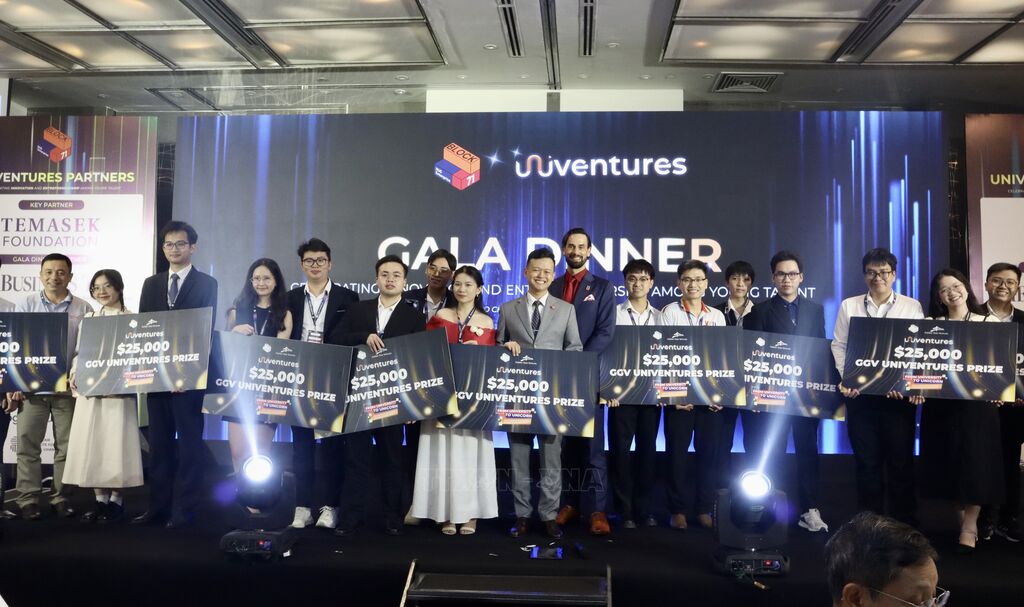
| Top 10 start-ups from Vietnamese universities receive innovation support from Singapore. (Photo: VNA) |
Ho Chi Minh City (VNA) – Ten start-ups founded within Vietnamese universities have been selected for funding and incubation support under UniVentures, a regional innovation initiative led by BLOCK71 Vietnam in partnership with the Temasek Foundation.
The results were unveiled at the UniVentures Gala Dinner held in Ho Chi Minh City on January 29.
BLOCK71 is a global start-up accelerator network operating in 11 cities worldwide, including Ho Chi Minh City, and serves as a key pillar of the start-up ecosystem at the National University of Singapore (NUS). BLOCK71 Vietnam is a strategic collaboration between the NUS and Becamex IDC, Vietnam's leading industrial park developer.
UniVentures seeks to nurture high-potential founders from Vietnamese universities, spanning students, alumni and researchers, who are developing practical, market-ready solutions to urgent regional challenges. Priority areas include healthcare access, environmental sustainability, workforce productivity and skills enhancement, and financial literacy.
UniVentures drew more than 1,400 applications nationwide through a stringent, multi-stage selection process. From this pool, 30 teams advanced to a closed pitching round to compete for the UniVentures Prize sponsored by Golden Gate Ventures, with total awards worth up to 250,000 USD. Ten standout teams were ultimately chosen to receive 25,000 USD each and to join a three-month incubation programme at BLOCK71 Vietnam, offering intensive mentoring, tailored support and market access opportunities. A subsequent phase will target start-ups ready to scale regionally, with prospects for continued incubation at BLOCK71 Singapore.
The selected projects share a strong technology-driven orientation, particularly in artificial intelligence (AI), digital solutions and advanced materials. Their innovations address large-scale, real-world issues across sectors including healthcare, education, legal services, agriculture, energy, environmental protection and public governance.
Among the highlights is EggVision, developed by Ho Chi Minh City University of Technology in collaboration with the University of Economics Ho Chi Minh City, which uses non-invasive computer vision to identify chick sex at the egg stage, reducing the culling of male chicks and cutting costs for hatcheries. MediPath, an AI-powered healthcare start-up founded by a postdoctoral researcher at the University of Da Nang, is building an AI operating system for hospitals to ease administrative workloads and help tackle overcrowding. Another example is Selformy, an AI-enabled learning platform created by alumni of the University of London and Ho Chi Minh City University of Medicine and Pharmacy, designed to help language centres attract learners and streamline operating costs.
Assoc. Prof. Benjamin Tee, Vice President for Innovation and Enterprise at NUS, said every start-up begins with a team of talented and driven individuals. He noted that beyond innovation, the selected projects demonstrate a strong emphasis on sustainability, operational efficiency and commercial viability, underscoring the growing role of universities in generating ideas, talent and technology start-ups in Vietnam. By running early-stage incubation programmes in Vietnam while opening pathways for scaling in Singapore and beyond, UniVentures is further deepening Singapore–Vietnam cooperation and strengthening bilateral innovation flows.
Edward Lim, Country Director of BLOCK71 Vietnam, said UniVentures is founded on the belief that university-born founders are a vital engine of the start-up ecosystem. With the right capabilities, mindset and networks, he said, they can build businesses that create substantial economic value for Vietnam and the wider region. The strong response to the programme, he added, reflects the expanding role of universities as hubs of innovation.
Meanwhile, Vinnie Lauria, Founding Partner of Golden Gate Ventures, remarked that Vietnam’s start-up ecosystem is moving into a new phase of maturity, marked by a stronger focus on market-driven, practical solutions. UniVentures, he said, offers a structured platform that brings together capital, mentorship and regional market access, enabling start-ups to scale beyond the domestic market./.