 |
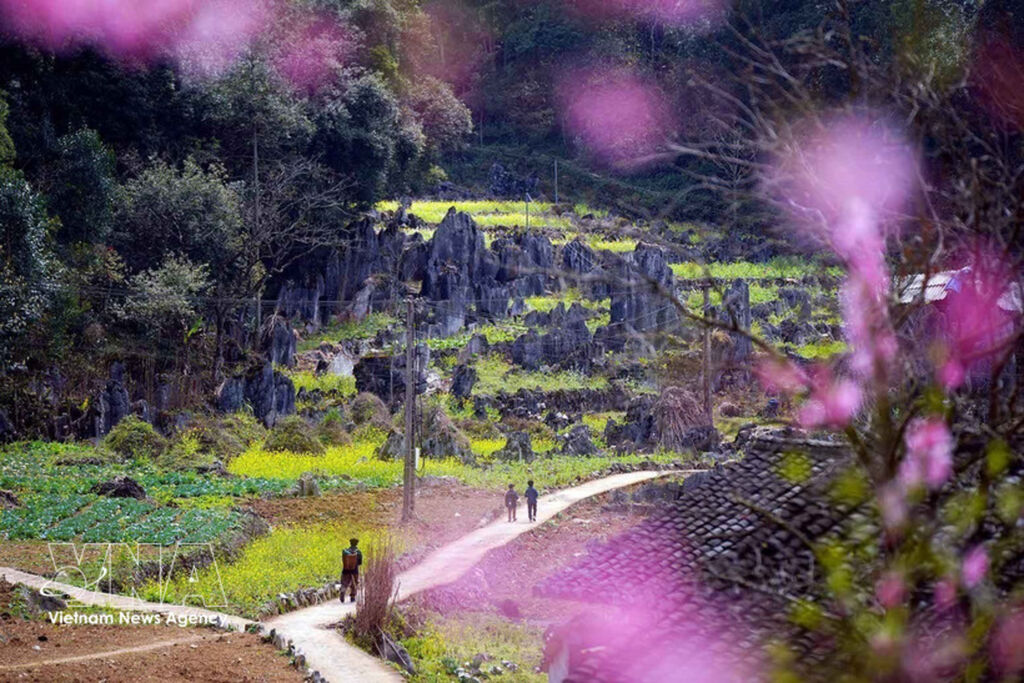
| The Dong Van Karst Plateau is a special heritage landscape where dramatic limestone mountains, local communities, and nature together define the unique character of Vietnam's northernmost region. (Photo: VNA) |
Tuyen Quang (VNA) – Authorities of the northern mountainous province of Tuyen Quang are working to balance biodiversity conservation with local livelihoods as growing populations of wild monkeys in the Dong Van Karst Plateau increasingly damage crops, highlighting the need for long-term solutions that safeguard both wildlife and communities.
The growing populations of rhesus macaques and assamese macaques in Lung Cu, Sa Phin and surrounding areas are seen as a positive sign for biodiversity. However, their increasing presence has also created challenges for local communities whose livelihoods depend on agriculture.
According to local residents and authorities, wild monkeys have been present in the area about 20 years, with their popultion estimated at around 200 individuals. As their population has grown, they have expanded their foraging range into farming areas in villages such as Lung Hoa A, Lung Hoa B, San Si Tung, Ma Lung, Ma Lau, Mo Pai Phin and Lung Thau.
Since late 2023, monkeys have increasingly raided vegetable plots and fruit orchards in Lung Cu, Sa Phin and nearby areas, damaging more than 12 hectares of farmland.
Sung Mi The, a farmer in Sa Phin commune, said vegetables, beans and fruit trees are all vulnerable to monkey attacks. Switching to alternative crops is not an easy solution, as farmers must choose varieties suited to local soil and climate while also being less attractive to wildlife. In the mountainous region, where harvests are already heavily dependent on weather conditions, crop losses directly threaten household food security.
In recent years, local authorities have stepped up public awareness campaigns, urging residents not to hunt or harm the monkeys while providing guidance on protecting crops through non-destructive measures.
Vice Chairman of People's Committee of Sa Phin commune Vang Di Xoang called for a comprehensive assessment of damaged farmland and appropriate support for affected households alongside measures to conserve the monkey population.
He said effective conservation depends on addressing people's concerns. Conservation organisations should conduct detailed surveys to identify practical solutions that promote harmonious coexistence between humans and wildlife.
Reliable data on monkey populations, habitats, migration routes, seasonal feeding patterns, affected crops and the extent of damage are needed to develop appropriate support policies, designate conservation zones, adjust farming practices and build sustainable livelihood models.
According to Dao Duy Tuan, head of the provincial Forest Protection Department, immediate priorities include proposing compensation mechanisms for crop losses while studying policies to help farmers diversify crops and livestock to improve incomes.
He said the approach represents a shift from responding to individual incidents toward managing the long-term relationship between biodiversity conservation and socio-economic development.
The Dong Van Karst Plateau is a unique heritage landscape where dramatic limestone mountains, local communities, and nature together define the unique character of Vietnam's northernmost region. Preserving its UNESCO Global Geopark status is not only a matter of completing documents, but also safeguarding the living heritage found in its villages, forest and diverse wildlife.
Authorities hope that science-based conservation, backed by government policies and community participation, will make efforts to protect the monkey population a model for balancing biodiversity conservation with sustainable livelihoods./.