Vietnamese fruit expands foothold in Chinese market
Thanks to its strategic location bordering Vietnam and other ASEAN countries, Guangxi remains a major gateway for tropical fruit entering China. Chinese media have also identified Vietnamese lychees as one of the country's favourite seasonal fruits.
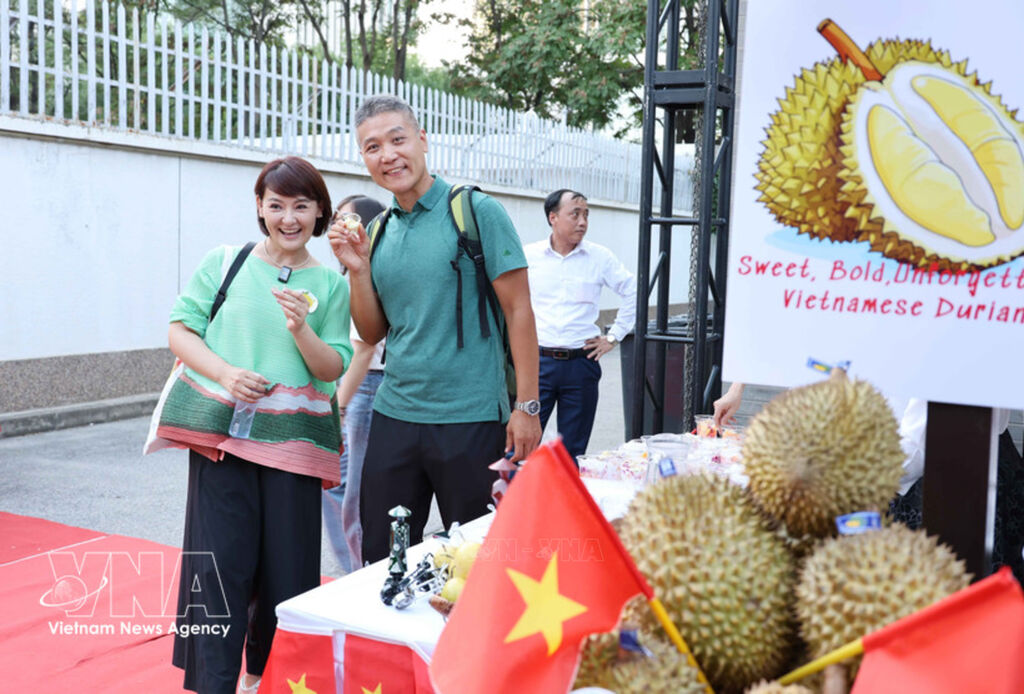
Vietnamese durian is promoted at an event in Beijing. (Photo: VNA)

Beijing (VNA) – Vietnamese fruit is gaining a stronger foothold in China as rising consumer demand, improved cross-border logistics and trade facilitation measures continue to boost exports, Chinese media have reported.

The Economic Daily said imported fruit from the Association of Southeast Asian Nations (ASEAN), including durian, mangosteen and particularly Vietnamese lychees, has become increasingly popular at wholesale markets and fruit retailers in Nanning, capital of China's Guangxi Zhuang Autonomous Region, during the summer season. Monthong durian is currently retailing at 20–25 RMB (about 3–3.7 USD) per 500g, while mangosteen sells for 13–16 RMB per 500g.

Thanks to its strategic location bordering Vietnam and other ASEAN countries, Guangxi remains a major gateway for tropical fruit entering China. Official data cited by the newspaper show that one in every two imported durians sold in China is cleared through Guangxi's border checkpoints. Chinese media have also identified Vietnamese lychees as one of the country's favourite seasonal fruits. Together with durian, dragon fruit, bananas and other tropical produce, Vietnamese fruit is enriching supplies for China's 1.4-billion-strong consumer market.

According to Zhu Yanling, Deputy Director General of the Guangxi Department of Commerce, fruit imports from ASEAN through Guangxi exceeded 40 billion RMB (around 5.9 billion USD) in 2025, an increase of 20% year-on-year, accounting for more than one-third of China's total fruit imports from ASEAN. In the first five months of 2026, the region imported 1.25 million tonnes of fruit from ASEAN, up 13.5% compared with the same period last year.

Chinese media noted that the upgrading of the China-ASEAN Free Trade Area (ACFTA) to Version 3.0, coupled with the implementation of the Regional Comprehensive Economic Partnership (RCEP), is injecting fresh momentum into agricultural trade between China and ASEAN, with Vietnam playing an increasingly important role as a supplier.

To support growing trade flows, Guangxi has expanded infrastructure at the Youyi Guan border gate, Qinzhou Port and Nanning Wuxu International Airport, while establishing 12 monitoring points for fruit imports across road, sea, rail and air routes. Nanning Customs has also rolled out a dedicated "green lane" and smart quarantine procedures for imported fruit, cutting customs clearance times by around 40%.

At the same time, the region has strengthened its cold-chain logistics network through dedicated refrigerated freight services, refrigerated containers and modern cold-storage facilities, helping reduce transport times, minimise spoilage and maintain fruit quality.

Chinese media said ongoing improvements in logistics, customs efficiency and trade promotion are expected to further expand the market share of Vietnamese fruit in China, providing fresh momentum for agricultural trade between the two neighbouring countries./.

VNA
See Also

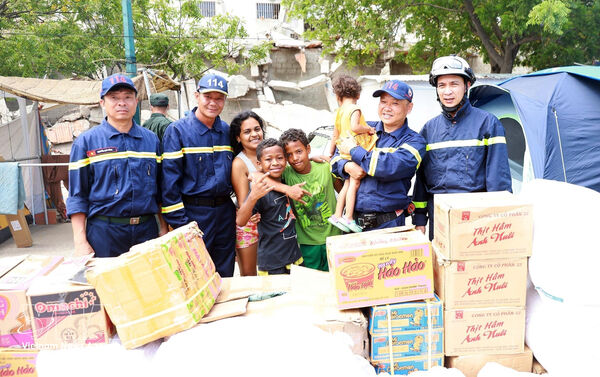
Vietnam's warmth lights up cold night in La Guaira

The earthquake may have broken some of the strongest concrete steel, yet it failed to extinguish the kindness or the resilience forged in solidarity. Together, the La Guaira locals are enduring their longest days, held together by hands that refuse to let go.

Keeping children safe online - an urgent priority

Amid the rapid pace of technological development, particularly the rise of artificial intelligence (AI), efforts to prevent and address online child exploitation have become increasingly complex and challenging. Building a strong protective framework for children in cyberspace has been an urgent priority, providing a secure foundation for future generations to develop safely, confidently, and creatively in an ever-expanding digital world.

Emulation, commendation movements must be tied to concrete targets, tasks: PM

The council reviewed its performance and the implementation of emulation and commendation work during the first half of the year, agreed on key tasks for the remainder of 2026, and considered nominations for the conferment and posthumous conferment of the “Hero of the People's Armed Forces” and “Hero of Labour” titles on collectives and individuals with outstanding achievements.

Hanoi accelerates AI city development

As Hanoi moves to realise its long-term development vision for a new era, the capital is stepping up efforts to attract investment. By signing 50 memoranda of understanding with leading domestic and international corporations and organisations, the city aims not only to expand infrastructure but also to lay the foundation for becoming a modern AI city, with technology serving as a key driver of growth.

Hanoi charts path to multi-centred, multi-layered urban structure

The Government has launched an action programme to develop Hanoi in the new era, putting people at the heart of development and leveraging innovation, green and digital transformation, and the circular economy to drive sustainable growth and strengthen the capital’s competitiveness.

Ho Chi Minh City – Half a century of confidence and aspiration

Half a century has passed since Saigon-Gia Dinh was renamed Ho Chi Minh City in honour of President Ho Chi Minh. Today, the city has not only maintained its role as Vietnam's economic powerhouse but has also gradually established itself as a regional hub for finance, industry and innovation.

Trade promotion: Driving Vietnamese products further afield

Hoang Minh Chien, Deputy Director of the Trade Promotion Agency (Vietrade) under the Ministry of Industry and Trade, said trade promotion activities are undergoing a significant shift from broad-based support to more in-depth assistance, with enhancing business competitiveness at the core.