 |
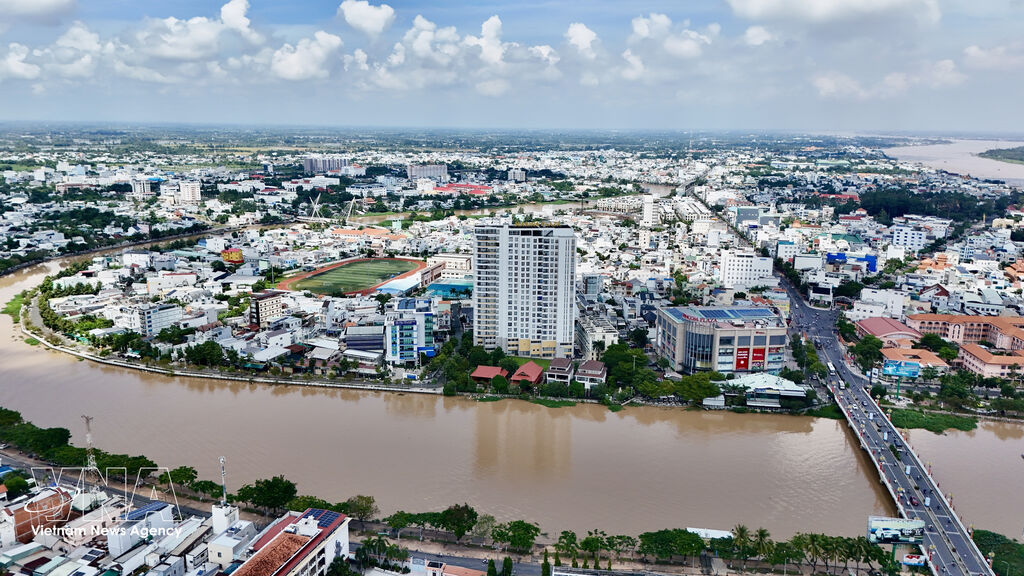
| A corner of Long Xuyen ward in An Giang province, a key trading hub of the Long Xuyen quadrangle region. (Photo: VNA) |
Hanoi (VNA) - Amid global economic uncertainty and growing scepticism about the sustainability of growth, Vietnam’s economy continues to show resilience, maintaining key growth drivers. It is widely seen as a regional bright spot by international institutions, albeit with a cautiously optimistic outlook amid external risks.
In updated reports released in April, international financial institutions and economic organisations maintained an optimistic view of Vietnam’s economic prospects.
According to the Asian Development Outlook (ADO) report released on April 10, the Asian Development Bank (ADB) forecasts Vietnam’s GDP to reach 7.2% in 2026 and remain around 7% in 2027. Sharing this view, the ASEAN+3 Macroeconomic Research Office (AMRO) and United Overseas Bank (UOB) also project growth in the range of 7–7.2%. The World Bank (WB) and HSBC take a more cautious stance, with forecasts of 6.3–6.5%. However, all institutions agree that Vietnam remains among the fastest-growing economies in the region.
This positive assessment is grounded in fundamentals rather than short-term expectations. A key driver is the production and export sector. AMRO highlights that growth is underpinned by export-oriented production and stable foreign direct investment (FDI), reflecting sustained investor confidence amid global supply chain realignment.
UOB also notes that the processing and manufacturing industries maintained strong growth in the first quarter of 2026, demonstrating resilience against external shocks. ADB reported that the country’s Purchasing Managers’ Index (PMI) reached 54.3 points in February, marking the eighth consecutive month above the expansion threshold.
UOB experts said the manufacturing and processing sector continues to play a “locomotive” role in driving industrial growth, despite supply chain disruptions.
Domestic demand is increasingly seen as another stabilising factor. AMRO emphasises that consumption remains steady, supported by fiscal measures such as tax extensions and expanded public investment. ADB also expects continued recovery in the services sector, particularly tourism and technology, providing a crucial buffer against a potential slowdown in external demand from the export sector.
However, the reports also consistently highlight external risks, most notably volatility in energy prices. HSBC warns that Vietnam is highly sensitive to global oil price fluctuations due to its reliance on energy imports. Rising oil prices could intensify inflationary pressure, while increasing production and transport costs.
HSBC projects full-year inflation at around 4.3%, with risks of further escalation if tensions in the Middle East persist. UOB also cautions about potential supply chain disruptions from the Middle East, a key source of inputs for petrochemicals, plastics, and fertilisers. In addition to energy-related factors, the risk of changes in tariff policies from major export markets—particularly the US - remains an unpredictable variable, requiring Vietnam to diversify its markets and trade partners.
International organisations assess that Vietnam’s economy remains stable, but caution that risks stem from rapid credit growth, rising public spending, and vulnerabilities in the financial sector. Nevertheless, flexible fiscal policies, structural reforms, infrastructure investment, and promoted green transition are seen as key factors supporting macroeconomic stability and underpinning sustainable long-term growth./.