 |
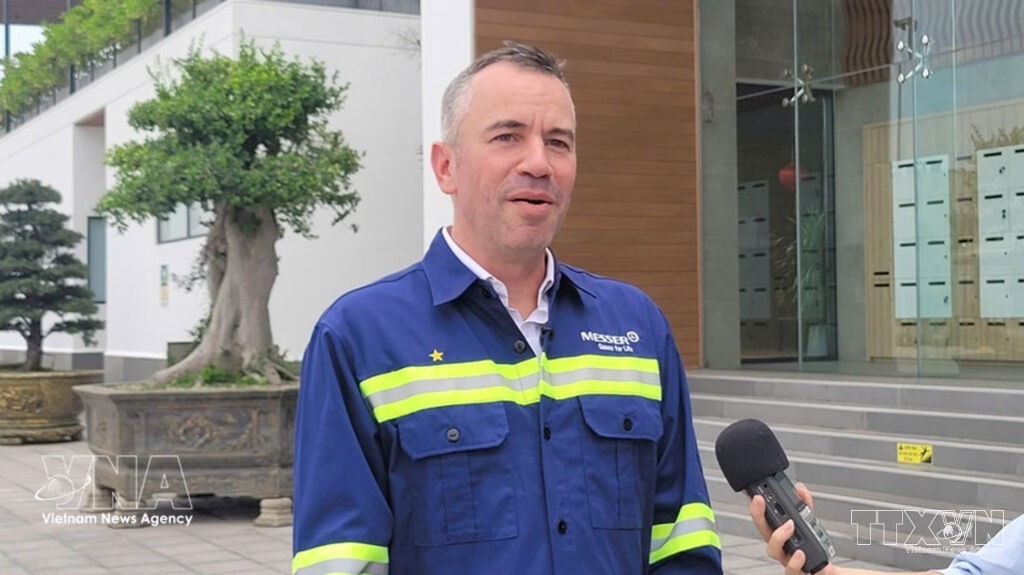
| Anthony Grandpierre, Chief Operating Officer of Messer Southeast Asia. (Photo: VNA) |
Hanoi (VNA) – German industrial gas group Messer considers Vietnam one of its most important markets in Southeast Asia and plans to expand its supply of low-emission hydrogen to meet rapidly growing demand for low-carbon industrial gas solutions across a range of manufacturing sectors, Anthony Grandpierre, Chief Operating Officer of Messer Southeast Asia, has told the press.
Messer sees significant potential in Vietnam’s large-scale industrial plants, Grandpierre said, adding that investing in rooftop solar systems to produce low-emission hydrogen from the outset is also a step toward gradually developing Vietnam’s hydrogen economy.
Discussing the development of the low-carbon hydrogen industry in Vietnam, he said hydrogen is not a new technology for Messer. The company has more than 120 years of experience in hydrogen production, storage, transport and industrial applications.
To boost low-emission hydrogen development, Grandpierre said Vietnam first needs a stable supply of renewable energy at a reasonable cost. Equally important are a direct power purchase agreement (DPPA) mechanism and integrated infrastructure for hydrogen production, transportation and distribution.
Once these conditions are in place and low-emission hydrogen becomes cost-competitive, the market will be able to expand much faster, creating a foundation for additional projects and broader use of low-carbon industrial gases in Vietnam, he added.
Assessing the outlook for Vietnam’s industrial gas sector, Grandpierre described the prospects as very positive. Vietnam is targeting GDP growth of 8–10% while attracting increasing investment in electronics, automotive manufacturing and other industrial sectors, all of which require substantial volumes of industrial gases, including high-purity hydrogen.
He said industrial gases will play a role in that growth by enabling more efficient, lower-emission manufacturing processes. As demand for products made through low-emission methods rises, more companies are likely to invest in the sector, supporting Vietnam’s efforts to meet its carbon reduction goals.
Regarding Messer’s new industrial gas plant project in Cai Mep Industrial Park, Grandpierre said the company selected Ho Chi Minh City because of rapidly growing industrial gas demand in southern Vietnam and the area’s energy infrastructure.
The Cai Mep Industrial Gas Plant is a joint venture between Germany’s Messer Group and PVChem of the Vietnam National Industry - Energy Group (Petrovietnam), with a total investment of 37 million USD. Located in the Cai Mep Industrial Park, the facility will have a capacity of 200,000 tonnes per year.
Construction is expected to begin in the third quarter of 2026, with commercial operations targeted for the third quarter of 2028. The project has received internal approval, and the partners are currently completing joint-venture establishment procedures and preparing equipment orders so construction can start once land allocation is finalised.
Grandpierre stressed that the plant will produce nitrogen, oxygen and argon while utilising cold energy recovered from the LNG regasification process to reduce electricity consumption by about 50% compared with conventional production methods. This is expected to significantly lower the carbon footprint of the products and help customer companies reduce CO2 emissions in their manufacturing operations.
Nitrogen from the project will serve the electronics, food processing, footwear, metallurgy and other industries, while oxygen will be supplied to the steel industry and healthcare sector in southern Vietnam, supporting both industrial demand and sustainable development objectives./.