 |
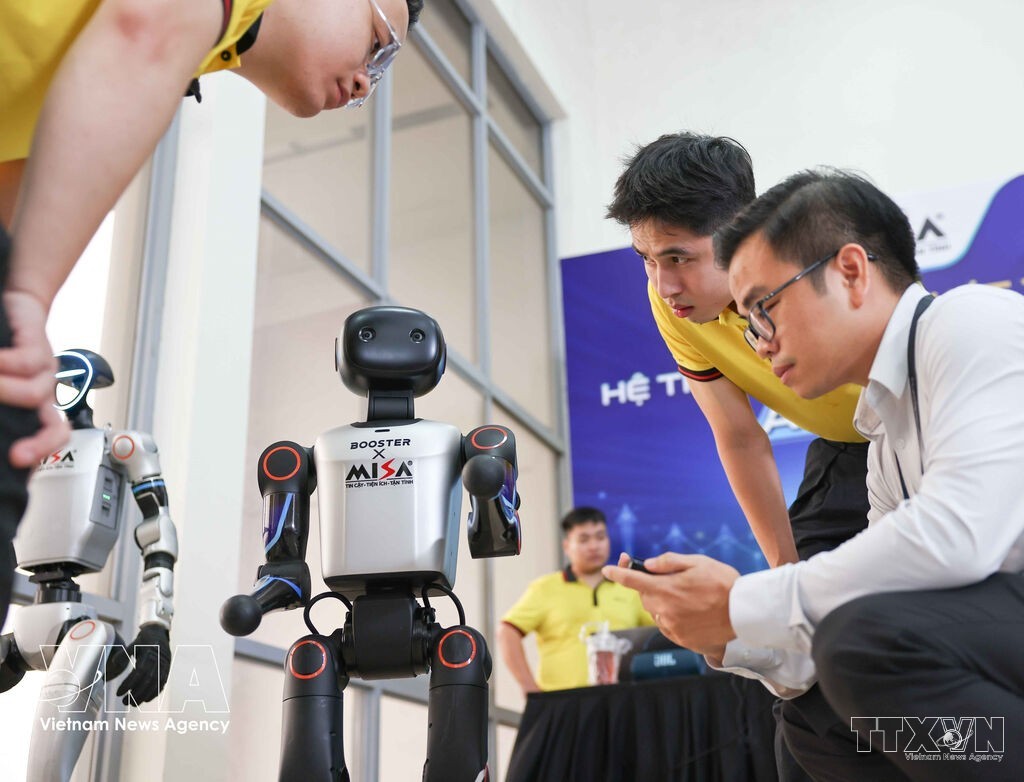
| A area showcasing products at AI Day 2026 held in Hanoi on April 5, 2026 (Photo: VNA) |
Hanoi (VNA) – Vietnam aims to rank among the three leading ASEAN countries in artificial intelligence (AI) by 2030, with the AI economy expected to account for around 6% of GDP and exports of AI products, services and solutions reaching about 5 billion USD, according to the National AI Strategy to 2045.
At a regular press briefing in August hosted by the Ministry of Science and Technology, Nguyen Khac Lich, Director of the ministry's Authority for Digital Technology and AI, said the strategy represents a move from just researching, developing, and applying AI to driving a full-scale national transformation powered by it.
AI is evolving beyond a technology tool into a core capability for policymaking, economic development and social governance. Human resources, infrastructure and data form the foundation, while effective institutions and AI governance are key to breakthroughs. The approach puts people at the centre, promotes AI skills among citizens, and calls for coordinated development of AI infrastructure, data and platforms while safeguarding safety, security and sovereignty.
By 2030, Vietnam aims for 60% of businesses using AI to improve efficiency, all civil servants using AI in their work weekly, and 60% of administrative decisions supported by data and AI. The satisfaction rate for AI-supported public services is expected to rise by at least 30%.
All ministries, sectors and localities are expected to have AI deployment plans, while all online public services and administrative dossiers will be AI-supported. The strategy also targets the development of a national AI computing capacity coordination platform, a platform for evaluating Vietnamese-language AI models, at least five shared AI platforms, 10 Vietnamese AI brands and eight Vietnamese-language AI models of four different scales.
To support these goals, annual total investment in AI is expected to reach 1-1.5% of GDP. Key datasets will be digitised, standardised, cleaned, and made AI-ready.
Vietnam also aims to develop a strong AI workforce, including 10,000 highly qualified AI professionals and 50,000 university-level or higher personnel with AI application skills by 2030. Some 500,000 workers will be trained to operate AI, while 10 million trained workers will receive basic AI skills.
The strategy sets out nine key pillars, focusing on AI talent and skills, data and models, infrastructure, research and technological capabilities, AI in governance and economic sectors, support for SMEs and cooperatives, and the development of a strong, safe and trustworthy AI ecosystem.
Vietnamese AI firms will play a central role, with emphasis on “Make in Vietnam” solutions and AI-native businesses. The strategy also calls for international cooperation while strengthening domestic capabilities and strategic autonomy through diversification of partners, technologies and supply chains.
The strategy’s breakthrough and strategic solutions focus on institutions and policies, national coordination and accountability, resource mobilisation, international cooperation and standards setting, public awareness and responsible AI, as well as monitoring and evaluation.
According to Lich, the implementation will follow the “six clear” principle - clear people, clear tasks, clear timelines, clear responsibilities, clear outputs and clear authority.
The Ministry of Science and Technology will be responsible for directing inter-sectoral coordination for implementation, while ministries, sectors and localities will formulate plans and mobilise resources. Businesses, research and training institutions, and other relevant organisations will contribute to assigned tasks, he said.
By 2045, Vietnam aims to join Asia’s top 10 in AI research, development and technological mastery, with AI serving as a core platform for the State, economy and society, he went on.
At the briefing, the ministry also launched its one-stop-shop AI portal at ai.dda.gov.vn to support implementation of the AI Law and related regulations. The platform enables businesses, developers, State agencies, experts and citizens to handle procedures, submit declarations, access information and engage with regulators through a unified system.
Its key functions include receiving applications for controlled testing, AI risk classification and system registration, serious incident and periodic reporting, publication of assessment results and violations, and connecting businesses with support programmes, shared infrastructure and data, and other AI development resources./.