 |
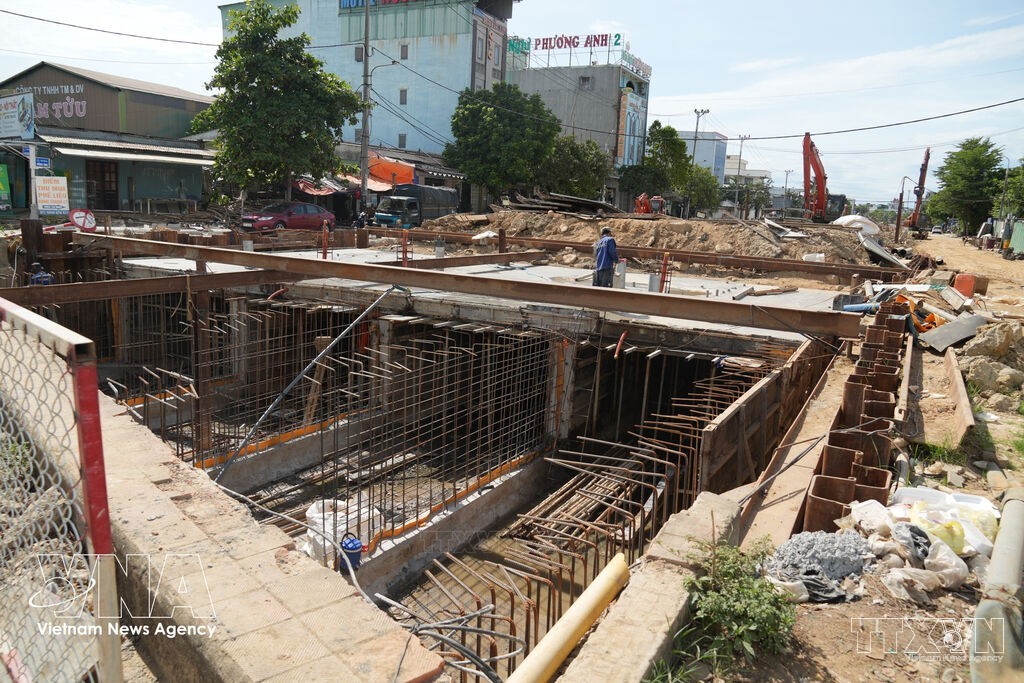
| Construction workers reinforce steel and pour concrete to cover the underground drainage channel, helping collect rainwater and tackle flooding in Da Nang. (Photo: VNA) |
Hanoi (VNA) – The 14th Party Central Committee's recent Conclusion No. 75-KL/TW on environmental protection and proactive response to climate change in the new period has called for the development of climate-resilient urban areas in response to increasingly extreme impacts from nature.
Smart urban areas are no longer simply about technology; they are becoming a tool that enables authorities to forecast risks, adapt quickly and protect their residents. A city can issue early warnings about areas at risk of flooding, adjust traffic flows when incidents occur, monitor air quality in real time or simulate the impact of a project before it is implemented. These capabilities are gradually becoming a new standard in modern urban management.
According to Tran Quoc Thai, Director of the Department of Urban Development under the Ministry of Construction, Vietnam currently has more than 900 urban areas, with the urbanisation rate continuing to rise rapidly. Cities are the main drivers of economic growth, but they are also highly vulnerable to climate change due to their high population density, heavy pressure on infrastructure and concentration of economic assets.
The World Bank (WB) likewise considers Vietnam one of the countries most severely affected by climate change. Without stronger adaptive capacity, climate impacts could significantly affect long-term growth, particularly in coastal urban areas and low-lying delta regions.
Da Nang has emerged as one of the localities at the forefront of smart urban development, with the establishment of an information, monitoring and smart operations centre that connects data from multiple areas, including transport, public services, the environment and residents’ feedback, to support governance.
The distinctive feature of this model is its shift from management based on manual reporting to data-driven one. Rather than waiting for incidents to occur before taking action, authorities can monitor the state of the central coastal city in real time and respond earlier.
According to planning experts, the new generation of smart cities should not be measured by the number of cameras or sensors deployed, but by their ability to turn data into decisions.
Do Thanh Tung, former Director of the Vietnam Institute of Architecture, said smart urban development should begin with planning and management, with technology serving as a tool to improve operational efficiency. A city can only truly be considered smart when it is capable of adapting to changes in the environment, climate and social needs.
This trend is also consistent with recommendations from the United Nations Human Settlements Programme (UN-Habitat). The organisation said cities of the future must address three challenges simultaneously: developing the economy, improving quality of life and strengthening resilience to shocks such as natural disasters and climate change.
In major urban areas, the most pressing challenge today is how to connect data across different sectors. This is also a challenge highlighted by many experts as Vietnam rolls out smart-city initiatives. Technology is not the biggest barrier; the difficulties lie in data standardisation, information-sharing mechanisms and the capacity to operate the systems.
Domestic technology companies such as Viettel Solutions and CMC Technology & Solution are currently involved in developing data platforms, operations centres and digital solutions for numerous localities. However, experts noted that technology companies can only provide the tools, while the development of effective governance models depends on how authorities organise data and make decisions.
Investing in climate resilience not only helps reduce damage caused by natural disasters but also creates a foundation for sustainable growth. For rapidly urbanising countries such as Vietnam, integrating climate considerations from the planning stage is considered a decisive factor, the WB suggested./.