 |
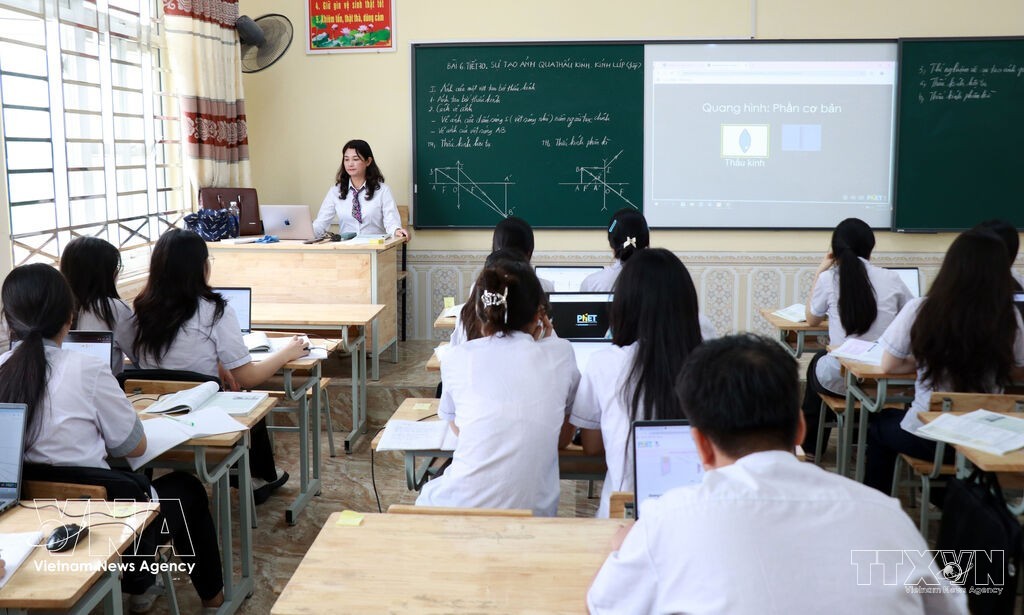
| An AI-applied class at Chu Van An Lower Secondary School in Kim Bang ward, Ninh Binh province (Photo: VNA) |
Hanoi (VNA) – School students will receive 12 periods of artificial intelligence (AI) education each academic year under a framework recently issued by the Ministry of Education and Training.
The framework aims to develop students’ AI competencies and gradually prepare human resources capable of adapting to rapid advances in science, technology and digital transformation.
The AI education content is structured around four areas corresponding to key AI competencies: human-centred thinking, AI ethics, AI techniques and applications, and AI system design. Human-centred thinking and AI ethics serve as guiding principles to ensure that AI is used safely, responsibly and in line with ethical and legal requirements.
The framework covers two educational stages: basic education, including primary and lower secondary levels, and career-oriented education at upper secondary level.
At the primary level, students will explore simple AI applications and gain an initial understanding of AI’s role in daily life, while learning about personal data protection and copyright.
At lower secondary level, students will learn to use AI tools to create digital products and address learning-related problems as well as study basic AI principles and citizens’ responsibilities in a digital society.
At upper secondary level, students will be encouraged to explore, design and improve simple AI tools through projects, developing problem-solving and creative skills while gaining exposure to potential career paths.
The framework seeks to build AI competency on the foundation of informatics skills and computer science knowledge under the current Informatics curriculum. It will also contribute to developing the qualities and general competencies set out in the 2018 General Education Programme, helping students become active digital citizens capable of using and contributing to AI-based products and solutions effectively, creatively and responsibly.
The AI education programme comprises core and extended content. The core content, designed to ensure essential learning outcomes for all students, will be delivered through AI education topics with 12 periods allocated per class each academic year.
The topics will be incorporated into schools’ education plans and two-session-per-day teaching schedules in ways suited to students’ characteristics and schools’ conditions, without creating excessive pressure or workload. AI content may also be integrated into other subjects and educational activities to reinforce and apply students’ knowledge and skills, without changing or increasing the required learning outcomes of those subjects.
Extended content may be offered beyond the 12-period core programme, depending on students’ needs and abilities and schools’ conditions. It may include clubs, projects, experiential activities, extracurricular programmes and research.
AI teaching will emphasise experience, practice, problem-solving and age-appropriate project-based learning. Ethical issues, potential risks and responsibility in AI use may be addressed through discussions, debates, role-playing and case studies.
The learning process will progress from observation and hands-on experience at primary level to exploration, explanation and verification at lower secondary level, and analysis, critical evaluation and solution development at upper secondary level./.