 |
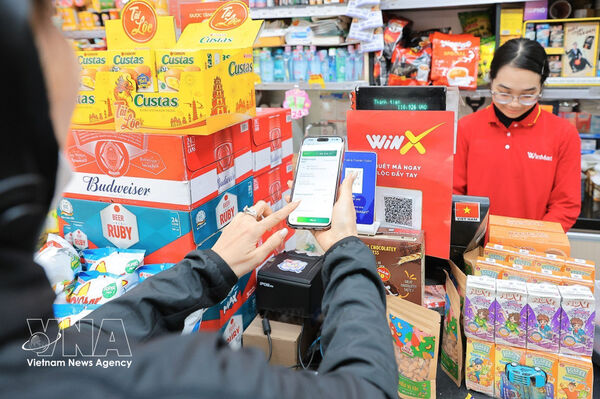
| Cashless payments increase by nearly 38% in number in 2025. (Photo: VNA) |
Hanoi (VNA) - Vietnam's banking sector is stepping up digital transformation, expanding cashless payments, strengthening system security, and promoting inclusive digital financial services to better serve people and businesses.
According to the State Bank of Vietnam (SBV), non-cash payments recorded strong growth in the first quarter of 2026, with transactions rising 37.98% in volume and 14.22% in value year-on-year, reflecting a clear shift toward digital payments.
Internet-based transactions posted the highest growth, 65.68% in volume and 28.85% in value. Mobile payments remained dominant, increasing 33.22% in volume and 8.35% in value. Meanwhile, QR code payments surged 52.4% in value despite a 16.43% rise in volume, indicating wider use in higher-value transactions.
Traditional payment methods continued to decline. By the end of March, the number of ATMs fell 3.01% year-on-year to 20,699, while POS devices rose slightly 0.53% to 772,552 units. ATM transactions dropped 9.29% in volume, showing reduced reliance on cash.
These figures not only demonstrate changes in consumer behavior but also underline the effectiveness of policies promoting cashless payments in recent years.
Alongside the traditional banking system, Mobile Money services are playing an important role in advancing financial inclusion, particularly in rural and mountainous areas.
As of March 31, 2026, there were 11.45 million Mobile Money accounts, with 5.64 million transactions worth 154.34 billion VND (5.8 million USD). Although still modest in scale compared to the overall market, Mobile Money has proven effective in bringing financial services closer to people in areas with limited access to banking services.
Data connectivity, improved identification quality
Data serves as a crucial foundation for banking digital transformation. The sector has been investing in and upgrading data infrastructure to ensure it is accurate, sufficient and unified.
 |
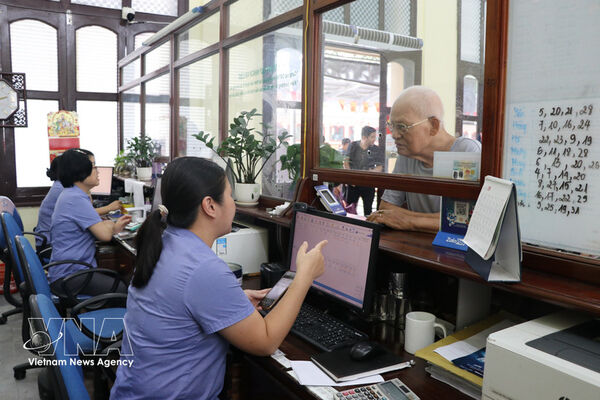
| 100% of transaction accounts on digital channels have been biometrically verified. (Photo: VNA) |
The effective utilisation of the national population database, the VNeID electronic identification system, and chip-based citizen ID cards has yielded significant results. As of April 24, more than 156.6 million customer records had undergone biometric verification, helping improve accuracy and transparency while reducing fraudulent accounts. Credit data has also been cleaned and standardised on a large scale.
Many banks and payment intermediaries have integrated biometric authentication, chip-based ID verification, and VNeID systems into their services. The SBV has also connected specialised databases to the national data centre and promoted data sharing via the NDXP platform, forming an interconnected data ecosystem.
Ensuring security remains a priority amid rapid digitalisation. The central bank has coordinated with relevant agencies to combat high-tech crime and deploy user protection measures.
The System for Intelligent Monitoring and Oversight SIMO, which supports risk monitoring and fraud prevention in payment activities has been rolled out to 149 organisations. It has issued alerts to over 3.8 million customers, helping more than 1.2 million halt or cancel suspicious transactions worth over 4.3 trillion VND.
Administrative reform continues to support digital transformation. The SBV has simplified over 90% of administrative procedures and expanded online public services, ensuring all eligible procedures are digitised. In early 2026, digitised records accounted for nearly 74%, while electronic results reached nearly 79%.
The sector is also promoting innovation and digital culture through initiatives aligned with national digital transformation policies. More than 1,480 initiatives have been recorded, alongside the establishment of over 2,600 “digital ambassadors” to drive innovation across the system. These efforts highlight the banking sector’s deepening digital transformation, contributing to the growth of the digital economy and improved service delivery./.