 |
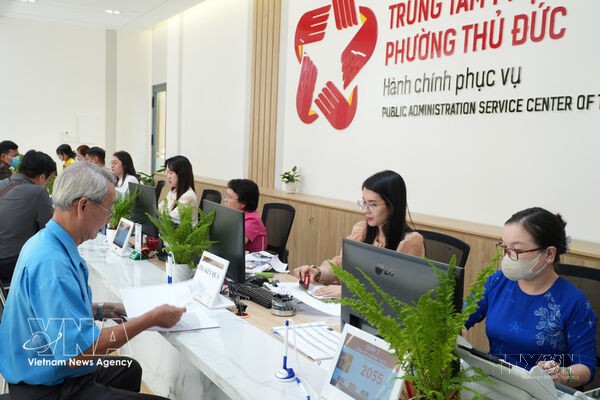
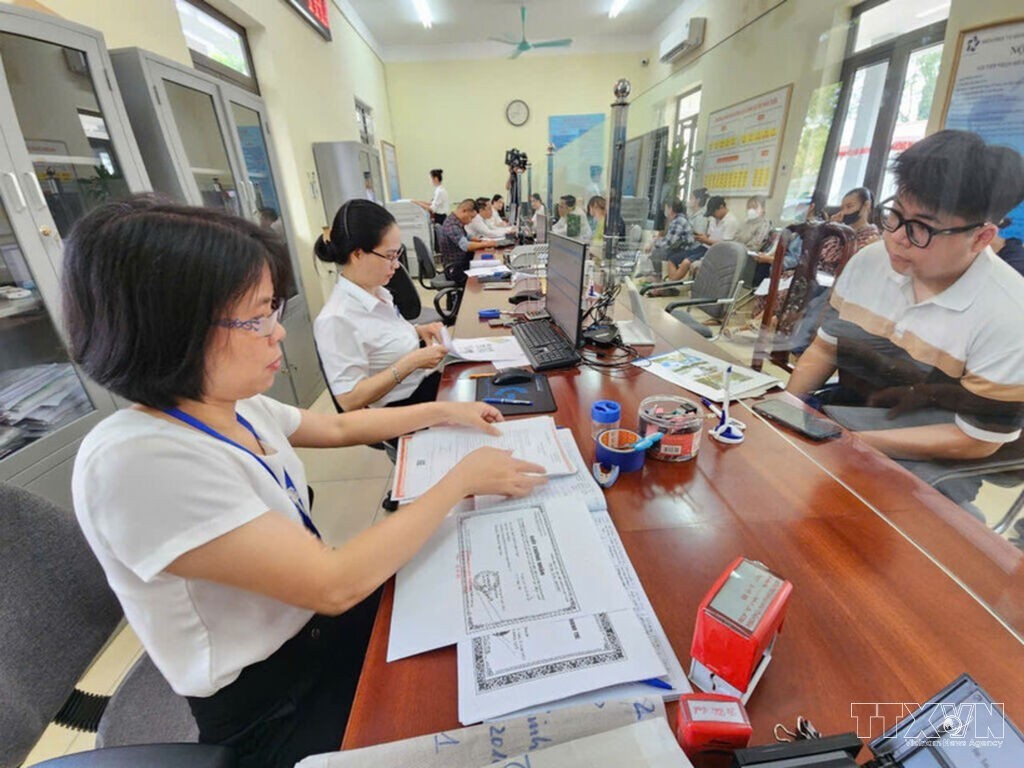
| Civil servants handle administrative procedures at the Public Administrative Service Centre of Thien Loc commune in Hanoi. (Photo published by VNA) |
Hanoi (VNA) – After years of growth driven largely by urban expansion, infrastructure investment and capital inflows, Hanoi is entering a new phase of development centred on knowledge, technology and innovation.
Over the past year, the capital has steadily shifted from simply applying digital technologies to embracing data-driven governance, laying the groundwork for faster and more sustainable growth.
According to Nguyen Van Phong, Deputy Secretary of the Hanoi Party Committee, the implementation of the Politburo’s Resolution No. 57-NQ/TW on breakthroughs in science and technology development, innovation and national digital transformation is aimed not only at promoting sci-tech development but also at fundamentally modernising governance and improving the effectiveness of the public administration system. This vision has become even more evident following the adoption of the two-tier local administration model in July 2025. The city views administrative streamlining as more than reducing intermediate layers, linking it with simplified procedures, integrated data systems and improved public services for citizens and businesses.
At the core of this new governance model is data. The goal, Phong said, is not digitalisation for its own sake, but ensuring that every management decision is evidence-based, every task is transparently monitored, and every outcome is measurable.
A key initiative has been the rollout of HanoiWork, a unified digital workspace that enables real-time monitoring of tasks from the municipal level to grassroots administrations. The platform clearly assigns responsibilities to agencies and officials while integrating OKR (Objectives and Key Results)- and KPI (Key Performance Indicator)-based performance management and automatic alerts for delayed assignments. The system has now been deployed across 179 units, involving more than 77,000 officials and managing nearly 240,000 tasks digitally.
Along with the digital governance platform, Hanoi has also prioritised digital workforce development. The city has issued a digital competency framework for officials, civil servants and citizens, while approving a digital skills development programme for 2026–2030. Tens of thousands of public employees have already received training in digital transformation, cybersecurity and artificial intelligence (AI), while more than 5,400 community digital transformation teams continue supporting digital adoption at the grassroots level.
Hanoi aims for every public servant to have access to an AI assistant by 2026 to help search legal documents, prepare reports, review records, analyse data and support policy formulation.
The city is also pursuing comprehensive administrative reform under the principle of “standardise before digitalise.” Instead of merely transferring existing procedures online, Hanoi has redesigned administrative processes to improve efficiency and service quality. More than 700,000 applications have been processed regardless of residency status, over 2,000 administrative procedures have been restructured, and data reuse has exceeded 97%. The iHanoi application has become the city’s official digital platform for government-citizen interaction, with more than 6.2 million registered accounts and hundreds of millions of visits.
Beyond public administration, Hanoi increasingly views data as a strategic resource for innovation and economic development. The city has built extensive shared databases, including information on more than 2.1 million land parcels, 93 open datasets and over 9.2 million electronic health records covering nearly 99% of the population, while linking data across all public hospitals. A centralised transport database is also under development to support real-time traffic management.
Rather than relying solely on internal resources, the city is encouraging universities, research institutes, enterprises and startups to develop solutions for practical challenges in transport, health care, education, urban planning, environmental protection, heritage conservation and traditional craft villages.
To support this strategy, Hanoi is establishing an innovation centre based on an integrated ecosystem combining research, incubation, startup acceleration, venture capital connections and technology commercialisation. The city is also introducing policy measures such as regulatory sandboxes, venture capital funds and incentives to attract high-quality talent and technology enterprises.
The capital city aims for the digital economy to contribute around 40% of its Gross Regional Domestic Product (GRDP) by 2030, with the Hoa Lac Hi-Tech Park serving as the core research and development hub./.