 |
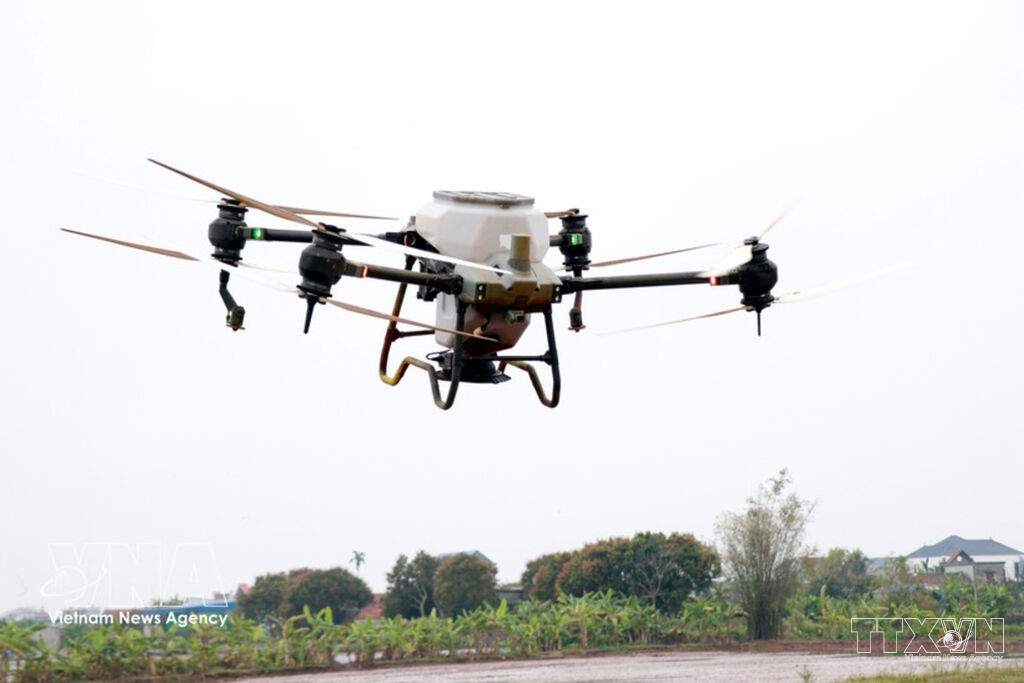
| The Nam Dai Duong youth cooperative, based in Nghia Hung commune of Ninh Binh province, uses unmanned aerial vehicles for rice seeding. (Illustrative photo: VNA) |
Paris (VNA) – The Prime Minister's Decision No. 21/2026/QD-TTg, which took effect on July 1, 2026, promulgating the lists of strategic technologies and tech-products, marks a new direction for the sector’s development. However, the move also highlights the need for a well-defined scheme to ensure that Vietnamese technology products are competitive in international markets.
Speaking to the Vietnam News Agency's correspondents in France, Dr Ta Anh Phuong, CEO of Seinetime, a French technology start-up specialising in data personalisation and artificial intelligence (AI) solutions, cautioned that Vietnam should avoid developing products aimed solely at the domestic market. Such an approach, he said, could result in high costs, rapid technological obsolescence and limited participation in global supply chains.
He said that Vietnam's strategic technology goods should pass a global relevance test and strive to achieve strategic indispensability, making them products that international corporations actively seek to incorporate into their operations.
To achieve this, Phuong proposed three key priorities.
First, the country should capitalise on its unique geographical advantages and proprietary data. It should focus on sectors where domestic and Southeast Asian data, expertise or operating conditions provide a competitive edge that is difficult to replicate. Examples include Vietnamese-language AI models, Southeast Asia-specific datasets, tropical agriculture technologies and digital solutions tailored to the region.
Second, Vietnam should position itself as a regional technology testing and standards hub for the Association of Southeast Asian Nations (ASEAN). According to Phuong, the country could become a regional certification centre for technology products, particularly in cybersecurity and digital infrastructure, by developing testing facilities, certification systems and technical standards for those entering the ASEAN market.
Third, Vietnamese companies should develop technologies that create high switching costs for customers. Rather than focusing solely on end-user products, businesses should prioritise foundational technologies, supporting components, embedded software modules and deeply integrated solutions for major global manufacturers. If Vietnamese technologies are incorporated at the co-design stage of product development, replacing them later would become both costly and technically challenging.
Phuong also recommended adopting an "anchor client" strategy. Under this approach, the Government would help connect domestic technology firms with two or three multinational corporations operating in Vietnam to pilot and deploy strategic technology products at an early stage.
Such partnerships would enable Vietnamese companies to refine their products to international standards while building verified reference cases that could support expansion into global markets. He noted that the strategy is particularly feasible given the presence in Vietnam of major multinational companies such as LG, Intel, Bosch, Amkor, Unilever and Qualcomm.
Looking ahead to the next five years, Phuong suggested that the country should not attempt to develop all 30 strategic technology products simultaneously, but instead concentrate resources on a carefully selected number of priority areas.
He recommended adopting the 80:20 principle, channelling financial resources, institutional support and human capital into five to seven core product groups capable of generating the vast majority of economic value, while fostering a technology ecosystem able to sustain its own long-term growth./.