 |
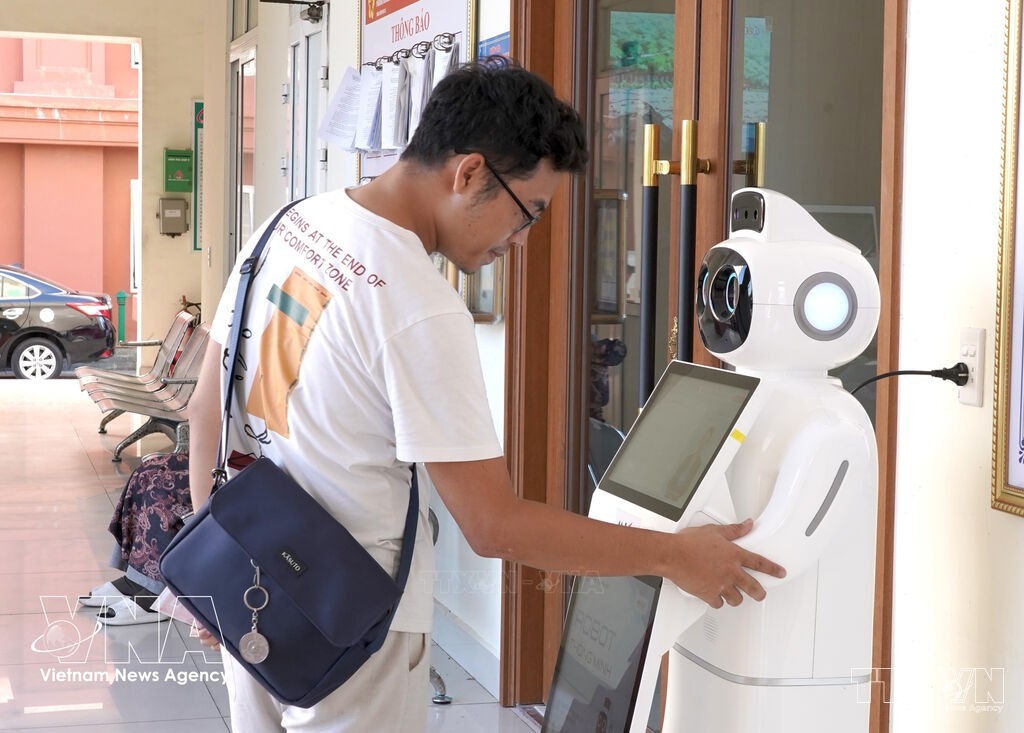
| AI-powered robots help ease the workload of civil servants in providing initial consultations, while enabling citizens to become familiar with AI applications in accessing public services. (Photo: VNA) |
Hanoi (VNA) – Deputy Prime Minister Le Tien Chau has signed Decision No. 1528/QD-TTg dated August 11, 2026, approving the national programme on artificial intelligence (AI) human resources development through 2030, with a vision to 2035.
The programme aims to develop an AI workforce of sufficient scale, structure and quality to meet the requirements of strategic technology sectors, enhance national technological self-reliance, promote innovation and digital transformation, and foster the digital economy and digital society. It also seeks to make the ability to use and apply AI one of the essential competencies of learners, workers, managers and administrators.
The programme also targets the development of highly qualified and specialised personnel capable of researching, developing, mastering, deploying and managing AI systems in a safe, reliable and responsible manner. It aims to help Vietnam become one of the leading countries in the region in AI human resources development, thereby improving labour productivity and national competitiveness while safeguarding national interests in the AI era.
By 2030, the programme targets widespread access to knowledge, skills and competencies for the safe and effective use of AI among learners, workers, managers and administrators. Specifically, at least 80% of general education and university preparatory students, 100% of learners at higher education institutions and at least 80% of learners at vocational education establishments are expected to acquire such competencies. The goals also cover at least 90% of civil servants, public employees and workers at public non-business units, and 100% of personnel working in education and training.
The programme also targets the training, retraining and upskilling of at least 50,000 people with undergraduate or higher qualifications who can apply AI in key sectors and fields.
At the same time, at least 10,000 highly qualified AI personnel, including researchers, engineers and experts capable of researching, developing, mastering, deploying, operating and managing advanced AI systems, will be trained and developed. Of this number, a minimum of 1,500 specialists is expected to be capable of researching, developing, and mastering core technologies and leading key AI tasks.
An AI-integrated education system will be established across all levels and types of education, with 100% of higher education institutions expected to introduce regulations governing the use of the technology in training, research and assessment.
The programme also aims to establish at least 10 advanced, specialised AI training and research centres, as well as at least 25 higher education institutions serving as hubs for AI training, research and innovation.
With a vision to 2035, it seeks to set up a modern and sustainable AI human resources ecosystem capable of adapting to technological developments and international integration. The ability to use and apply AI is expected to become a widespread competency among the workforce, while the technology will serve as a foundational one driving learning, work, production, business and national governance.
To achieve these objectives, the programme sets out a range of specific tasks and solutions, including developing and completing the institutional framework; developing a pool of teachers, experts and training support networks; developing highly qualified human resources; linking training with businesses and the labour market; and developing infrastructure, data and shared practical-learning environments for training, among others.
Particular priority will be given to supporting vulnerable groups, workers at risk of displacement by automation, learners in disadvantaged areas, women working in technology, people with disabilities and other groups requiring equitable access to AI capabilities./.