 |
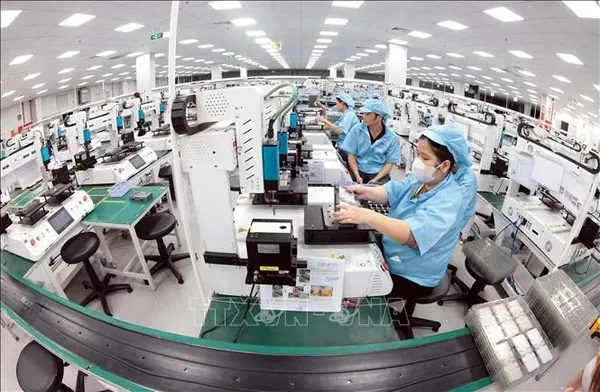
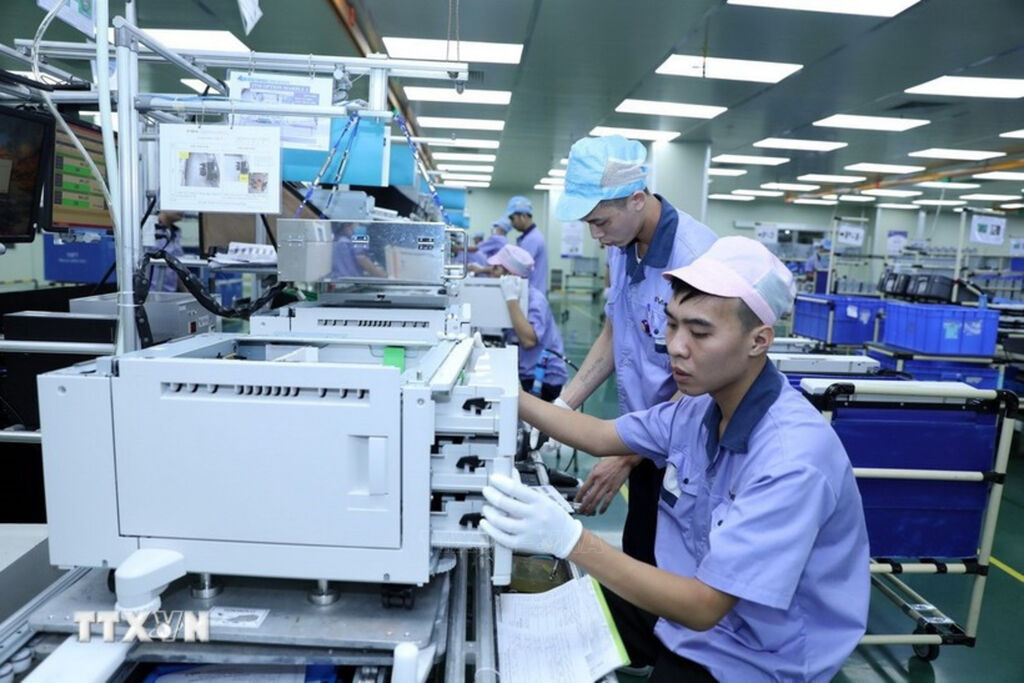
| Workers at the VSIP Hai Phong industrial and urban complex, which specialises in producing electronic components for office equipment. (Photo: VNA) |
Hanoi (VNA) – The Government has promulgated Resolution No. 02/NQ-CP, setting out key tasks and solutions to improve the business environment and strengthen national competitiveness in 2026.
The Resolution affirms the need to synchronously and comprehensively improve the investment and business environment across all sectors. This will provide a foundation for all economic sectors to achieve long-term development, cooperation and healthy competition; ensure fair, open and transparent access to resources, markets and development opportunities; and promote the development of new productive forces and production methods, with a focus on digital economy, green economy and circular economy, the building of a digital society, and an ecosystem-friendly environment.
It calls for a resolute shift in legislative mindset from “management” to “facilitation and development”, with people and enterprises placed at the centre of service delivery. The quality of the legal normative system will be improved to thoroughly remove bottlenecks, encourage enterprise development in priority sectors, promote and protect innovative enterprises, ensure transparency, and safeguard enterprises’ business and property rights. Groundbreaking mechanisms and policies will be boldly proposed and issued to unlock all resources, enhance the competitiveness of the economy.
Administrative reforms will be stepped up alongside thorough decentralisation and delegation of authority, with greater emphasis on transparency, autonomy and accountability to prevent corruption, waste and negative phenomena. Notably, the mindset will shift strongly from control-oriented management to facilitation and service delivery, replacing ex-ante controls with ex-post supervision based on clear standards and technical regulations.
The Resolution sets the objective of substantially improving the quality of the investment and business environment in line with domestic realities and global trends, thereby lifting Vietnam’s position in international rankings. It seeks to build a competitive, transparent and stable business climate that lowers compliance costs, aligns with international best practices, encourages innovation, unleashes productive potential, mobilises resources and creates fresh momentum for growth.
By the end of 2026, Vietnam aims to rank among the world’s top 50 performers in the United Nations Sustainable Development Goals, advance at least three places in the International Property Rights Index, and climb at least one position in the Global Innovation Index.
The targets also include rising at least two places in the UN E-Government Development Index, maintaining Tier 1 status in the Global Cybersecurity Index, improving by at least four places in the World Bank’s Logistics Performance Index, and advancing at least four places in the Travel and Tourism Development Index.
Alongside these goals, indicators reflecting public and business perceptions of the performance of authorities at all levels will be improved. The national median score of the Provincial Competitiveness Index is expected to increase by one point, while the average Public Administration Reform Index is targeted at 84.7%for ministries and ministerial-level agencies and 88.87% for provinces and centrally run cities. The national average Satisfaction Index of Public Administrative Services is projected to reach 86%. At the same time, a healthy competitive environment will be fostered to accelerate the entry and re-entry of enterprises into the market and curb business withdrawals.
To deliver these outcomes, the Resolution outlines four major tasks and solutions, beginning with the rigorous and comprehensive implementation of foundational institutional pillars, including the Politburo's resolutions on science, technology and innovation, international integration in the new context, law-making and enforcement, private sector development, national energy security, education and training, public health, and the development of the state sector. The coordinated execution of these policies is expected to generate strong momentum for national advancement and help realise the vision of Vietnam becoming a high-income developed country by 2045.
The Resolution also calls for continued decisive action in streamlining the organisational structure and effectively operating the two-tier local administration model, while proactively addressing challenges in commune-level administration. In addition, it stresses the importance of fully, consistently and effectively implementing all assigned tasks, solutions, targets and measures to ensure tangible improvements in the business environment and national competitiveness in 2026./.