 |
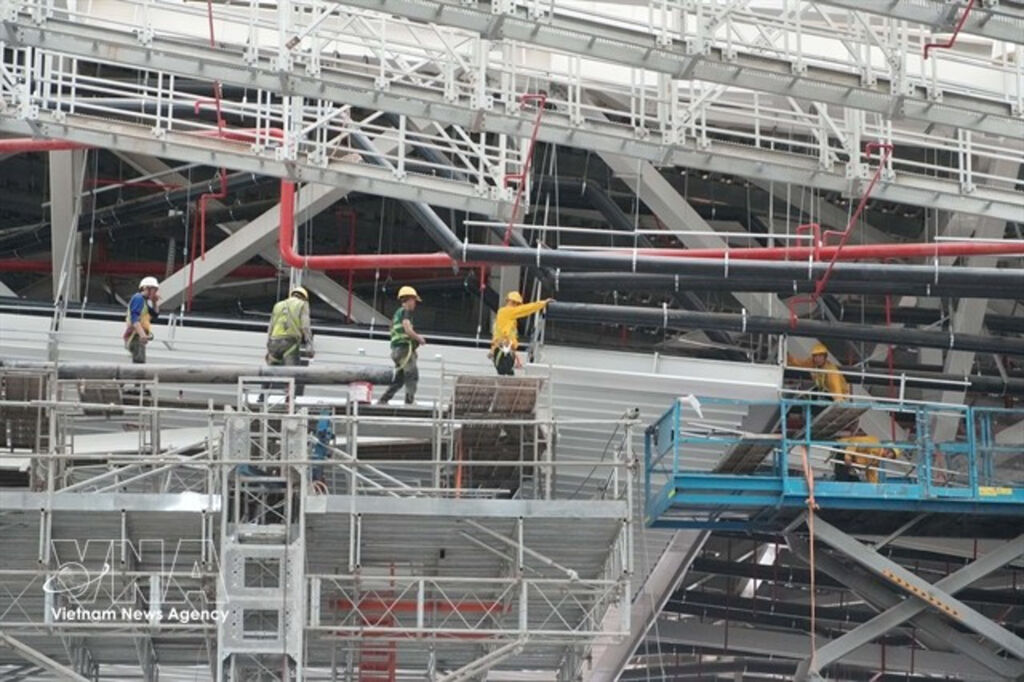
| Construction is being sped up at Long Thanh International Airport. Vietnam plans to put seven new airports into operation by 2030, including two flagship airports, Long Thành and Gia Bình. (Photo: VNA) |
Hanoi (VNS/VNA) – Vietnam plans to put seven new airports into operation by 2030 as part of a broader effort to expand the country's aviation network and meet rising travel demand.
These include two flagship airports, Long Thanh and Gia Binh, and five others, namely Quang Tri, Phan Thiet, Sa Pa, Tho Chu and Thanh Son.
Together with upgrades and expansions at existing airports, the projects are expected to increase the network's total annual capacity to up to 220 million passengers.
According to a recent report by the Ministry of Construction reviewing implementation of the national airport development plan for 2021-2030, Vietnam aims to have 32 airports by the end of the decade, including 15 international and 17 domestic airports, with a total area of more than 26,000ha.
By 2050, three more domestic airports would be added to the network to bring the total number of airports in Vietnam to 35.
The ministry said the airport network has been designed under a hub-and-spoke model. Airports are located along the country's north-south axis, with a high concentration in key economic regions across northern, central and southern Vietnam. This configuration will help maintain air links to remote, border and island areas to support national defence and socio-economic development.
Vietnam currently has 22 airports in operation and five new airports under construction, including Long Thanh, Gia Binh, Quang Trị, Phan Thiet and Tho Chu. Of those currently operating, 20 out of 22 are under the management of the State-owned Airports Corporation of Vietnam, while Van Don and Phu Quoc are run by Sun Group.
The ministry said plans for expansion or upgrades have been approved for 14 airports, while planning work is underway for the remaining eight.
According to the ministry, passenger and cargo traffic is mainly concentrated at major gateways, with about 80% of total throughput handled by five international airports: Tan Son Nhat, Noi Bai, Da Nang, Cam Ranh and Phu Quoc.
Some regional airports, including Can Tho and Chu Lai, continue to operate below their designed capacity.
With regard to investment in the airport infrastructure system, the ministry estimated Vietnam would need 485 trillion VND (18.5 billion USD) between 2021 and 2030, with about 55% expected to come from State funding and the remainder from private investment.
Some airport projects have been implemented under public-private partnership (PPP) or commercial investment models, including Gia Binh, Van Don, Quang Tri and Phan Thiet.
The ministry said phase one of Long Thanh Airport remains one of the country's most important airport infrastructure projects.
Gia Binh International Airport, developed by Masterise Group, is scheduled for completion in 2027 to help serve activities related to the upcoming APEC Summit.
Quang Tri Airport is being developed by T&T Group under a PPP model, while Phan Thiet Airport is funded by Sun Group.
The Ministry of National Defence is developing dual-use airports at Thanh Son and Tho Chu.
Air transport demand is forecast to continue growing rapidly in the next few years.
With a double-digit economic growth target, annual passenger traffic is projected to exceed 191 million by 2030, representing average growth of about 9.7% per year through 2030. Air cargo throughput is forecast to reach around 3.75 million tonnes annually by 2030, with average growth of approximately 19.3% per year over the same period.
The Ministry of Construction said a comprehensive review of the national airport development plan would focus on reassessing potential airport projects, while also studying additional locations for possible inclusion in the network.
Airports that no longer align with development needs or fail to meet necessary requirements could be removed from the plan, the ministry said./.