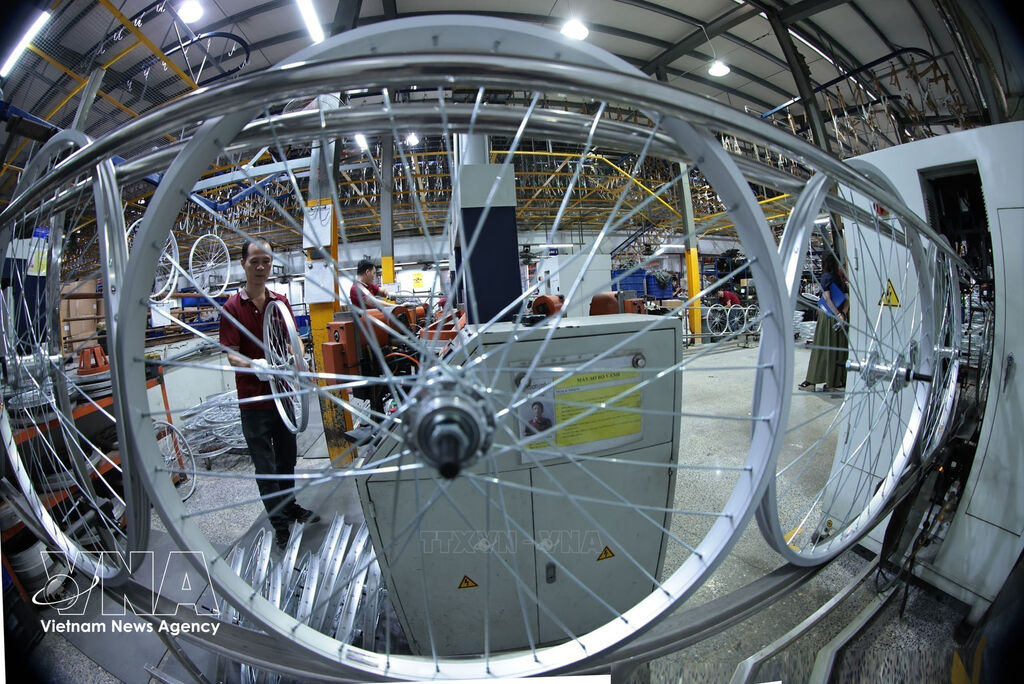
 |
| An automated bicycle rim inspection machine (replacing work previously carried out by 20 workers) at Hanoi Thong Nhat JSC. (Photo: VNA) |
Hanoi (VNA) – To make science, technology, innovation and digital transformation the central drivers of economic growth, further solutions are needed to translate policies, legal frameworks and strategic directions into practical outcomes.
Associate Professor Dr Vu Sy Cuong of the Academy of Finance said the Politburo’s Resolution No. 57-NQ/TW marks a major strategic shift, moving Vietnam away from a growth model based on capital and low-cost labour towards one driven by productivity, science, technology and innovation. At the same time, the Politburo’s Resolution No. 68-NQ/TW on the private economic sector's development identifies the sector as a pioneering force in advancing science, technology, innovation and digital transformation.
In recent years, the National Assembly has also translated these orientations into practice by passing a series of strategic laws designed to establish a stronger legal foundation and create momentum for science, technology, innovation and digital transformation to become key engines of economic growth.
However, experts and researchers held that significant obstacles remain in the practical operation of the economy. These include an overly administrative approach and rigid management of scientific activities, shortages in financial resources and shortcomings in allocation mechanisms, as well as a persistent gap between laboratory research and commercial markets. In addition, businesses have yet to be fully positioned at the centre of the innovation ecosystem, while issues surrounding intellectual property, valuation and appraisal of research assets remain unresolved.
Former Deputy Director of the Central Institute for Economic Management Tran Kim Chung said greater focus should be placed on developing strategic industries and technologies, including artificial intelligence and big data, while stepping up the training and effective use of high-quality human resources. Development efforts should also properly recognise and leverage the role of science and technology in creating new economic models based on emerging resources.
According to Associate Professor Dr Cuong, procedures for disbursing funds from financial support programmes for small- and medium-sized enterprises should be streamlined, alongside simplifying access to policy incentives. He also proposed introducing co-financing mechanisms for corporate research and development and piloting public procurement or commissioning schemes for innovative products to help create market demand for start-ups.
Notably, state management agencies should improve financial governance mechanisms for the public sector's science and technology activities and adopt a more streamlined, outcome-based budgeting approach with greater accountability for final results, he suggested.
There is a need to restructure State budget management for science, technology, innovation and digital transformation. This would involve shifting from invoice- and document-based audits towards evaluation based on outputs and performance outcomes.
 |
| The egg collection and sorting line at QL Vietnam Agroresources Co., Ltd. in Tay Ninh province. (Photo: VNA) |
Experts said the industry needs to establish mechanisms that grant full ownership rights – including usage, valuation and transfer rights – over patents and intellectual assets developed through public funding to research institutions or directly to scientists.
Once these assets are successfully valued and contributed as capital to spin-off enterprises that generate commercial returns, the State could recover its investment through corporate and personal income tax revenues generated from newly created value chains, thereby reinforcing science, technology, innovation and digital transformation as the central drivers of economic growth./.