 |
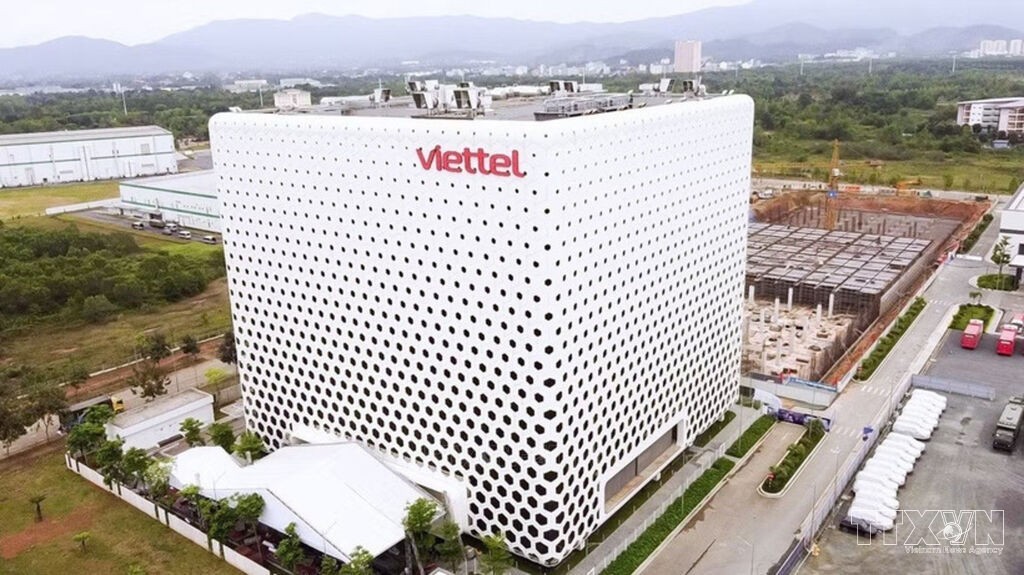
| Viettel 2's Hoa Lac Data Centre (Photo: Viettel) |
Hanoi (VNA) - Vietnam is witnessing a new wave of large-scale data centre investment as demand for infrastructure powering artificial intelligence (AI), cloud computing and data economy accelerates.
Billion USD projects pile up
Since early 2026, a flurry of large-scale commitments has landed. In February, UAE technology group G42 and a consortium of FPT, VinaCapital and Viet Thai unveiled a long-term partnership to build data centre infrastructure at Saigon Hi-Tech Park in Ho Chi Minh City at a cost of 2 billion USD.
In March, a venture of Accelerated Infrastructure Capital, Kinh Bac City Development Holding Corporation and international partners disclosed an AI data centre valued at about 2.1 billion USD, including the facility, regional infrastructure, power, water and drainage systems, and GPU capacity. Full investment is slated by the end of the 2027 first quarter.
In late April, Starmason committed 480.26 million USD to a hyperscale complex with up to 60MG of IT load for AI and cloud workloads. Singapore-based Evolution, Hathor and Frontier separately announced a 508.78 million USD project, Evolution DC VN HCMC, with 52MW of capacity, targeting Uptime Tier III+ and eventual Tier IV certification.
Le Ba Tan, CEO of Viettel IDC, sees the global data centre market reaching 627.4 billion USD by 2030, with Asia-Pacific at 174.8 billion USD. He projects global growth of about 8.8%, versus 9.3% in APAC and almost 14% in Southeast Asia.
Vietnam is among the highest-potential markets, Tan said, with installed capacity of roughly 104MW seen rising five-to six-fold to nearly 600MW by 2030.
“Vietnam is an attractive destination for next-generation data centres, and these facilities will be able to meet AI demand”, Tan said.
Cost advantages and room for growth
Vietnam’s appeal rests partly on competitive costs and ample expansion headroom.
Cushman & Wakefield puts Asia-Pacific data centre construction costs at 7.9-19.2 million USD per MW. Vietnam ranges from 5.7-8.7 million USD, averaging about 7.2 million USD, with annual construction cost inflation of roughly 3.8%.
Hanoi and Ho Chi Minh City account for about 73MW of operational capacity, with another 137 megawatts planned by 2030. As projects get larger, power access is emerging as the key constraint: a 100MW project in major clusters faces waits of about two to three years for new supply, the report said.
Le Thi Huyen Trang, CEO of JLL Vietnam, said AI has become critical infrastructure rather than a trend, and that power, data and deployment speed will determine which markets win.
Commercial power prices remain competitive regionally, and Vietnam’s sizable hydropower, wind and solar mix fits well with tenants’ environmental targets. The country also sits on landing points for major submarine cable routes.
Industrial and high-tech parks near cities are the primary sites for development. Land for data centres typically costs 30-50% more than conventional industrial plots because of requirements for location, power, fiber connectivity and dedicated substations.
Building infrastructure to maintain competitiveness
Still, experts said Vietnam’s edge will hinge not just on open investment rules but on coordinated preparations in regulation and infrastructure.
Tan said Vietnam must clear bottlenecks in power supply for large projects, renewable energy access, cooling suited to a tropical climate, the workforce to run AI infrastructure and tougher data sovereignty, security and cross-border flow requirements.
Competitive advantage will increasingly belong to countries that can build an integrated digital ecosystem spanning data centres, cloud computing, connectivity and cybersecurity for AI. If Vietnam sustains momentum and clears power, international connectivity and workforce constraints, it can narrow the gap with Southeast Asia’s leading cloud hubs, he added.
Louis Nguyen, Chairman and CEO of Saigon Asset Management, said attracting billions USD from hyperscale operators requires a clear, stable investment environment and adequate infrastructure.
First, Vietnam needs to finish and clarify its data framework, especially sovereignty, privacy, storage, management and cross-border transfers which matter most to investors, especially US-listed companies.
Enforcement must also be predictable so investors can gauge compliance obligations before committing billions USD.
Second is infrastructure readiness. Hyperscale projects need reliable power, renewable energy access, suitable land and water, fiber networks and sufficient submarine cable capacity.
David Jackson, General Director of Avison Young Vietnam, said Vietnam should focus on regulation, infrastructure and workforce to draw more data centre capital./.