Vietnam - model for driving economic growth: Indonesian expert
Vietnam's experience offers valuable lessons for Indonesia as it seeks to move away from a resource-dependent growth model towards an economy with stronger manufacturing and export capacity, according to Indonesian economist Jonathan Pincus.
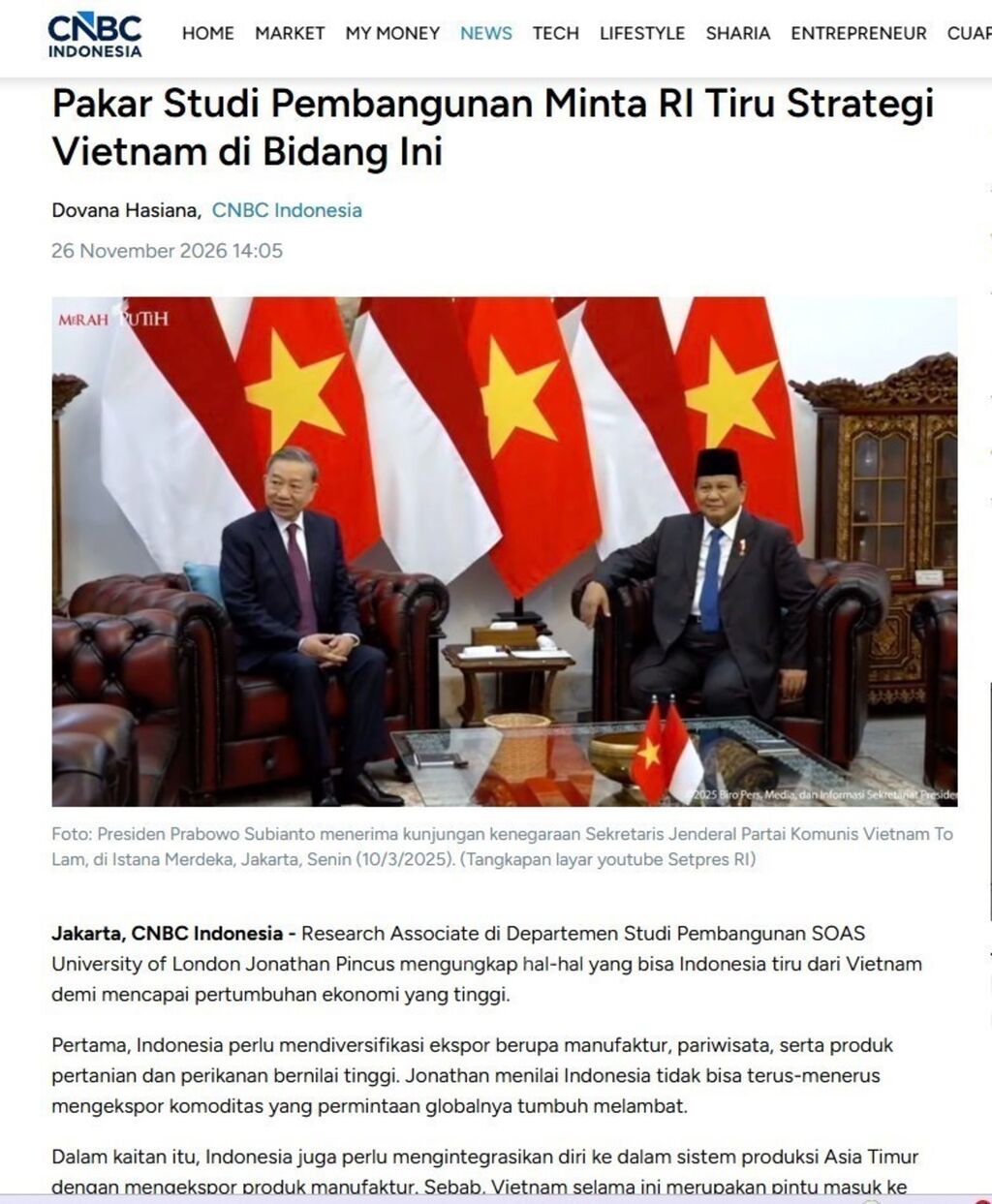
The article by Indonesian economist Jonathan Pincus on CNBC Indonesia on November 26. (Photo: Screenshot)

Jakarta (VNA) – Indonesia should study Vietnam’s development experience, particularly in export diversification, investment attraction and education quality improvement, to achieve faster and more sustainable economic growth, according to Indonesian economist Jonathan Pincus.

In an article published by CNBC Indonesia on November 26, Pincus, a research fellow at the Department of Development Studies, SOAS University of London (UK), analysed lessons Indonesia could learn from its Southeast Asian neighbour as it seeks to accelerate economic growth.

Pincus said Indonesia needs to restructure its export composition and reduce its reliance on raw materials, since global demand for many commodities is growing more slowly.

Instead, the country should expand exports of manufactured goods, tourism services, agricultural products and high-value seafood.

He stressed that deeper integration into East Asian production networks through manufactured exports is essential for Indonesia to improve its competitiveness.

Vietnam has emerged as an important gateway connecting regional economies with East Asian production networks, enabling it to better capitalise on rising global demand for industrial goods, he noted.

Pincus warned that Indonesia will struggle to make major economic progress if it continues to rely heavily on resource exports. Shifting towards industrial production is necessary, as demand for manufactured goods is growing faster globally and this will allow the economy to participate more deeply in international value chains.

Another lesson concerns promoting competition among local governments in attracting investment.

According to Pincus, Vietnam has created incentives for local authorities to take a more proactive approach to improving the business environment, seeking investors and strengthening their competitiveness.

In contrast, Indonesian localities tend to focus on securing budget allocations from the central government rather than competing healthily to attract investment projects and promote economic development.

Improving education quality, from preschool to high school levels, is another area where Indonesia could learn from Vietnam.

Pincus cited results from the Organisation for Economic Co-operation and Development's (OECD) Programme for International Student Assessment (PISA), which show that Vietnamese students perform well compared with those in many countries with similar income levels.

He attributed part of this achievement to teachers' responsibility for students' learning outcomes. In Vietnam, teachers are expected to link their professional responsibilities with students' progress and academic performance, helping improve the quality of general education.

These recommendations come as Indonesia pursues a target of raising economic growth to 8% by 2029, significantly above the about 5% growth rate maintained in recent years.

Diversifying production, boosting labour productivity and improving human resource quality have therefore become key priorities for Southeast Asia's largest economy.

Pincus's analysis suggests that Vietnam's experience offers valuable lessons for Indonesia as it seeks to move away from a resource-dependent growth model towards an economy with stronger manufacturing and export capacity./.


Related News

Vietnamese businesses, entrepreneurs make growing contributions to national development

Vietnam Entrepreneurs’ Day is an opportunity to recognise businesses’ contributions and reinforce the entrepreneurial spirit, the pursuit of legitimate prosperity and national responsibility. With stronger policies and greater innovation, Vietnamese enterprises are expected to play an increasingly important role in economic growth and the country’s ambition to become a strong, prosperous nation.

Vietnam’s exports accelerate towards year-end targets

Vietnam’s exports rose 24.5% year on year to 434.30 billion USD in the first nine months of 2026, supporting strong economic growth despite global trade uncertainties. Efforts to diversify markets, leverage free trade agreements and improve product value are expected to sustain export momentum and help narrow the trade deficit in the final months of the year.

See Also

Lao PM’s visit to deepen Vietnam-Laos strategic cohesion: ambassador

The Lao PM's upcoming official visit to Vietnam is expected to strengthen political trust, promote strategic exchanges and translate high-level agreements into practical cooperation programmes and projects that bring tangible benefits to the people and business communities of both countries.

Cuban magazine praises Vietnam’s forward-looking spirit

Vietnam is admired not only for its rich natural landscapes, from mountains and terraced fields to deltas, tropical forests and mangroves, but also for the beauty of its people and its “countless” achievements in politics, socio-economic development, culture and environmental protection, according to Cuba’s Bohemia magazine.

APEC 2027 to affirm Vietnam’s role, standing: Malaysian scholar

For Vietnam, APEC 2027 is a chance to advance productivity, innovation, infrastructure links and economic resilience while expanding its diplomatic reach. China’s 2026 initiatives provide a starting point, and Vietnam’s host year will test whether that momentum can be carried forward into durable regional cooperation

APEC 2026: Top Vietnamese leader’s speeches offer far-sighted vision

The top Vietnamese leader’s APEC Leaders’ Week attendance and bilateral engagements in China signal both Vietnam’s confidence in its own development path and its sense of responsibility for regional governance and shared prosperity, said Liu Ying, a research fellow at the Chongyang Institute for Financial Studies at Renmin University of China.

APEC 2027: Vietnam aims to promote regional connectivity, sustainable development

Professor Tao Yitao, Dean of the Belt and Road Research Institute at Shenzhen University, China, described the visit as having three interconnected dimensions, namely political orientation, continuity in the APEC agenda and industrial cooperation. Its significance extended beyond the signing of cooperation documents, reflecting the strategic importance both countries attach to their bilateral relationship amid changes in regional cooperation.

Vietnam builds on APEC 2026 outcomes towards hosting APEC 2027: Foreign minister

Vietnam participated in APEC 2026 not only as an active and proactive member but also with the responsibility of the host of APEC 2027. Its engagement reflects the country's consistent foreign policy, ambitious and sustainable development goals in the new era, and desire to make greater contributions to the common future of the Asia-Pacific region.

Vietnam’s independent foreign policy strengthens ASEAN’s unity: Thai scholar

Prime Minister Le Minh Hung’s participation in the 49th ASEAN Summit and related summits in Manila, the Philippines, reaffirms Vietnam’s commitment to an independent and self-reliant foreign policy while contributing to ASEAN’s unity and regional cooperation, according to Songkrit Kirk Pongern, a lecturer in ASEAN Studies at Kasetsart University, Thailand, in an interview with Vietnam News Agency (VNA).