 |
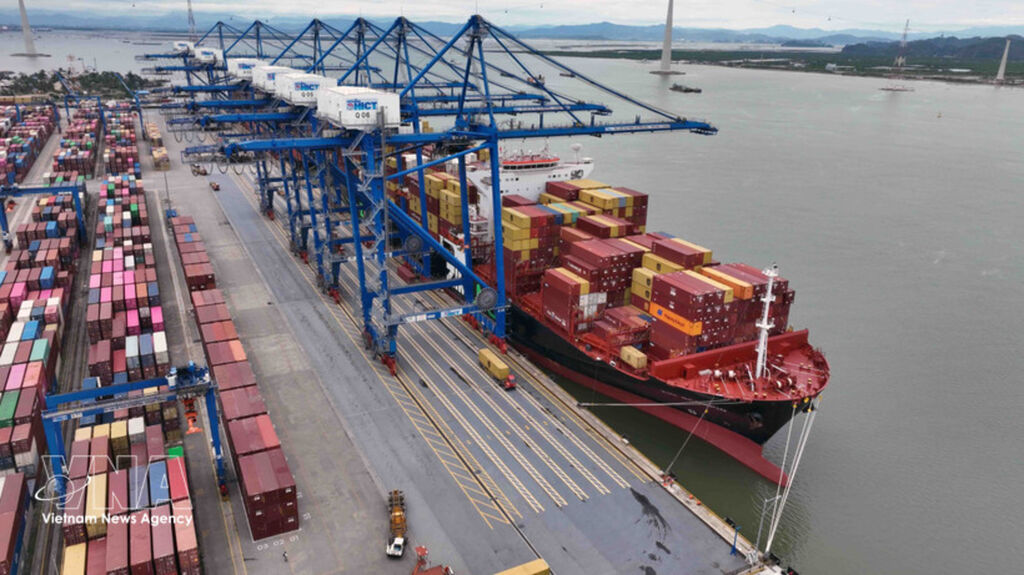
| Exports and imports are handled at Hai Phong International Container Terminal. (Photo: VNA) |
Hanoi (VNA) – Vietnam is quietly pushing ahead with reforms and emerging as an attractive destination for investors in the 2026–2035 period, according to an analysis published by US-based logistics website morethanshipping.com.
The article described Vietnam as strategically positioned along major regional maritime routes, including the East – West corridor linking the Americas, the Middle East, India and Europe, and the North – South corridor connecting China and Southeast Asia, helping make the country a gateway for international trade.
With a coastline stretching roughly 3,200 kilometres and 114 seaports as of January 2022, including several deep-water ports, Vietnam enjoys major advantages in logistics and import – export activities, it said.
Many factories in Vietnam are owned by Chinese and Republic of Korean firms, facilitating integration into existing supply chains and easing the transfer of production standards, procedures and product information, according to the writing.
Despite global economic headwinds and natural disasters in 2025, Vietnam has demonstrated strong resilience, recording GDP growth of 8.02% in 2025 and further reinforcing economists’ optimistic outlook.
The article said the country continues to attract foreign direct investment (FDI) as businesses seek to diversify their presence in Asia, access the Vietnamese and South Asian markets, complement operations in China, and take advantage of Vietnam’s extensive network of free trade agreements (FTAs), manufacturing advantages and market opportunities.
A recent key driver is the development in the US – Vietnam trade relationship with preferential trade agreements such as the Bilateral Trade Agreement and commitments under the US Generalised System of Preferences (GSP). Many firms consider Vietnam a safer or supplementary investment destination in Asia.
Vietnam is also entering a pivotal stage of development as it pursues ambitious growth targets and economic restructuring. The Government is prioritising high-value growth through policies aimed at improving productivity, promoting innovation and accelerating industrial upgrading.
The year 2026 holds special significance as it marks the beginning of the final phase of Vietnam’s 2021–2030 Socio-Economic Development Strategy, with priorities placed on high-quality growth, digital transformation and sustainable development, according to morethanshipping.com.
Under its updated development planning framework, Vietnam is focusing on strategic and high-tech sectors such as electronics, digital technology, automobile manufacturing, railways and shipbuilding, while gradually expanding into emerging industries including semiconductors, robotics, automation and artificial intelligence (AI). By 2030, it aims to become Southeast Asia’s second-largest e-commerce market and further transition towards a knowledge-based and innovative economy.
Among the factors making Vietnam an increasingly attractive investment destination, the article particularly emphasised the country’s stable political environment and strong growth drivers.
It noted that Vietnam has a relatively stable government, a clear economic vision, reasonable policy management mechanisms, low investment barriers and strong incentive schemes compared to similar markets.
The country has also set ambitious growth targets, aiming for annual GDP growth of over 8% and above 10% during the 2026–2030 period, while seeking to raise per capita income to around 8,500 USD by 2030 and 38,000 USD by 2050.
The writing added Vietnam’s large and youthful workforce, estimated at nearly 60 million people and expanding by around one million workers annually, remains a major advantage for long-term investment and manufacturing development./.