 |
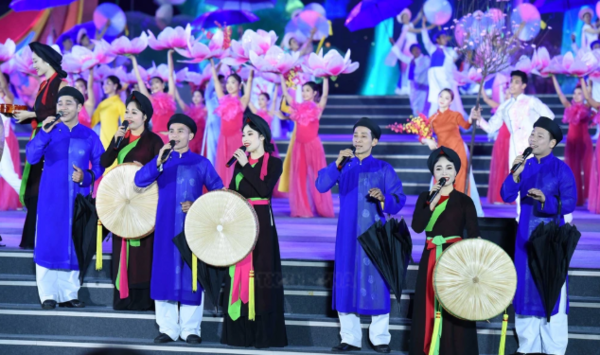
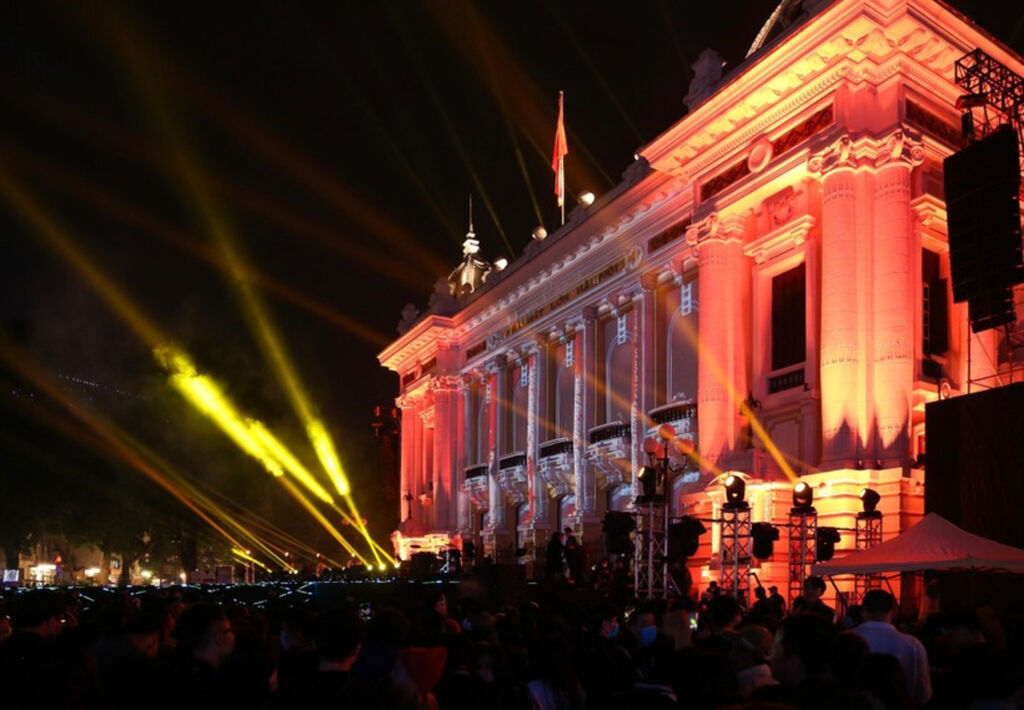
| A light performance in front of Hanoi Opera House (Photo: VNA) |
Hanoi (VNA) - Vietnam has issued a new strategy for cultural industries development to 2030, with a vision to 2045, signaling robust government backing to elevate the sector as a cornerstone of economic growth and a tool to boost the nation's global brand and influence.
Building a leading cultural industries ecosystem
The updated framework, succeeding the 2016 strategy, represents a step-change in scale and focus. The prior plan sets broad goals like job creation, whereas the latest version introduces specific quantitative benchmarks: cultural industries are projected to employ 6% of the national workforce by 2030, increasing to 8% by 2045.
It narrows the defined cultural sectors from 12 to 10, with emphasis on six priority areas: cinema, performing arts, software and entertainment games, advertising, handicrafts, and cultural tourism.
Targets are aggressive. By 2045, the sector is slated to account for 9% of GDP. Export value is forecast to rise 7% annually through 2030 and 9% thereafter, while the number of cultural enterprises is expected to expand 10% per year on average. Marking the 100th anniversary of the founding of the Democratic Republic of Vietnam (now the Socialist Republic of Vietnam) in 2045, the country seeks to establish a regionally dominant cultural industries hub with global reach, serving as a creativity-driven pillar for overall economic growth.
The plan also prioritises digitisation, aiming for digital cultural products to make up over 80% of total output.
Pioneering a new path
Exporting cultural goods stands as a central goal of the strategy, highlighting Vietnam's shift toward higher-value economic development and greater soft power projection.
Assoc. Prof. Bui Hoai Son, a full-time member of the National Assembly's Committee on Culture and Social Affairs, noted that at advanced stages of development, cultural industries often emerge as fresh growth engines and a source of national soft power. Vietnam, he said, now possesses key enablers: Southeast Asia's fourth-largest economy, a burgeoning middle class, advanced digital infrastructure, a more open creative landscape, and a unique cultural heritage with broad international appeal. Pursuing cultural exports thus aligns with the country's rising profile.
Experts highlighted the importance of global perception: positive reception of Vietnamese cultural products abroad can foster goodwill, drive tourism inflows, and bolster confidence in other Vietnamese exports. Advanced economies have long used culture as a vanguard for deeper diplomatic and economic ties.
At global forums and policy discussions, foreign experts urged Vietnam to analyse overseas consumer preferences and produce market-oriented content from the design stage, rather than focusing primarily on domestic audiences. Initial export priorities should include accessible formats like children's literature, animation, TV formats, and music. This requires cultivating a new cohort of globally competitive creative professionals.
Crucially, sustainable cultural exports also demand building investor trust in Vietnam's creative ecosystem, through refined regulations and support infrastructure. The sector must operate as a genuine market-driven industry, necessitating more policies conducive to intellectual property protection, tax incentives, public procurement and biddging in creative sectors, dedicated venture funds, and robust public-private partnerships.
The role of the state must be clearly defined, not only as a provider of seed funding and foundational investment, but also as a source of encouragement and reassurance for artists and producers seeking to compete internationally. Vietnam needs cultural products with strong national branding to compete effectively, integrated with broader nation-branding, cultural diplomacy, and international partnerships./.