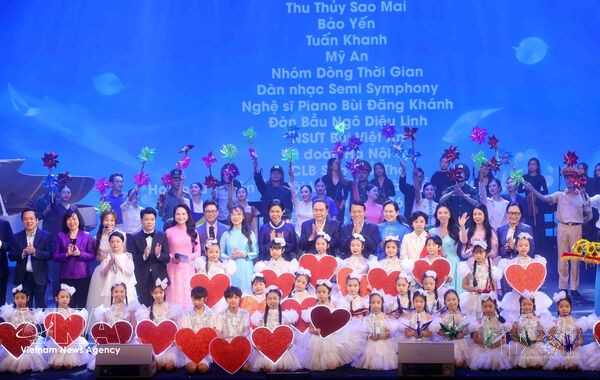
Katrin Kandel, CEO of Facing the World, said that it’s incredibly moving to see an international auction supporting children in Vietnam for the first time.
SPA’s entry into the Hanoi/Ho Chi Minh City – Da Nang corridor expands choices in airlines, flight schedules and services for residents and tourists while strengthening connectivity among the country’s major economic and tourism hubs.
Vietnam’s traditional festivals and horse races are rooted in communal folk life, evolving as forms of wholesome recreation and sport that vividly reflect the customs and distinctive cultural identity of local communities. What distinguishes Vietnam’s traditional horse racing festivals from those elsewhere in the world is that they feature farmer “jockeys” competing on pack horses.
The Travelers’ Choice Awards Best of the Best by leading global online travel platform Tripadvisor has ranked Quy Nhon in the central province of Gia Lai fourth among the world’s 25 top trending destinations for 2026.
For long, the image of the horse has been a powerful source of creative inspiration in Vietnamese art - from folk art and applied art to modern and contemporary visual expression.
During the nine-day Tet holiday alone, the province welcomed more than 1.1 million visitors, including an estimated 248,000 international arrivals, reaffirming its position as one of Vietnam’s leading tourism hubs.
During the nine-day Lunar New Year (Tet) holiday, Vietnam's tourism sector served an estimated 14 million visitors, up 12% year-on-year, according to the Vietnam National Authority of Tourism (VNAT) under the Ministry of Culture, Sports and Tourism.
The Vietnamese delegation, led by the Ministry of Education and Training, will officially inaugurate the Vietnam Education Exhibition at APAIE 2026 on February 23.
The statue of Mother Goddess Lieu Hanh preserved at Quang Cung Temple in the northern province of Ninh Binh is regarded as one of the most remarkable masterpieces of Vietnamese spiritual sculpture.
As the warmth of family reunions lingers and the scent of peach and ochna blossoms fills the spring air, the festival season awakens across Vietnam. From the northern mountains to the fertile deltas, crowds gather at communal houses, temples, and pagodas.
This strong growth underscores Hanoi’s robust tourism appeal from the start of the new year. The structure of international source markets continued to expand, with key markets, including China, the Republic of Korea (RoK), India, France, the UK, the US, Germany and the Philippines.
Prestigious fashion magazine Vogue has officially listed Con Dao Island, part of the great Ho Chi Minh City metropolitan area, among the world’s most ideal honeymoon destinations for 2026, underscoring the strong potential of the island district in capturing the high-end resort market.
During these days, moss has flourished across the rocky outcrops of Co Thach – Binh Thanh beach in Lien Huong commune, the Central Highland province of Lam Dong, creating a lush green expanse along the coastline. Ba Khom rock bank appears to be adorned in a soft, velvet-like emerald coat, attracting a multitude of locals and tourists alike for sightseeing and photography.
Each dish embodies not only taste but also memories and cultural values nurtured over generations. Sustaining this heritage ensures that Vietnamese cuisine is not eroded by time, but continues to be cherished, renewed and shared with care and respect.
In recent years, alongside the tradition of family reunions during the Lunar New Year (Tet), travelling during the holiday has become increasingly popular. Early spring travel is not merely about sightseeing; it also carries the meaning of seeking good fortune, peace and cultural experiences across different regions of the country.
In recent years, seasonal flower tourism has flourished in Vietnam’s northern mountainous provinces. Beyond being a fleeting trend, flower-sightseeing is evolving into a signature tourism product, opening up numerous development opportunities for various localities.
Bat Trang traditional pottery village in Hanoi is entering a new season of creativity. From earth and fire, shaped by the skilful hands of artisans, symbolic creatures embodying the beliefs and aspirations of the Vietnamese people gradually come to life. Among them is a collection of sacred ceramic horse figures, carrying the spirit of the Year of the Horse.
Located in Western Hoa Lu Ward, Dan Kinh Thien – Thung Ui is historically recognised as a ceremonial site where kings of Vietnam’s feudal dynasties performed heaven-worshipping rites, one of the highest rituals in the court ceremonial tradition. The site was recently introduced to travel firms through a familiarisation programme organised by the Ninh Binh provincial Department of Tourism in coordination with Xuan Truong Construction Enterprise.
A series of exhibitions, diverse in materials and perspectives, not only celebrate the zodiac animal of the year but also invite visitors on a journey into the cultural, historical and artistic depth associated with this familiar motif.
While fireworks and countdown celebrations light up much of the country, New Year’s Eve on Con Dao is markedly subdued. At midnight, the island becomes an “island of candles” as locals gather at Hang Duong Cemetery to pay tribute to national heroes.