 |
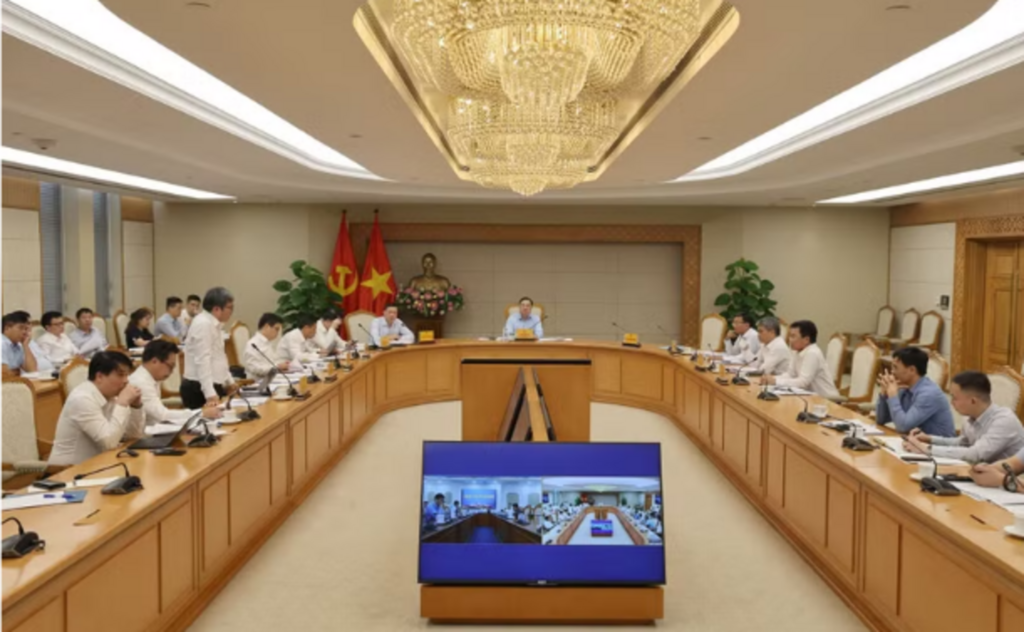
| An overview of the working session (Photo: VGP) |
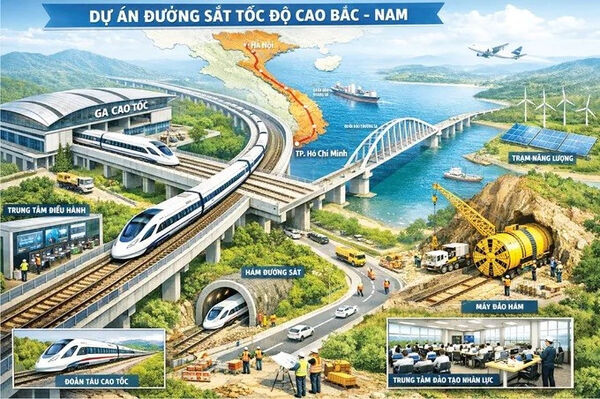
Hanoi (VNA) - The Ministry of Construction, along with other ministries and agencies, must accelerate ongoing tasks while proposing ways to meet the political imperative of launching the North–South high-speed railway with optimal efficiency, said Permanent Deputy Prime Minister Pham Gia Tuc.
Chairing a working session with several ministries, agencies and authorities from Hanoi and Ho Chi Minh City in Hanoi on April 22, Tuc underscored railway projects’ significance, saying that they will deliver substantial contributions to Vietnam’s long-term double-digit growth targets and unlock numerous development opportunities.
He asked ministries, agencies, and localities to closely follow resolutions, conclusions, and directions from the Party Central Committee, its Politburo and Secretariat, the National Assembly, and other competent authorities in the construction of the North–South high-speed railway line and other railway projects.
A thorough assessment must therefore be carried out across economic, political, foreign affairs, financial and governance aspects, including the identification of the most effective models for management, operation and utilisation. Special focus should be given to technology transfer and workforce training, with the aim of achieving early self-reliance in technology and developing a domestic railway industry.
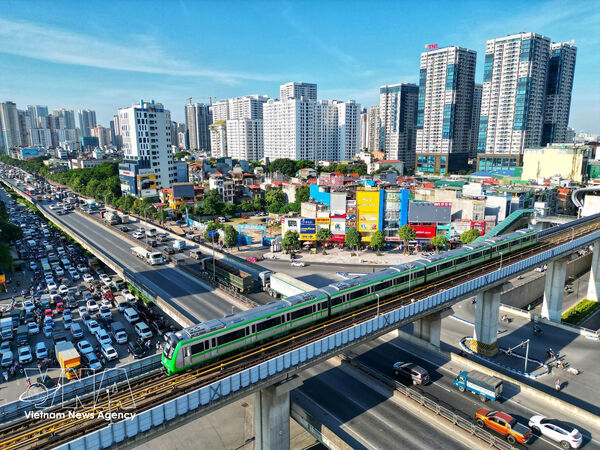
Tuc pointed to lessons from the rollout of several urban railway projects, where the adoption of disparate technologies and unclear or inconsistent standards and regulations led to poor connectivity. These shortcomings have been clearly identified and must be avoided in the North–South high-speed railway and other railway projects.
The ministries of construction, industry and trade, science and technology, justice, and other relevant ministries and agencies were assigned to work closely together to promptly finalise and approve technical standards and regulations for the North–South high-speed railway. These should ensure modernity comparable to those in developed countries and serve as the basis to select technologies, consultants, and contractors, on the condition of substantive technology transfer to foster the domestic railway industry.
They were also asked to further refine regulations on management, operation, and utilisation to ensure efficiency, while streamlining administrative procedures and business conditions that match practical needs.
According to him, there should be proactive planning and diversification of funding sources, including the state budget, official development assistance, private investment, and public–private partnerships tailored to individual projects.
On workforce training, he stressed that it must “go one step ahead, from a very early stage” through proactive and tight coordination with partners. This should cover everything from basic hands-on training to advanced courses tied directly to ongoing projects, drawing on multiple funding channels such as the state budget, enterprises, private resources and international support.
Commenting on the Lao Cai–Hanoi–Hai Phong and Hanoi–Dong Dang railway projects, Tuc said they will boost economic, trade and tourism activities between Vietnam and China, while improving connectivity with Russia and Central Asian countries.
Localities along the planned railway lines must immediately begin site clearance and resettlement in areas where boundaries have already been determined, and stand ready to act as soon as the North–South high-speed railway project secures approval.
Turning to transit-oriented development (TOD) along the North–South high-speed railway, he stressed that choosing the route alignment holds critical importance because it directly influences land clearance and overall investment costs. Each station is envisioned as a “small city” or local economic hub. Localities must therefore urgently develop plans to maximise the railway’s economic benefits, aligned with the specific strengths of each region and area.
Tuc acknowledged progress on urban railway projects in Hanoi and Ho Chi Minh City. However, both cities need to tackle inconsistencies in technical standards and regulations across existing lines to ensure seamless connectivity. At the same time, they should propose additional metro lines, including underground sections, to provide convenient transport for residents while meeting requirements for security, safety and climate change adaptation.
He also affirmed his readiness to work directly with ministries, agencies, and localities on specific projects to promptly settle issues falling under the authority of the Government and the Prime Minister./.