 |
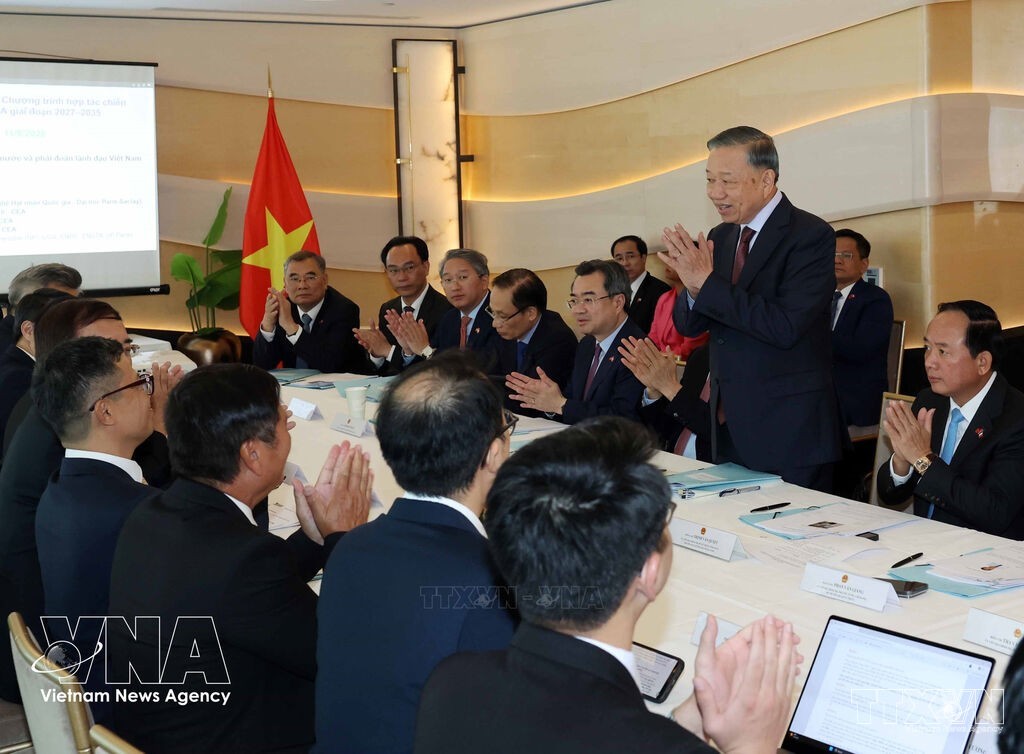
| General Secretary of the Communist Party of Vietnam Central Committee and President To Lam receives Vietnamese technology experts in France. (Photo: VNA) |
Paris (VNA) – General Secretary of the Communist Party of Vietnam Central Committee and President To Lam hosted a group of Vietnamese technology experts based in France on September 11 afternoon (local time) in Paris, as part of his official visit to the European country and attendance at the International Space Summit.
General Secretary and President Lam stressed that while the experts work in different fields, they all share a fundamental common view that Vietnam can achieve rapid, sustainable growth and greater self-reliance only by building robust scientific and technological capacity and fully pooling the brainpower of Vietnamese talents at home and abroad.
He highlighted a critical national asset - the network of Vietnamese scientists, experts and intellectuals working at top global sci-tech centres, including those in France. This pool serves as both an intellectual resource and a gateway to worldwide knowledge, technology and innovation networks.
The priority, he said, is converting that potential into tangible outcomes. Occasional meetings are no longer sufficient; Vietnam must shift from general appeals to specific assignments, from ad-hoc encounters to ongoing collaboration, from advice to joint execution, and from pledges to measurable products.
The top leader called for precise identification of the problems Vietnam needs to solve. Ministries, agencies, research institutes, universities and domestic firms must proactively place orders. Vague statements about needing skilled experts or advanced technology fall short. The country must specify the exact challenges, missing technologies, required specialists, receiving agencies and final deliverables. Only by defining these problems clearly can Vietnam match the right talents to the right tasks and unlock full capabilities.
Each expert should focus on practical contributions, such as undertaking research projects, mentoring young staff, designing training courses, linking French institutes and companies with Vietnamese partners, and transferring technology for gradual mastery. Large-scale ambitions are unnecessary at the outset; thorough delivery of concrete results matters more, he said.
General Secretary and President Lam underscored the need for correct selection of priority fields. With finite resources, Vietnam cannot chase every technology or spread itself thin. Energy and the nuclear industry, in particular, demand a systematic, cautious and science-based approach. Full preparation across institutional mechanisms, policy, quality workforce, scientific-technological capacity, industrial capability and governance is essential. Neither complacency and haste nor unnecessary delay is acceptable. Once priorities are correctly chosen, they must be pursued to completion, with results as the sole benchmark.
He expressed wish that the experts and scientists would keep connecting Vietnam with leading research groups, prestigious universities and major technology firms, helping build the country’s long-term capabilities. Each individual functions both as a specialist and as a bridge of expertise, technology and trust linking Vietnam with France and the wider world, the leader noted.
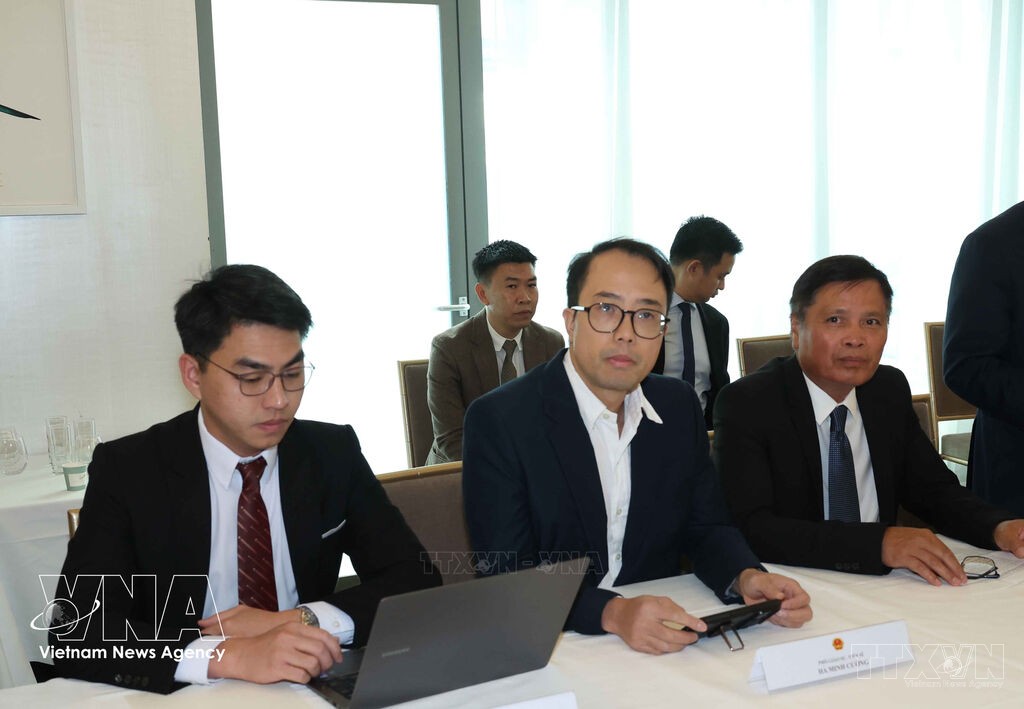 |
| Vietnamese technology experts at the reception. (Photo: VNA) |
The Vietnamese Party and State clearly recognise their duty to refine institutional frameworks, foster a favourable, transparent and efficient working environment, and clear barriers in procedures, financing, expert engagement and research. The goal is to enable scientists to contribute to the national agenda in a flexible, substantive and sustained manner, he said.
Vietnamese Ambassador to France Trinh Duc Hai noted that Vietnamese experts and intellectuals in France are active across multiple fields. Many hold senior roles in key French bodies and universities and remain strongly committed to contributing their expertise to national development.
The experts put forward proposals on nuclear power, artificial intelligence, semiconductors and aerospace. These included strategic courses to train leading engineers, a national data analytics system covering anti-fraud, healthcare and finance, integration of fragmented state databases, AI applications in aerospace design, and the establishment of an optoelectronics centre in Vietnam.
They also called on the Party and State to create more supportive conditions for overseas Vietnamese experts and intellectuals to engage more deeply in national development, particularly in priority sectors matching their specialised expertise./.