 |
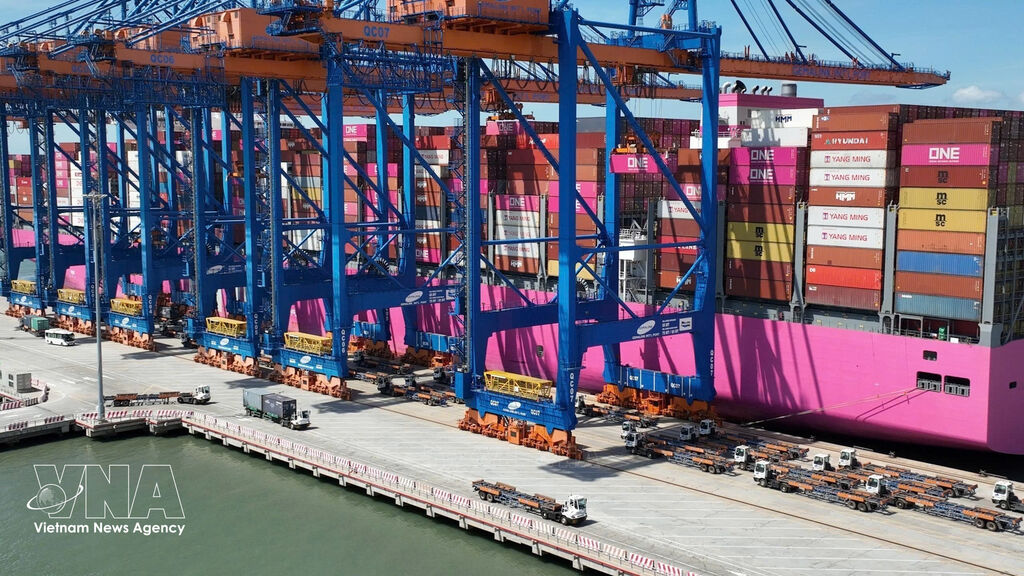
| Container handling operations at Gemalink Port in the Cai Mep–Thi Vai port complex, Tan Phuoc ward, Ho Chi Minh City. (Photo: VNA) |
Hanoi (VNA) - Vietnam is emerging as one of Southeast Asia’s most dynamic logistics markets as companies accelerate supply chain diversification and expand their manufacturing and distribution networks across the region.
According to Cushman & Wakefield’s latest Waypoint: Global Industrial Dynamics 2026 report, e-commerce and manufacturing remain the primary drivers of demand across Asia-Pacific. Southeast Asia is emerging as a major beneficiary of supply chain regionalisation and production relocation, with Vietnam, Indonesia and Thailand seeing robust leasing activity that reinforces their roles as key industrial and logistics centres.
The report attributes Vietnam’s strong performance to sustained manufacturing growth, export-oriented investment and rising domestic consumption. As companies pursue greater supply chain diversification, demand for industrial and logistics facilities is increasingly focused on locations offering efficient access to ports, airports, expressways and major manufacturing clusters.
In the Southern Key Economic Region, encompassing Ho Chi Minh City, Dong Nai and Tay Ninh, industrial real estate continues to benefit from a well-established manufacturing ecosystem, a large consumer base and improving transport connectivity. As of the first quarter of 2026, the total supply of industrial park land in the region reached approximately 36,400 hectares, while the supply of ready-built factories (RBFs) and ready-built warehouses (RBWs) stood at around 6.8 million square metres and 6.6 million square metres, respectively. Occupancy rates remained high, exceeding 90% for both RBFs and RBWs, while the occupancy rate for industrial park land hit 74.8%
Meanwhile, the Northern Key Economic Region is drawing growing investor interest thanks to its strengths in electronics production, high-value manufacturing and cross-border trade. Occupancy rates have reached 63% for industrial land, 86% for RBFs and 82% for RBWs, highlighting sustained demand across the market.
The report also points to a shift in investment priorities. While location remains important, investors are increasingly weighing factors such as infrastructure quality, developer expertise and the ability to meet demanding operational standards when selecting sites.
Vietnam’s industrial market mirrors a broader regional trend of tightening vacancy rates. Across Asia-Pacific, 43% of markets are expected to record lower vacancy levels over the next three years as stronger demand coincides with more measured new supply. This is intensifying competition for high-quality logistics assets in well-connected locations.
At the same time, occupier requirements are evolving. Businesses are placing greater emphasis on modern, automation-ready and energy-efficient facilities as they seek to enhance supply chain resilience, improve operational efficiency and support long-term growth. As a result, demand is increasingly shifting toward newer, higher-specification logistics and industrial properties./.