 |
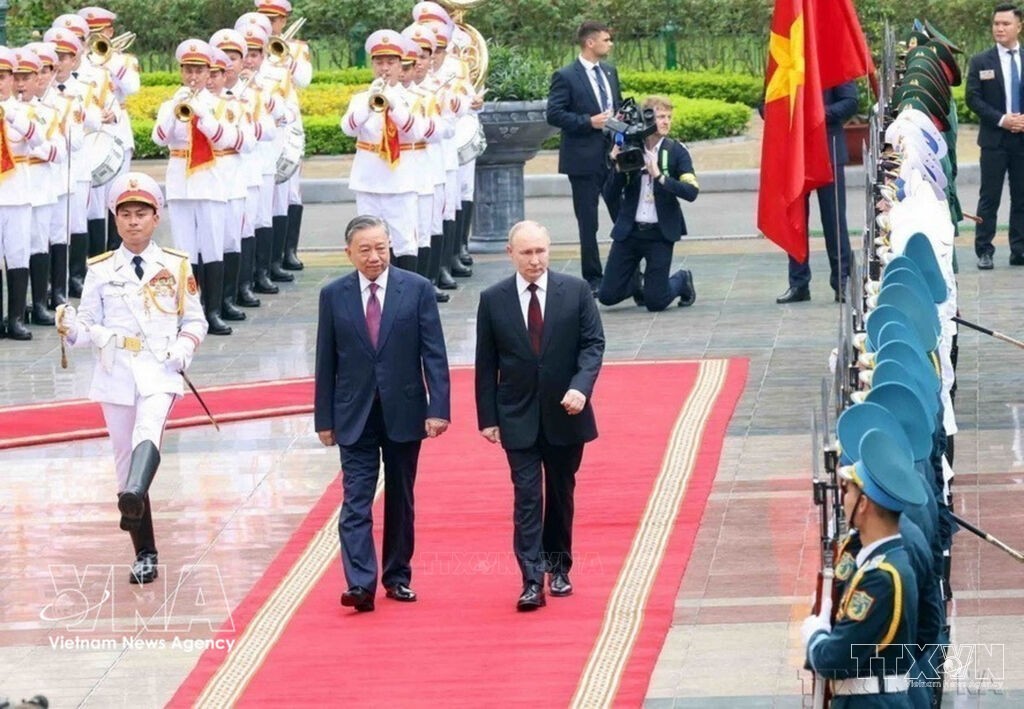
| President To Lam chairs the official welcome ceremony for Russian President Vladimir Putin during his state visit to Vietnam at the invitation of the then General Secretary of the Communist Party of Vietnam Central Committee Nguyen Phu Trong from June 19-20, 2024. (Photo: VNA) |
Hanoi (VNA) – General Secretary of the Communist Party of Vietnam’s Central Committee and President To Lam and his spouse, together with a high-ranking Vietnamese delegation, will pay a state visit to Russia next week, the first of its kind by Vietnam’s Party and State leader since 1991.
Made at the invitation of Russian President Vladimir Putin and coming immediately after Vietnam successfully held the 14th National Party Congress and elected deputies to the 16th National Assembly, the visit marks a new milestone and is expected to provide strong momentum for bilateral relations across all fields.
More than seven decades of close, enduring Vietnam-Russia ties
Vietnam and the former Soviet Union, now Russia, established diplomatic relations on January 30, 1950. Vietnam and Russia signed the Treaty on Principles of Friendly Relations on June 16, 1994.
Their ties were elevated to a strategic partnership in 2001 and a comprehensive strategic partnership in 2012. In 2021, the two countries issued a joint statement on a vision for their comprehensive strategic partnership to 2030.
In recent years, bilateral relations have continued to develop, maintaining a high level of political trust. In May 2025, during General Secretary Lam’s official visit to Russia and attendance at celebrations marking the 80th anniversary of victory in the Great Patriotic War, the two sides adopted a joint statement on major orientations for Vietnam-Russia comprehensive strategic partnership relations in the new phase of cooperation.
The statement reaffirmed their determination to make full use of existing potential, advantages and opportunities for bilateral cooperation, preserve and strengthen the traditional friendship, and bring the comprehensive strategic partnership to a new qualitative level.
The two countries maintain regular and substantive political dialogue at all levels, particularly at the highest level, making an important contribution to strengthening bilateral relations. Since the beginning of 2026 alone, Vietnam has sent two Prime Minister-level delegations and two Deputy Prime Minister-level delegations to Russia.
Economic, trade and investment ties have also continued to grow steadily. In 2025, two-way trade reached nearly 4.77 billion USD, while the figure stood at 3.24 billion USD in the first seven months of 2026.
Russia currently has 199 investment projects in Vietnam, with a total registered capital of 990 million USD, ranking 26th among 147 countries and territories investing in the Southeast Asian country. Vietnam has 16 projects in Russia with a total registered capital of 1.6 billion USD (as of December 2025).
Oil and gas and energy remain an important pillar of bilateral cooperation. The two sides have signed an intergovernmental agreement on the construction of the Ninh Thuan 1 nuclear power plant in Vietnam. The project is a long-term strategic undertaking and a symbol of their joint work in the new period.
Relations have also developed positively in a wide range of other areas, including defence and security, science and technology, culture, tourism, and education and training.
The two sides also coordinate closely at multilateral forums and international organisations, including the United Nations, the Asia-Pacific Economic Cooperation (APEC), the Asia-Europe Meeting (ASEM), the ASEAN Regional Forum (ARF) and the Conference on Interaction and Confidence-Building Measures in Asia (CICA).
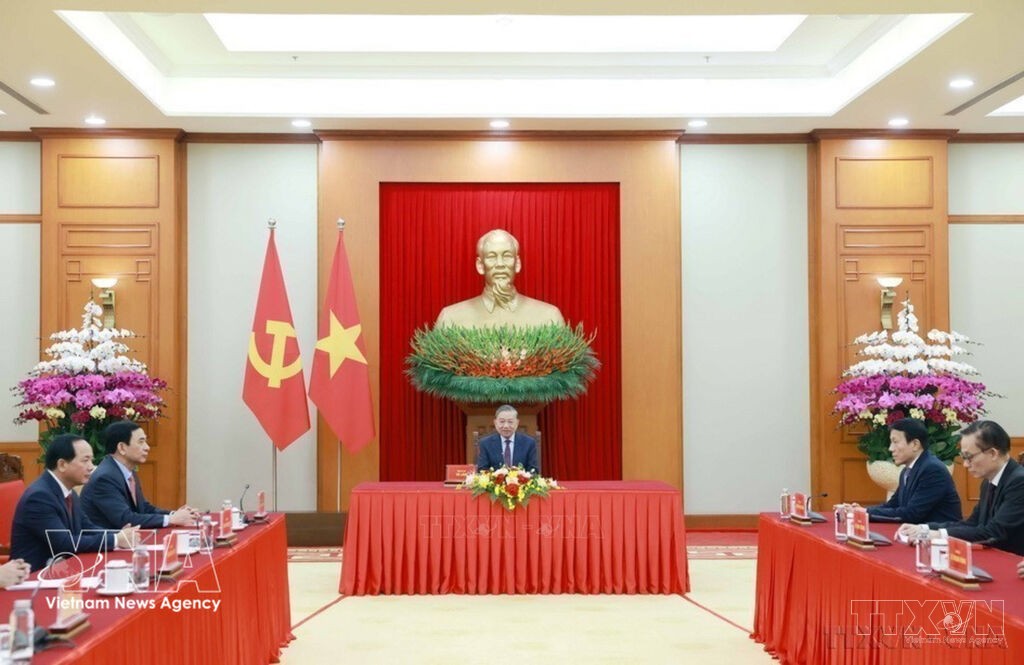 |
| General Secretary of the Communist Party of Vietnam Central Committee To Lam during a phone call with Russian President Vladimir Putin on January 24, 2026. (Photo: VNA) |
Giving fresh impetus to bilateral ties
Building on more than 75 years of positive bilateral relations, General Secretary and President Lam’s state visit is an event of particular significance.
Deputy Minister of Foreign Affairs Le Thi Thu Hang said it is a clear manifestation of Vietnam’s foreign policy of independence, self-reliance, self-strengthening, peace, friendship, cooperation and development, as well as multilateralisation and diversification of external relations.
It will also provide an opportunity to mobilise appropriate resources in areas such as energy, science and technology, human resource training and infrastructure development, helping implement Politburo resolutions in support of the country’s rapid and sustainable development.
The visit will allow the highest-ranking leaders of the two countries to engage in extensive discussions on strategic issues, establish a long-term vision and create a new milestone and fresh political momentum to elevate Vietnam-Russia relations comprehensively, while linking bilateral cooperation with each country’s development objectives in the new period.
Vietnamese Ambassador to Russia Dang Minh Khoi said that as part of the visit, the Lev N. Tolstoy International Peace Prize would be presented to General Secretary and President Lam. He described the award as recognition and appreciation by the international community in general and Russia in particular of Vietnam’s and the top leader’s efforts and contributions to building a fair world order based on international law, and promoting peace, stability and development in the Asia-Pacific region and around the world.
Khoi said there are enormous opportunities for cooperation between Vietnam and Russia, with the two countries possessing many complementary strengths: Vietnam is emerging strongly and integrating deeply into the international community, with a young workforce ambitious to advance, while Russia boasts world-leading strengths in fundamental scientific research and remains a leader in areas such as space and nuclear technology.
For Russia, Deputy Prime Minister Dmitry Chernyshenko said the visit is not merely a continuation of the tradition of regular high-level contacts but also an opportunity to create new momentum for cooperation between the two countries.
This cooperation covers trade and economy, science and technology, people-to-people relations and education — areas that are being prioritised during the sides’ ongoing Year of Science and Education Cooperation.
Russian Ambassador to Vietnam Bezdetko Gennady Stepanovich affirmed that the visit is an important milestone in the development of the Vietnam-Russia comprehensive strategic partnership. The Russian side expects the two sides to hold substantive discussions on all issues on the bilateral agenda, agree on new long-term areas of cooperation and make concrete decisions to further consolidate their strong relationship./.