 |
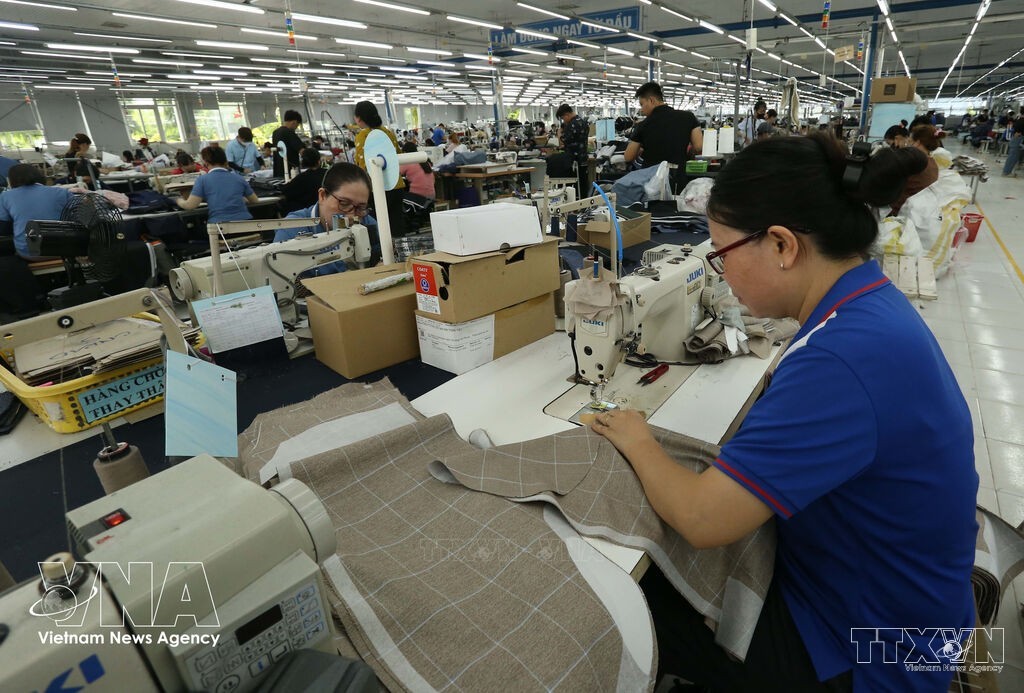
| Workers make clothes for export at Nha Be- Hau Giang Garment JSC in Vi Thanh ward, Can Tho city. (Photo: VNA) |
Kuala Lumpur (VNA) – Vietnam is sustaining exceptional growth and, together with Malaysia, Thailand and the Philippines, is strengthening the case for ASEAN’s “Fabulous Five,” according to Shan Saeed, Global Chief Economist at Juwai IQI.
Bloomberg's latest cross-decade growth matrix delivers a clear signal: global growth is slowing, advanced economies are entering a slower-growth era, and genuine accelerators are increasingly rare.
"Buried in that matrix is a trend that reinforces a thesis I've been developing for months — ASEAN's growth story is becoming increasingly differentiated from that of the mature world," Saeed told the Vietnam News Agency.
He said Indonesia is the acceleration story. Its growth rate, clustered around 4% over the past decade, rises toward roughly 5% in the next — putting it above the 45-degree parity line that separates economies gaining momentum from those losing it.
"Vietnam is the resilience story. Its projected growth moderates slightly from its exceptional post-2016 pace, but remains around 5% — a rate that would be remarkable for most advanced economies," the economist noted.
"Together, they provide two different expressions of the broader ASEAN opportunity."
Saeed said this is the empirical spine of the Fabulous Five — the framework he has built around a simple proposition: ASEAN's next decade will be shaped disproportionately by five markets, driven not simply by commodity cycles but by labour depth, manufacturing capacity, domestic consumption, infrastructure and increasingly sophisticated supply chains.
He elaborated that Indonesia's downstream nickel strategy and industrial localisation provide tangible mechanisms for its acceleration. Meanwhile, Vietnam's electronics manufacturing and export ecosystem provide a different engine of resilience.
The two countries are not following identical paths; that is precisely the point, he said, explaining that one is gaining momentum while the other is sustaining an unusually high rate of expansion.
The economist added that the comparable data for Malaysia, Thailand and the Philippines sits outside this particular Bloomberg matrix. But the broader structural case for the Fabulous Five rests on more than a single growth chart: together, these five economies account for the overwhelming majority of ASEAN's population and represent some of the region's deepest pools of labour, manufacturing capacity, consumption and investment opportunity./.