 |
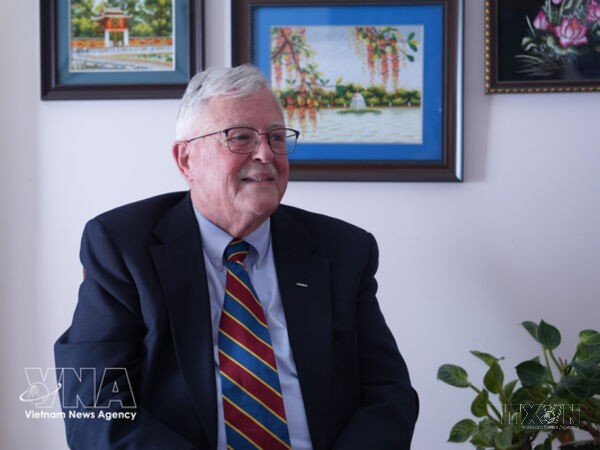
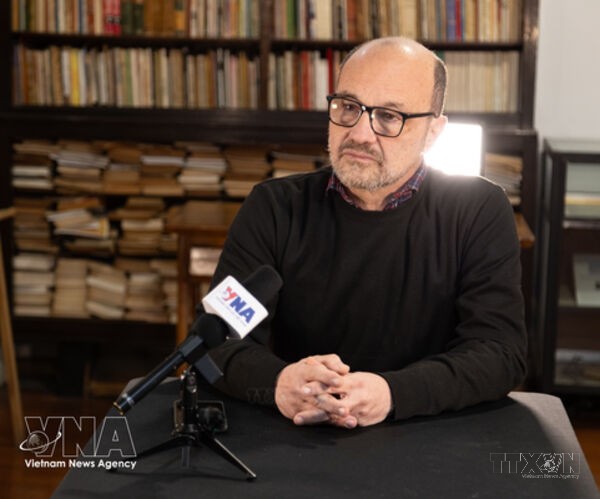
| British researcher Kyril Whittaker (Photo publish by VNA) |
London (VNA) – Vietnam has three key factors needed to turn policies into concrete results: a unified implementation structure, policies grounded in local realities, and broad public support, according to British researcher of Vietnamese politics and history Kyril Whittaker.
Speaking to Vietnam News Agency correspondents in London, Whittaker, also a member of the Communist Party of Britain, analysed the four strategic shifts outlined by General Secretary of the Communist Party of Vietnam Central Committee and President To Lam at the third plenum of the 14th Party Central Committee. The four shifts focus on improving the Party's leadership and governance capacity and the performance of the State apparatus; managing the country's development space and making better use of national resources; establishing a growth model based on productivity, knowledge, technology and people; and proactively preventing risks while strengthening resilience, adaptability and national defence.
“The single most effective way to deliver on policies in a concrete rather than abstract way, is to ensure that you have three key things,” Whittaker said. First, a unified structure with which to deliver a policy, second policy which is rooted in material reality, and finally the support of broader society.
“In Vietnam all three of these elements are present,” the scholar said.
Taking the first element for example, he said the first shift especially discusses how to better ensure the unified action of the state and localities in responding to events, through a unified and disciplined state/locality management. Rules and legislation is clear, meaning policies and how they are meant to be implemented are clear in each locality.
The second element, means to ensure that the policy matches the material reality of each locality. There would, for example, be little point in creating legislation which viewed all localities as experiencing the same difficulties to the same extents. Different localities experience issues differently and therefore policies must be clear and take into account what the situation is around the country.
He said General Secretary and President To Lam makes this clear when he discusses the second shift stating: "ensuring that each proposal creates new development value for the locality, the region, and the entire country."
Drawing on his research on late Party General Secretary Le Duan, Whittaker also highlighted the importance of examining how policies work in practice, including at farms, factories, infrastructure projects, households and organisations.
Whittaker said that in his research on General Secretary Le Duan for example, it should be noted that he consistently sought to examine the reality of policy implementation on the ground, in farms, factories, infrastructure projects, households, organisations and more.
Finally, support of the people is essential. President Ho Chi Minh stated that an easy task cannot be done without the people’s support, while the most difficult ones can be fulfilled with their help.
“The broader context of all legislation in Vietnam, and this is consistently stressed in documents and speech is that all policies must be for the benefit of the people,” Whittaker said.
Turning to the third and fourth strategic shifts, Whittaker said Vietnam's green transition offers significant opportunities for international cooperation.
Renewable energy and cleaner forms of energy are something of a necessity, given global commitments to climate targets, the scholar said.
He added that he sees solar panels are quite common in Vietnam, and Vietnam is making serious and consistent efforts to reduce traffic pollution around the country through policies, the construction of new public transport networks, encouragement to use these through free fares or subsidised fares.
Whittaker said Vietnam is well known for its beautiful natural scenery, and the closeness with which many people live side by side with nature. Even in big cities, one can see cafes which build themselves around fish habitats, or create a green oasis in the middle of an urban area.
Vietnam also has a great record of tree planting and aforestation which many countries around the world could learn from, stated.
In Vietnam, sustainability is now something considered in all government projects and construction is directly oriented towards sustainability, for example in Resolution No. 188/2025/QH, which discusses urban development oriented towards public transport.
In his view, stronger implementation capacity at home provides a foundation for Vietnam to deepen international cooperation and integration. At the centre of both efforts, he said, should be people and sustainable development./.