The AI education content is structured around four areas corresponding to key AI competencies: human-centred thinking, AI ethics, AI techniques and applications, and AI system design.
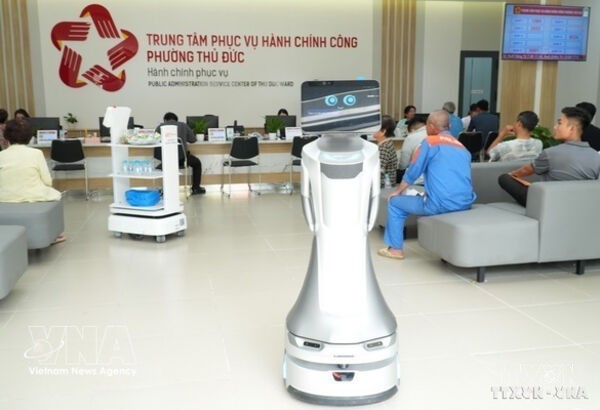
At the Vietnam National Fine Arts Museum on Nguyen Thai Hoc Street, Hanoi, a robot receptionist has been greeting visitors on the ground floor since mid-June
Beyond preservation, digitalisation is opening new opportunities for smart tourism, thereby expanding public access to heritage and enhancing research activities.
Continued investment in digital literacy, particularly for older people, ethnic minority communities and residents in remote mountainous areas, along with better training for frontline public servants, will be essential to ensure that everyone can confidently access and benefit from online public services.
The capital city of Hanoi aims for the digital economy to contribute around 40% of its Gross Regional Domestic Product (GRDP) by 2030, with the Hoa Lac Hi-Tech Park serving as the core research and development hub.
The platform is expected to enable the Government to establish a unified digital management space linking central and local authorities, with every assigned task clearly identifying the responsible agency, implementation deadline, expected outputs, progress updates, delay warnings and accountability.
Under Directive No. 29/CT-TTg, the Prime Minister instructed ministers, heads of ministerial-level agencies and provincial and municipal leaders to treat science, technology, innovation and digital transformation as a top political priority, stressing that faster disbursement must go hand in hand with efficiency, transparency and the prevention of waste and corruption.
Digital transformation in the heritage sector should adopt a people-centred approach, ensuring the meaningful participation of communities at every stage-from documentation and preservation to the management, use and dissemination of cultural data. Jonathan Baker, Representative of the United Nations Educational, Scientific and Cultural Organization (UNESCO) told the Vietnam News Agency during an interview on July 8.
A year after adopting the two-tier local administration model, Bu Gia Map, a remote border commune in the southern city of Dong Nai with a significant ethnic minority community, has experienced notable improvements in public administration, making digital public services more accessible to residents and boosting governance efficiency.
Vietnam currently has about 17,400 OCOP products rated three stars or above. The figure is set to increase to around 25,000 by 2030, with greater emphasis on improving quality, adding value and enhancing competitiveness rather than simply expanding the number of products.
As Vietnam accelerates its national digital transformation, every correctly verified mobile subscription builds a more comprehensive and reliable telecom database, laying the groundwork for secure, sustainable digital services and public confidence in the country’s digital ecosystem.
As institutions continue to improve, resources are allocated more effectively, officials are placed where their abilities can be best used, and digital transformation advances further, Vietnam's two-tier local administration model is expected to deliver increasingly better results for both the State and its people.
According to the Vietnam Logistics Business Association (VLA), the logistics sector will require around 2.2 million workers by 2030, including 1.6 million employees for logistics service providers and nearly 600,000 personnel supporting logistics operations in manufacturing and trading enterprises.
The new rules enable electronic vehicle registration certificates to be displayed on the VNeID and VNeTraffic applications, both operated by the Ministry of Public Security.
The project aims to transform VNeID into a modern, secure and highly scalable national digital platform capable of effectively serving citizens, businesses, agencies and organisations in handling administrative procedures, accessing online public services, conducting electronic transactions and using digital utilities.
Research by the Ministry of Justice (MoJ) shows that AI adoption in the legal sector remains constrained by fragmented, unstandardised and weakly connected legal databases. A unified national legal data ecosystem has yet to be established, while big data and AI applications are still largely confined to pilot programmes and have not been integrated across the full legislative process, including drafting, appraisal, review and inspection of legal documents.
A key target under the new plan is the establishment of five digital technology incubators, or Deeptech Hubs, at universities and research institutes with strong potential. The education ministry also plans to launch a training programme for 1,000 outstanding technology entrepreneurs and develop criteria for selecting and supporting startup ecosystems within educational institutions.
Looking ahead to 2035, Vietnam envisions becoming a comprehensive and sustainable digital nation where all transactions between citizens and government agencies are conducted online. National databases, with population data at the core, will be interconnected and efficiently utilised to support smart governance and real-time decision-making.
Delegates at the 11th National Congress of the Vietnam Fatherland Front (VFF) for 2026–2031 shared the view that applying artificial intelligence (AI) and digital transformation is an inevitable step for national development in the coming period.